
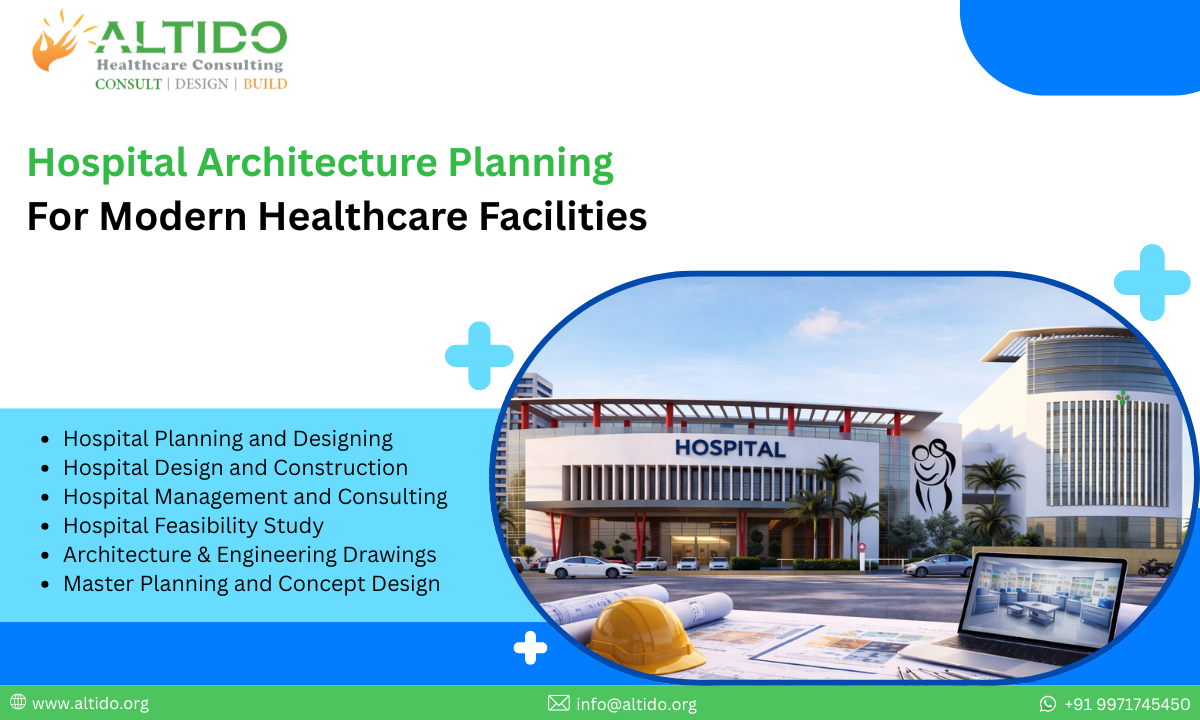
Hospital architecture design and planning play a crucial role in shaping the quality, efficiency, and sustainability of healthcare delivery. A well-designed hospital is not just a building—it is a complex ecosystem that integrates medical technology, patient comfort, staff efficiency, safety, and future scalability. At Altido Healthcare Consulting, we specialize in creating hospitals that are functional, compliant, cost-effective, and future-ready.
People Also Like to read this: Best Hospital and Healthcare Architects in Delhi: Altido Healthcare Consulting
Understanding Hospital Architecture Design & Planning
Hospital architecture design and planning involve the strategic organization of spaces, workflows, and infrastructure to support clinical excellence and operational efficiency. Unlike conventional buildings, hospitals must accommodate diverse functions such as diagnostics, emergency care, surgery, inpatient services, outpatient clinics, and support services—all while maintaining strict regulatory compliance.
Effective planning ensures:
- Smooth patient, staff, and material movement
- Infection control and safety
- Optimal use of space and resources
- Flexibility for future expansion
Key Principles of Hospital Architecture Design
1. Patient-Centric Design
Modern hospital architecture prioritizes patient comfort and healing. Natural lighting, noise control, intuitive wayfinding, and privacy enhance the patient experience and contribute to faster recovery.
Key patient-focused elements include:
- Clear zoning and easy navigation
- Comfortable waiting areas
- Adequate daylight and ventilation
- Privacy in wards and consultation rooms
2. Efficient Functional Zoning
Functional zoning is the backbone of hospital planning. Departments are organized based on clinical relationships and workflow efficiency.
Typical zoning includes:
- Public zones (OPD, reception, diagnostics)
- Semi-restricted zones (wards, ICUs)
- Restricted zones (OT complex, sterile areas)
- Support zones (CSSD, laundry, stores, utilities)
Proper zoning minimizes travel time, avoids cross-contamination, and improves operational efficiency.
3. Optimized Workflow Planning
A well-planned hospital ensures separate movement paths for patients, staff, supplies, and waste. This reduces congestion, enhances safety, and improves response times in critical situations.
At Altido Healthcare Consulting, we analyze clinical workflows to design layouts that support:
- Faster patient turnaround
- Reduced staff fatigue
- Better coordination between departments
Hospital Planning Stages
Feasibility & Concept Planning
Hospital planning begins with feasibility studies that assess market demand, bed capacity, specialty mix, and financial viability. Concept planning translates these insights into spatial requirements and design intent.
Master Planning
Master planning defines the overall site layout, building orientation, circulation routes, parking, and future expansion zones. It ensures long-term flexibility and phased development.
Architectural Design Development
This stage converts concepts into detailed architectural layouts, elevations, and sections while integrating medical planning, engineering systems, and statutory norms.
Engineering Integration
Hospital architecture must seamlessly integrate:
- HVAC systems for infection control
- Medical gas pipelines
- Electrical and backup power systems
- Fire safety and life safety systems
Coordination between architecture and engineering is essential for operational reliability.
Role of Technology in Hospital Architecture
Modern hospital design incorporates advanced technology to enhance efficiency and care quality. Digital planning tools, BIM (Building Information Modeling), and simulation models help optimize layouts and detect design conflicts early.
Technology-enabled design supports:
- Smart patient rooms
- Telemedicine infrastructure
- Automated logistics and tracking
- Energy-efficient building systems
Sustainability in Hospital Design
Sustainable hospital architecture reduces operating costs while supporting environmental responsibility. Energy-efficient systems, water conservation measures, and eco-friendly materials are increasingly integral to hospital planning.
Sustainable design benefits include:
- Lower utility expenses
- Improved indoor air quality
- Reduced environmental impact
- Long-term operational savings
Compliance and Regulatory Considerations
Hospital architecture design must comply with national and international healthcare standards. In India, hospitals follow guidelines such as NABH, NBC, fire safety norms, and local development regulations.
Altido Healthcare Consulting ensures that every project meets:
- Healthcare accreditation standards
- Safety and accessibility norms
- Local authority and statutory requirements
Designing for Future Growth
Healthcare demands evolve rapidly. A well-planned hospital is designed with adaptability in mind. Modular layouts, flexible departments, and provision for vertical or horizontal expansion allow hospitals to grow without disrupting operations.
Future-ready design considers:
- Expansion of bed capacity
- Introduction of new specialties
- Upgrading medical technology
Why Choose Altido Healthcare Consulting?
Altido Healthcare Consulting offers end-to-end hospital architecture design and planning services, combining medical planning expertise with architectural excellence. Our multidisciplinary team understands both healthcare operations and building design, ensuring seamless execution from concept to commissioning.
Our strengths include:
- Deep healthcare domain expertise
- Customized, patient-centric solutions
- Cost-effective and scalable designs
- Compliance-driven planning approach
Conclusion
Hospital architecture design and planning are critical to delivering high-quality, efficient, and sustainable healthcare services. A thoughtfully designed hospital improves patient outcomes, enhances staff productivity, and ensures long-term operational success.
At Altido Healthcare Consulting, we transform healthcare visions into functional, future-ready facilities through strategic planning, innovative design, and industry best practices. Whether it’s a new hospital, expansion, or redevelopment, our expertise ensures your healthcare facility is built to serve today’s needs and tomorrow’s growth.