
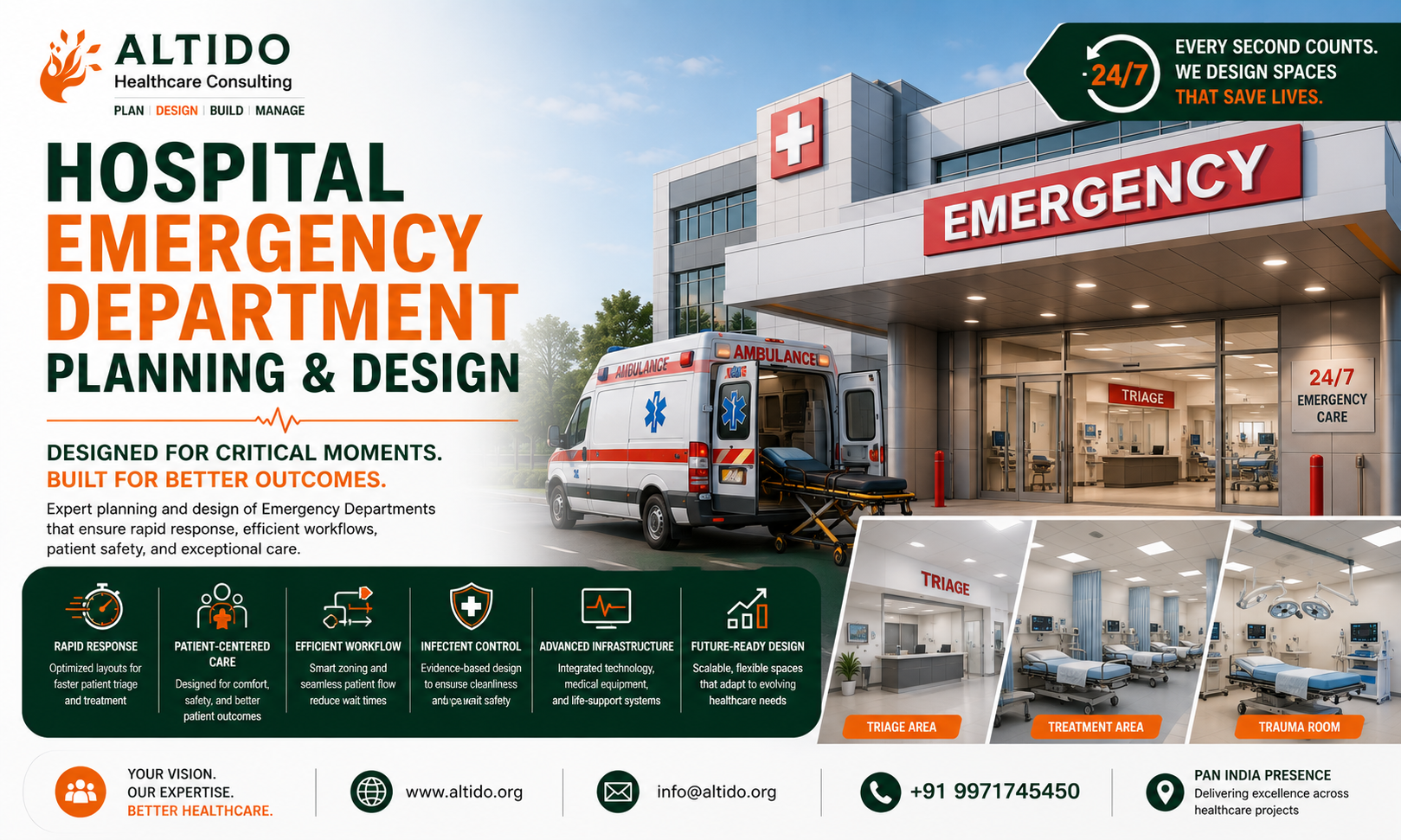
The Emergency Department (ED) is one of the most critical areas of any hospital. It is the first point of contact for patients requiring immediate medical attention and plays a major role in saving lives during emergencies. Designing an efficient emergency department requires careful planning, advanced healthcare knowledge, and a deep understanding of clinical workflows.
Hospital Emergency Department Planning & Design focuses on creating healthcare spaces that support rapid response, patient safety, medical efficiency, and seamless coordination between emergency teams.
Altido Healthcare Consulting provides specialized healthcare architecture, hospital planning, and emergency department design solutions to help hospitals develop modern, high-performance emergency care facilities.
People Also Like to read this: Hospital Design Consultant in Egypt: Creating Advanced Healthcare Facilities for the Future
Importance of Emergency Department Planning
Emergency departments operate 24/7 and handle a wide range of medical conditions, from minor injuries to life-threatening situations.
A well-planned emergency department helps achieve:
- Faster patient treatment
- Improved emergency response
- Better staff workflow
- Enhanced patient safety
- Effective infection control
- Efficient resource utilization
Poorly planned emergency spaces can lead to overcrowding, delays, and operational challenges.
What is Emergency Department Design?
Emergency department design involves planning spaces, systems, and workflows that support emergency medical services.
It includes:
- Patient arrival areas
- Triage zones
- Treatment rooms
- Trauma care areas
- Observation units
- Support spaces
- Staff facilities
- Medical equipment planning
The objective is to create a department where every second counts and healthcare teams can provide immediate care.
Key Principles of Emergency Department Planning
1. Strategic Location Planning
The emergency department should be easily accessible within the hospital campus.
Important considerations include:
Ambulance Access
The ambulance entry should provide:
- Direct access to emergency care
- Separate vehicle movement
- Quick patient transfer
Public Access
Patients arriving independently should have:
- Clear entrance visibility
- Convenient drop-off areas
- Easy navigation
Proper location planning improves emergency response time.
Emergency Department Zoning
Effective zoning is essential for smooth operations.
Emergency departments are generally divided into different zones:
Public Zone
Includes:
- Reception
- Registration
- Waiting areas
- Information desk
These spaces should be comfortable and easy to access.
Clinical Zone
Includes:
- Examination rooms
- Treatment areas
- Trauma rooms
- Observation beds
Clinical zones require controlled access and efficient workflow.
Support Zone
Includes:
- Medical storage
- Staff areas
- Clean utility
- Dirty utility
Equipment rooms
Proper zoning improves efficiency and infection prevention.
Triage Area Planning
Triage is the first clinical assessment point where patients are evaluated based on urgency.
A well-designed triage area includes:
- Assessment rooms
- Nursing stations
- Patient waiting areas
- Emergency communication systems
Effective triage planning ensures critical patients receive immediate care.
Emergency Treatment Area Design
Treatment areas should support rapid medical intervention.
Important design elements include:
- Adequate space around patient beds
- Easy access to equipment
- Medical gas connections
- Monitoring systems
- Staff visibility
The layout should allow doctors and nurses to respond quickly.
Trauma Room Planning
Trauma rooms are designed for critically injured patients.
They require:
- Large treatment spaces
- Emergency equipment
- Advanced monitoring systems
- Surgical support access
Trauma rooms should be connected efficiently with:
- Imaging departments
- Operation theatres
- Intensive care units
This improves emergency patient transfer.
Emergency Observation Unit Design
Observation units allow patients to be monitored before discharge or admission.
Planning includes:
- Patient beds
- Monitoring stations
- Nurse visibility
- Support facilities
A well-designed observation unit reduces unnecessary hospital admissions and improves patient management.
Patient Flow Management
Efficient patient movement is one of the most important aspects of emergency department design.
A successful ED separates:
- Emergency patients
- Walk-in patients
- Ambulance patients
- Critical cases
- Staff movement
- Supply movement
Good circulation planning reduces congestion and improves response time.
Infection Control in Emergency Design
Emergency departments handle a high volume of patients, increasing infection risks.
Design strategies include:
- Isolation rooms
- Proper ventilation
- Controlled air flow
- Hand hygiene stations
- Separate patient pathways
Infection control planning protects patients and healthcare workers.
Medical Equipment Planning
Emergency departments require advanced medical equipment.
Planning should consider:
- Equipment location
- Power requirements
- Medical gases
- Storage needs
- Accessibility
Common emergency equipment includes:
- Ventilators
- Patient monitors
- Defibrillators
- Emergency carts
- Diagnostic devices
Proper equipment planning improves emergency response efficiency.
Role of MEP Systems in Emergency Department Design
Mechanical, Electrical, and Plumbing systems are critical for emergency facilities.
HVAC Planning
Emergency areas require:
- Proper ventilation
- Air filtration
- Temperature control
Electrical Systems
Must support:
- Life-saving equipment
- Backup power
- Emergency lighting
Medical Gas Systems
Include:
- Oxygen
- Vacuum
- Medical air supply
Reliable infrastructure ensures uninterrupted emergency care.
Integration with Other Hospital Departments
Emergency departments must connect efficiently with other critical services.
Important connections include:
Radiology
For:
- X-ray
- CT scan
- MRI access
Operation Theatre
For emergency surgeries.
ICU
For critical patient transfer.
Laboratory
For fast diagnostic testing.
Proper connectivity improves treatment speed.
Smart Emergency Department Design
Modern hospitals are adopting technology-driven emergency solutions.
Smart ED features include:
- Digital patient tracking
- Electronic medical records
- Automated alerts
- Smart monitoring systems
Technology improves coordination and reduces treatment delays.
Emergency Department Capacity Planning
Capacity planning ensures the department can manage patient demand.
Factors include:
- Population served
- Emergency volume
- Number of treatment beds
- Future growth
Flexible planning helps hospitals adapt to changing healthcare needs.
Challenges in Emergency Department Planning
Emergency department projects face challenges such as:
- High patient volume
- Limited space
- Complex workflows
- Technology upgrades
- Staff coordination
Experienced healthcare consultants help solve these challenges through strategic design.
Why Choose Altido Healthcare Consulting?
Altido Healthcare Consulting provides specialized healthcare planning and design solutions for hospitals.
Our expertise includes:
- Emergency department planning
- Hospital master planning
- Healthcare architecture
- Space planning
- Medical equipment coordination
- Infrastructure consulting
- Operational planning
We help healthcare organizations create efficient emergency care environments that improve patient outcomes.
Future of Emergency Department Design
The future of emergency healthcare will focus on:
- Faster patient response
- Smart technology integration
- Patient-centered care
- Flexible emergency spaces
- Advanced medical infrastructure
Hospitals must design emergency departments that are ready for future healthcare challenges.
Conclusion
Hospital Emergency Department Planning & Design requires a combination of healthcare expertise, architectural planning, and operational understanding.
A properly designed emergency department improves patient care, enhances medical response, and supports healthcare teams in delivering life-saving services.
Altido Healthcare Consulting helps hospitals develop efficient, safe, and future-ready emergency departments through innovative healthcare architecture and planning solutions.
Altido Healthcare Consulting – Consult | Design | Build | Manage