
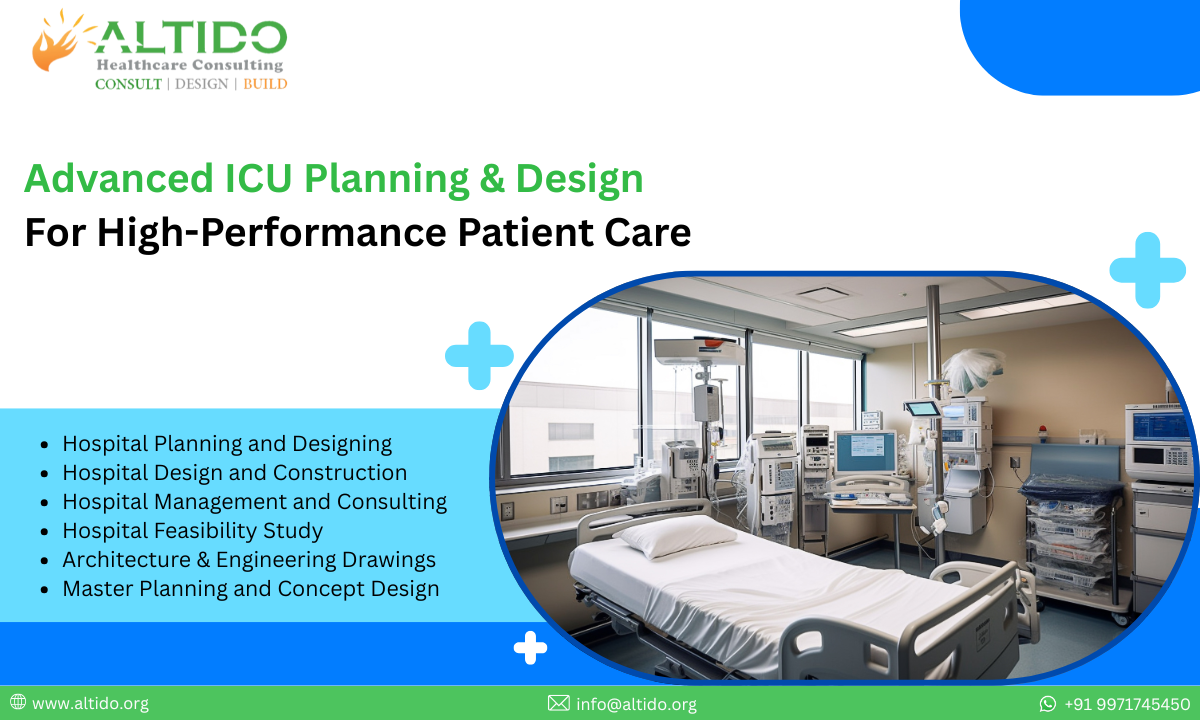
The Intensive Care Unit (ICU) is the most critical zone of any hospital, where life-saving interventions, advanced monitoring, and rapid clinical decisions take place. As healthcare continues to evolve with technology, patient-centric care, and stringent safety standards, ICU planning and designing must adapt to meet future demands. Modern ICU design is no longer limited to space allocation—it integrates workflow efficiency, infection control, digital health systems, and human-centered architecture.
Altido Healthcare Consulting specializes in future-ready ICU planning and designing, ensuring high-performance critical care environments that support patients, clinicians, and hospital operations alike.
People Also Like to read this: The Importance of Vastu Shastra in Hospital Planning and Design
Importance of ICU Planning and Designing
Effective ICU planning and designing directly impact patient outcomes, staff efficiency, and operational safety. Poorly designed ICUs can lead to overcrowding, worAkflow bottlenecks, infection risks, and staff fatigue.
A well-planned ICU ensures:
- Rapid response to emergencies
- Clear visibility and monitoring
- Optimal equipment placement
- Reduced infection transmission
- Comfort for patients and caregivers
Altido Healthcare Consulting brings a strategic and evidence-based approach to ICU design tailored to modern healthcare needs.
Key Principles of Future ICU Design
1. Patient-Centered ICU Layout
Future ICUs prioritize patient dignity, privacy, and comfort without compromising clinical efficiency. Single-bed ICU rooms with clear lines of sight are becoming the standard.
Benefits include:
- Improved infection control
- Reduced noise and stress
- Better family involvement
- Enhanced patient recovery
During ICU planning and designing, room layouts must accommodate advanced medical equipment while maintaining a healing environment.
2. Efficient Clinical Workflow Design
An efficient ICU layout reduces unnecessary staff movement and response times. Critical care zones are planned based on workflow logic rather than just available space.
Key planning considerations:
- Centralized nurse stations with decentralized substations
- Short travel distances between beds and support areas
- Logical placement of clean and dirty utilities
- Seamless access to diagnostic and support services
Altido Healthcare Consulting ensures workflow-driven ICU planning that improves staff productivity and patient safety.
3. Advanced Monitoring and Digital Integration
The ICU of the future is highly digital. Integrated monitoring systems allow clinicians to track vital parameters in real time and respond proactively.
Digital features include:
- Central monitoring dashboards
- AI-enabled early warning systems
- Electronic medical records integration
- Tele-ICU capabilities
ICU planning and designing must include adequate IT infrastructure, cabling pathways, and secure data systems from the initial design stage.
Infection Control and Safety in ICU Design
Infection prevention is a cornerstone of ICU design. Future ICUs incorporate design strategies that minimize cross-contamination and enhance hygiene.
Critical elements include:
- Negative and positive pressure rooms
- Hand hygiene stations at every entry point
- Antimicrobial surfaces and materials
- Separate circulation for staff, patients, and waste
Altido Healthcare Consulting aligns ICU designs with NABH, international guidelines, and best practices to ensure maximum safety.
Flexibility and Scalability in ICU Planning
Healthcare needs can change rapidly, as seen during global health emergencies. Future ICU planning focuses on flexibility and scalability.
Design strategies include:
- Modular bed layouts
- Convertible ICU and HDU spaces
- Expandable medical gas and electrical systems
- Space for future equipment upgrades
A flexible ICU design ensures hospitals remain operational and resilient during peak demand periods.
Staff Wellbeing and Ergonomic Design
The performance of ICU staff directly affects patient outcomes. Future ICU planning and designing emphasizes ergonomics and staff wellbeing.
Key features:
- Reduced noise and glare
- Ergonomically designed workstations
- Adequate rest and support areas
- Natural light access where possible
Altido Healthcare Consulting designs ICUs that support long working hours while minimizing fatigue and stress for healthcare professionals.
Family-Centered ICU Design
Modern critical care recognizes the role of families in patient recovery. Future ICUs are designed to accommodate family presence safely and comfortably.
Family-friendly design elements include:
- Dedicated family waiting areas
- In-room seating for attendants
- Clear communication zones
- Visual privacy controls
These features improve transparency, trust, and overall patient experience.
Sustainable and Energy-Efficient ICU Design
Sustainability is an integral part of future ICU design. Energy-efficient systems reduce operational costs while supporting environmental responsibility.
- Sustainable strategies include:
- Energy-efficient HVAC systems
- Smart lighting controls
- Optimized air change rates
- Use of eco-friendly materials
Altido Healthcare Consulting integrates sustainability into ICU planning and designing without compromising clinical performance.
Technology Trends Shaping the ICU of the Future
The future ICU will be driven by innovation and data-driven care models. Emerging trends include:
- Artificial intelligence for predictive care
- Robotics for medication and supply delivery
- Voice-activated clinical systems
- Remote patient monitoring and tele-consultation
ICU design must be technology-ready to accommodate these advancements seamlessly.
Role of Altido Healthcare Consulting in ICU Design
Altido Healthcare Consulting offers end-to-end ICU planning and designing services, including:
- Clinical requirement analysis
- Space planning and layout design
- Medical equipment planning
- MEP and IT coordination
- Compliance with NABH and global standards
With extensive experience in hospital architecture and healthcare consulting, Altido delivers ICUs that are safe, efficient, and future-proof.
Conclusion
The ICU design of the future goes beyond physical infrastructure—it creates intelligent, flexible, and patient-centric environments that enhance critical care delivery. Thoughtful ICU planning and designing ensure better outcomes, safer operations, and long-term sustainability for healthcare facilities.
Altido Healthcare Consulting combines clinical insight, architectural expertise, and technology integration to design ICUs that meet today’s challenges and tomorrow’s opportunities. By focusing on efficiency, safety, and innovation, Altido helps hospitals build ICUs that truly save lives.