
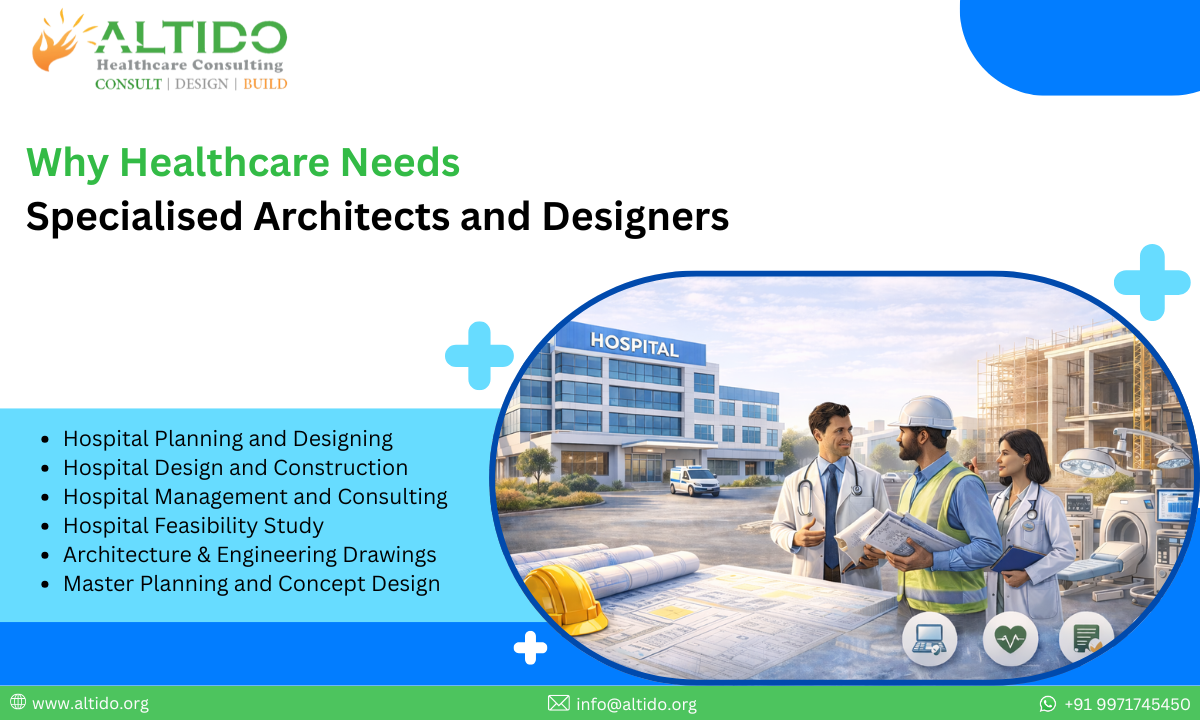
Healthcare facilities are among the most complex building types to design. Unlike commercial or residential projects, hospitals and healthcare centers must balance medical functionality, patient safety, regulatory compliance, advanced technology, and human-centered design—all within strict operational and budgetary constraints. This is why healthcare projects require specialized architects and designers with deep domain expertise.
At Altido Healthcare Consulting, we believe that specialised healthcare architecture is not a luxury—it is a necessity for creating efficient, safe, and future-ready medical facilities.
People Also Like to read this: Hospital Architects Near Me: How Altido Healthcare Consulting Delivers Future-Ready Hospitals
Understanding the Complexity of Healthcare Environments
Hospitals operate 24/7 and serve multiple stakeholders simultaneously—patients, doctors, nurses, administrators, visitors, and emergency services. Each group has distinct needs, workflows, and movement patterns.
A specialized healthcare architect understands:
- Clinical workflows and adjacencies
- Infection control and hygiene zoning
- Critical care requirements (ICU, OT, ER)
- Medical equipment integration
- Regulatory norms and accreditation standards
Without this expertise, design flaws can lead to operational inefficiencies, safety risks, and costly post-construction modifications.
Patient-Centric Design Improves Healing Outcomes
Research consistently shows that well-designed healthcare environments contribute to faster recovery, reduced stress, and improved patient satisfaction.
Specialised healthcare designers focus on:
- Natural light and ventilation
- Noise reduction and acoustic control
- Intuitive wayfinding and signage
- Comfortable waiting areas and wards
- Privacy and dignity for patients
At Altido Healthcare Consulting, patient-centric planning is embedded into every design decision—ensuring that healthcare spaces support both physical and emotional healing.
Efficient Clinical Workflow Is Critical
Hospitals are workflow-driven environments. Poor layouts can cause:
- Delays in patient care
- Staff fatigue
- Equipment bottlenecks
- Increased operational costs
Specialized healthcare architects design layouts that ensure:
- Clear separation of clean and dirty zones
- Efficient patient, staff, and material movement
- Optimal proximity between related departments
- Reduced travel time for doctors and nurses
This leads to smoother operations, better staff productivity, and improved quality of care.
Compliance with Healthcare Regulations and Standards
Healthcare buildings must comply with multiple national and international standards, such as:
- NABH and NABL guidelines
- Local building codes and fire safety norms
- Biomedical waste management rules
- Accessibility standards
- Infection control protocols
General architects may not be fully aware of these complex requirements. Specialized healthcare consultants like Altido ensure that designs are regulation-ready from day one, reducing approval delays and compliance risks.
Integration of Medical Technology and Equipment
Modern hospitals rely heavily on advanced medical technology—MRI, CT scanners, modular OTs, ICU equipment, and telemedicine systems. These require:
- Structural load planning
- Radiation shielding
- HVAC precision
- Power backup and redundancy
- IT and data infrastructure
Specialized healthcare designers coordinate closely with biomedical engineers and MEP teams to ensure seamless technology integration without compromising safety or performance.
Infection Control and Safety by Design
Infection prevention is a core requirement in healthcare facilities. Design plays a crucial role in minimizing hospital-acquired infections (HAIs).
Healthcare-specialised architects focus on:
- Proper zoning and circulation segregation
- Isolation rooms and negative pressure areas
- Easy-to-clean surfaces and materials
- Controlled airflows and ventilation systems
These design strategies significantly enhance patient safety and reduce clinical risks.
Scalability and Future Expansion Planning
Healthcare demand is constantly evolving. Facilities must be designed to adapt to:
- Increasing patient volumes
- New medical specialties
- Technological advancements
- Changing healthcare regulations
Specialized architects plan hospitals with future expansion, modular growth, and flexibility in mind—saving hospitals from expensive redesigns later.
Altido Healthcare Consulting emphasizes master planning that supports both immediate needs and long-term growth.
Cost Efficiency Through Smart Planning
While specialised healthcare architects may seem like an added cost initially, they actually reduce overall project costs by:
- Avoiding design errors and rework
- Optimizing space utilization
- Improving operational efficiency
- Reducing maintenance and energy costs
Smart healthcare design delivers higher ROI over the building’s lifecycle.
Multidisciplinary Coordination Is Essential
Healthcare projects require close coordination between:
- Architects
- Engineers
- Medical planners
- Biomedical experts
- Hospital administrators
Specialized healthcare consulting firms like Altido act as an integrated planning partner, ensuring all stakeholders work toward a unified vision.
Why Choose Altido Healthcare Consulting?
At Altido Healthcare Consulting, we specialise exclusively in healthcare infrastructure planning and design. Our expertise spans:
- Hospital planning and design
- Architecture and engineering coordination
- Feasibility studies
- Medical equipment planning
- Hospital renovation and expansion
We design healthcare facilities that are functional, compliant, patient-centric, and future-ready.
Conclusion
Healthcare architecture is not just about buildings—it is about saving lives, supporting caregivers, and improving community health outcomes. This level of responsibility demands specialised architects and designers who understand the unique challenges of healthcare environments.
By partnering with experienced healthcare consultants like Altido Healthcare Consulting, hospitals can ensure smarter planning, safer environments, and sustainable growth.