
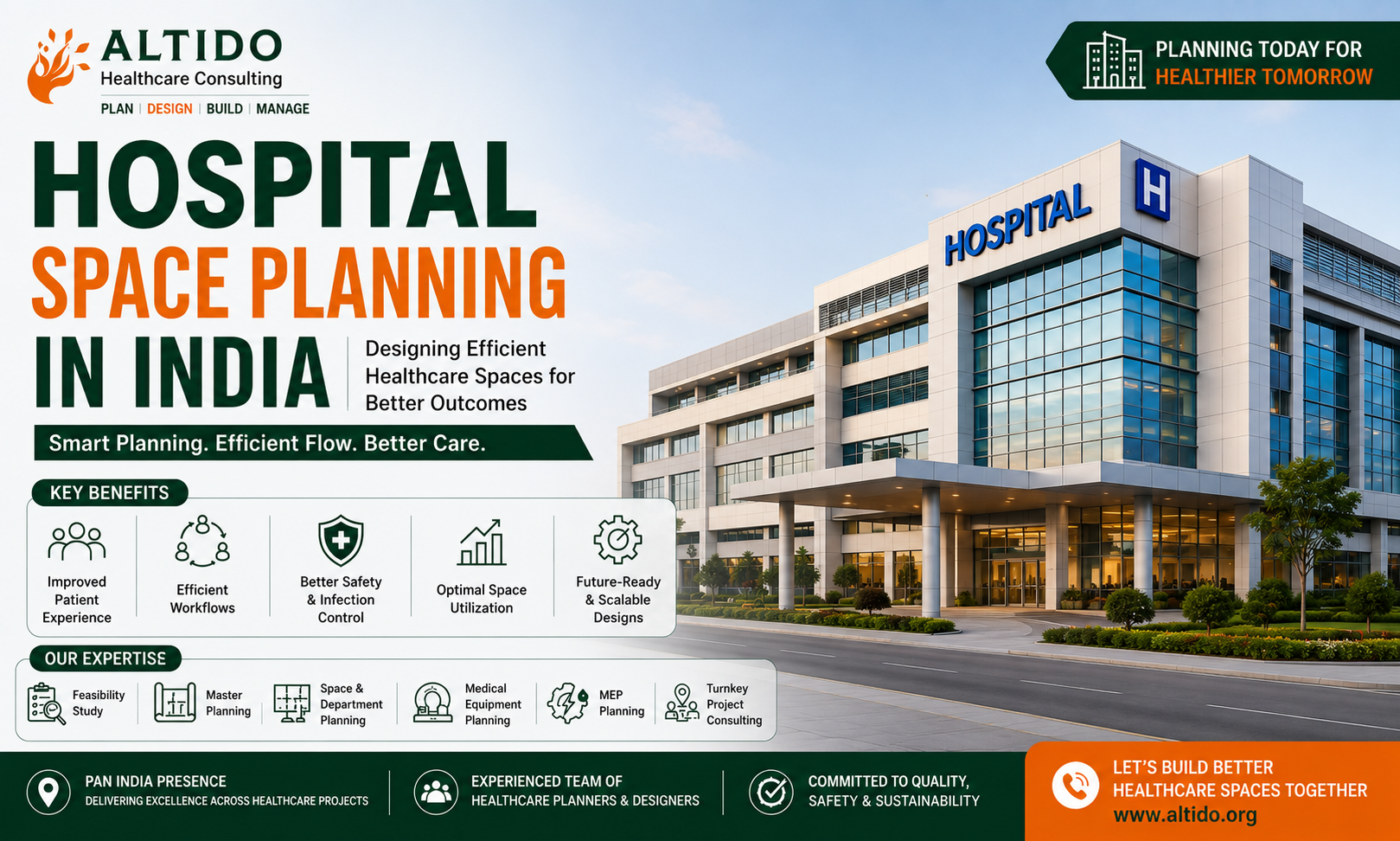
Healthcare infrastructure in India is rapidly transforming with increasing demand for advanced medical facilities, improved patient experiences, and efficient healthcare delivery systems. A successful hospital is not only defined by its medical expertise but also by how effectively its spaces are planned and organized.
Hospital space planning in India plays a crucial role in designing healthcare facilities that support smooth operations, patient safety, staff efficiency, and future expansion. Proper space planning ensures that every department, room, corridor, and support area contributes to better healthcare outcomes.
Altido Healthcare Consulting specializes in healthcare planning, hospital architecture, and infrastructure consulting, helping healthcare providers develop modern, functional, and patient-focused healthcare environments.
People Also Like to read this: Hospital Architect Consultant in Brunei: Building Modern Healthcare Infrastructure for a Healthier Future
What is Hospital Space Planning?
Hospital space planning is the process of organizing and designing healthcare spaces according to clinical requirements, operational workflows, safety standards, and patient needs.
It involves planning:
- Clinical departments
- Patient care areas
- Diagnostic facilities
- Treatment zones
- Support services
- Staff areas
- Public spaces
- Utility infrastructure
A well-planned hospital ensures that doctors, nurses, patients, visitors, and support teams can move efficiently without unnecessary delays.
Importance of Hospital Space Planning in India
India’s healthcare sector faces unique challenges due to:
- Growing population
- Increasing healthcare demand
- Limited urban land availability
- Rising patient expectations
- Need for advanced medical technology
Effective space planning helps healthcare organizations maximize available space while maintaining quality and efficiency.
Key benefits include:
Improved Patient Experience
Well-designed hospitals provide:
- Easy navigation
- Reduced waiting times
- Comfortable environments
- Better accessibility
A patient-friendly layout improves satisfaction and creates a positive healing experience.
Better Clinical Workflow
Proper planning allows doctors and staff to perform efficiently by reducing unnecessary movement between departments.
Enhanced Safety and Infection Control
Strategic zoning and circulation planning help control infection risks and maintain hygienic healthcare environments.
Future Expansion
Flexible hospital layouts allow additional departments, beds, and technologies to be added in the future.
Key Principles of Hospital Space Planning
Successful hospital planning requires careful consideration of several factors.
1. Departmental Zoning
Hospitals are divided into different zones based on their functions.
Typical hospital zones include:
Public Zone
Includes:
- Reception
- Waiting areas
- Registration counters
- Cafeteria
- Pharmacy
These areas should be easily accessible for patients and visitors.
Clinical Zone
Includes:
- OPD departments
- Emergency
- Operation theatres
- ICU
- Patient wards
Clinical areas require controlled access and efficient workflows.
Support Zone
Includes:
- Laundry
- Kitchen
- Stores
- Maintenance areas
- Biomedical waste management
Proper separation improves operational efficiency.
2. Patient Flow Planning
Patient movement is one of the most important aspects of hospital design.
A good hospital layout separates:
- Patient circulation
- Doctor movement
- Staff circulation
- Material transportation
- Waste movement
This reduces congestion and improves safety.
3. Outpatient Department (OPD) Planning
OPD is usually one of the busiest areas in a hospital.
Effective OPD planning includes:
- Registration areas
- Waiting spaces
- Consultation rooms
- Examination rooms
- Pharmacy access
- Diagnostic coordination
A well-designed OPD improves patient turnover and reduces waiting time.
4. Emergency Department Space Planning
Emergency departments require immediate access and fast response.
Important planning considerations include:
- Separate ambulance entry
- Emergency reception
- Trauma rooms
- Treatment bays
- ICU connectivity
- Diagnostic access
Emergency design focuses on speed, safety, and efficiency.
5. Operation Theatre Planning
Operation theatres require highly controlled environments.
OT planning includes:
- Pre-operative areas
- Operating rooms
- Recovery rooms
- Sterile zones
- Changing areas
- Equipment storage
Proper zoning supports infection prevention and surgical efficiency.
6. ICU and Critical Care Planning
ICUs require specialized infrastructure.
Important considerations include:
- Bed visibility
- Monitoring systems
- Medical gases
- Emergency access
- Isolation facilities
Space planning directly affects critical patient care.
7. Inpatient Ward Planning
Patient rooms should balance comfort, functionality, and healthcare requirements.
Planning includes:
- Single rooms
- Double rooms
- Nursing stations
- Utility areas
- Family waiting spaces
Modern hospitals focus on creating healing environments with better patient comfort.
Medical Equipment and Space Coordination
Modern healthcare depends on advanced medical technology.
Hospital space planning must accommodate:
- MRI machines
- CT scanners
- X-ray systems
- Cath labs
- Laboratory equipment
- Robotic surgery systems
Each equipment type requires specific:
- Space requirements
- Structural support
- Electrical needs
- HVAC requirements
Early medical equipment planning prevents future operational challenges.
Role of MEP in Hospital Space Planning
Mechanical, Electrical, and Plumbing systems are essential components of hospital design.
Mechanical Planning
Includes:
- HVAC systems
- Ventilation
- Air filtration
- Temperature control
Electrical Planning
Includes:
- Power supply
- Backup systems
- Medical equipment connections
Plumbing Planning
Includes:
- Water supply
- Drainage
- Medical gas systems
Integrated MEP planning ensures reliable hospital operations.
Space Standards and Efficiency
Hospitals must balance available space with functionality.
Efficient planning considers:
- Built-up area
- Department requirements
- Patient capacity
- Circulation space
- Support areas
The goal is to create maximum healthcare value from available resources.
Smart Hospital Space Planning
Technology is changing the way hospitals operate.
Modern hospital designs incorporate:
- Digital navigation systems
- Smart building management
- Automated workflows
- Electronic records
- Telemedicine facilities
Smart planning creates adaptable healthcare environments.
Sustainable Hospital Planning
Sustainability is becoming an important part of healthcare design.
Green hospital planning includes:
- Energy-efficient systems
- Natural daylight
- Water conservation
- Sustainable materials
- Waste reduction
Sustainable hospitals reduce operational costs and environmental impact.
Challenges in Hospital Space Planning in India
Hospital projects often face challenges such as:
- Limited land availability
- Budget limitations
- Complex regulations
- Changing healthcare needs
- Technology upgrades
Experienced healthcare consultants help overcome these challenges through strategic planning.
Why Choose Altido Healthcare Consulting?
Altido Healthcare Consulting provides specialized hospital planning and healthcare infrastructure solutions across India and international markets.
Our services include:
- Hospital feasibility studies
- Master planning
- Space planning
- Healthcare architecture
- Medical equipment planning
- MEP coordination
- Turnkey healthcare consulting
With healthcare-focused expertise, Altido helps organizations create hospitals that are efficient, scalable, and future-ready.
Future of Hospital Space Planning in India
The future of healthcare infrastructure will focus on:
- Smart hospitals
- Patient-centered designs
- Flexible spaces
- Sustainable buildings
- Digital healthcare integration
Hospitals designed today must be prepared for tomorrow’s healthcare challenges.
Conclusion
Hospital space planning in India is a critical component of successful healthcare infrastructure development. A well-planned hospital improves patient care, enhances operational efficiency, supports medical technology, and enables future growth.
With expert healthcare planning and architectural solutions, Altido Healthcare Consulting helps healthcare providers transform ideas into world-class medical facilities.
A thoughtfully planned hospital is more than a building—it is a foundation for better healthcare delivery and improved patient outcomes.