
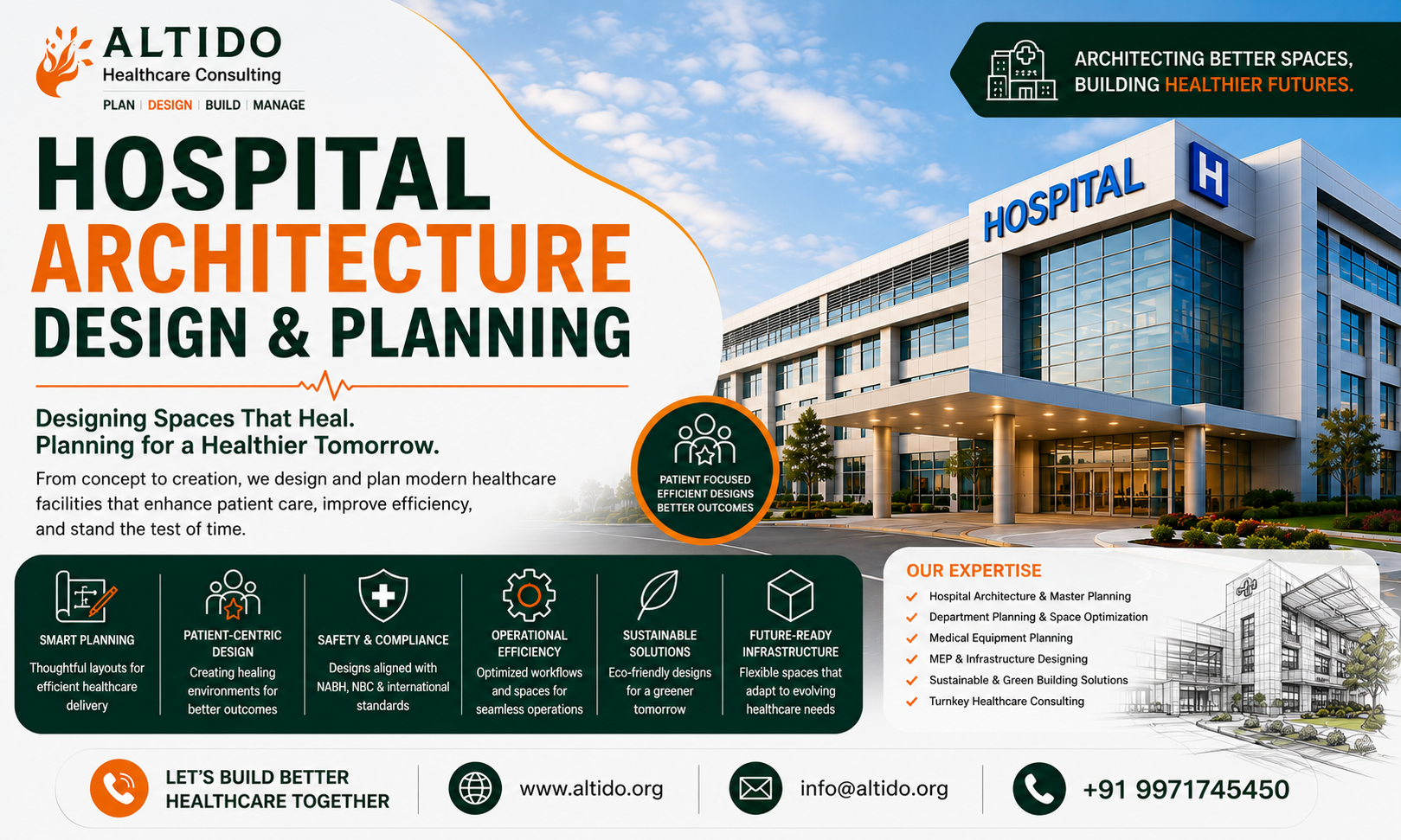
The healthcare industry is continuously evolving with advancements in medical technology, increasing patient expectations, and the need for efficient healthcare delivery systems. A hospital is no longer just a building; it is a carefully planned environment designed to support healing, medical excellence, operational efficiency, and long-term sustainability.
Hospital Architecture Design & Planning plays a vital role in developing healthcare facilities that are safe, functional, patient-friendly, and future-ready. From initial planning to final execution, every architectural decision impacts patient care, staff workflow, and hospital performance.
Altido Healthcare Consulting specializes in healthcare architecture, hospital planning, and infrastructure solutions, helping healthcare providers create modern medical facilities that meet national and international standards.
People Also Like to read this: Best Hospital Management Consultant in India: Transforming Healthcare Operations with Expert Solutions
Understanding Hospital Architecture Design
Hospital architecture is a specialized field focused on designing healthcare environments that support clinical operations and patient care.
Unlike regular commercial buildings, hospitals require detailed planning for:
- Patient movement
- Medical workflows
- Infection control
- Emergency response
- Medical equipment installation
- Staff efficiency
Future expansion
A well-designed hospital combines architecture, engineering, healthcare operations, and technology to create an efficient healthcare ecosystem.
Importance of Hospital Architecture Planning
Effective hospital planning ensures that healthcare facilities operate smoothly while providing a comfortable environment for patients and medical professionals.
Improved Patient Experience
A thoughtfully designed hospital provides:
- Easy navigation
- Comfortable waiting areas
- Better privacy
- Healing environments
- Accessible facilities
Patient-centered architecture improves satisfaction and supports better recovery.
Efficient Healthcare Operations
Proper planning reduces unnecessary movement and improves coordination between departments.
Efficient layouts help doctors, nurses, and staff deliver faster and better healthcare services.
Better Infection Control
Modern hospital design incorporates infection prevention strategies through:
- Proper zoning
- Air filtration systems
- Isolation facilities
- Controlled circulation
This creates safer healthcare environments.
Key Steps in Hospital Architecture Design & Planning
1. Hospital Feasibility Study
Before designing a hospital, a detailed feasibility study is essential.
It evaluates:
- Market demand
- Location suitability
- Healthcare requirements
- Investment planning
- Financial viability
- Future growth opportunities
A feasibility study helps investors and healthcare organizations make informed decisions.
2. Site Analysis and Selection
The hospital location significantly impacts accessibility and operational success.
Important site considerations include:
Accessibility
The hospital should have easy access for:
- Patients
- Ambulances
- Visitors
- Emergency services
Infrastructure Availability
The site should support:
- Electricity
- Water supply
- Drainage systems
- Communication networks
Expansion Potential
Future growth should be considered during site planning.
A flexible site allows additional departments and facilities to be developed later.
3. Hospital Master Planning
Hospital master planning creates the overall development strategy for the healthcare facility.
It includes:
- Building placement
- Department locations
- Traffic circulation
- Parking planning
- Utility networks
- Future expansion areas
A strong master plan ensures efficient use of space and resources.
4. Department Planning and Zoning
Hospitals contain multiple departments, each requiring specific planning.
Outpatient Department (OPD)
OPD planning focuses on:
- Patient registration
- Consultation rooms
- Waiting areas
- Examination rooms
- Pharmacy access
Efficient OPD design reduces waiting time and improves patient flow.
Emergency Department
Emergency areas require rapid access and quick response systems.
Planning includes:
- Ambulance entry
- Emergency treatment rooms
- Trauma areas
- Diagnostic connectivity
Operation Theatre Planning
Operation theatres require highly controlled environments.
Important design features include:
- Sterile zones
- Pre-operative areas
- Recovery rooms
- Equipment planning
- Infection control systems
Intensive Care Unit (ICU)
ICU design requires specialized infrastructure.
Key considerations:
- Patient monitoring
- Medical gases
- Nurse visibility
- Emergency access
- Infection prevention
Inpatient Areas
Patient rooms should provide:
- Comfort
- Privacy
- Safety
- Accessibility
Modern hospitals focus on creating healing environments for patients.
Patient Flow and Circulation Planning
One of the most important aspects of hospital architecture is movement planning.
Hospitals should have separate circulation routes for:
- Patients
- Doctors
- Staff
- Visitors
- Supplies
- Biomedical waste
Proper circulation improves efficiency and reduces infection risks.
Medical Equipment Planning
Modern hospitals depend heavily on advanced medical equipment.
Hospital architects coordinate with medical planners to accommodate:
- MRI machines
- CT scanners
- X-ray facilities
- Cath labs
- Laboratory equipment
- Surgical technology
Proper equipment planning ensures:
- Correct space allocation
- Utility coordination
- Smooth operation
MEP Planning in Hospital Architecture
Mechanical, Electrical, and Plumbing systems are essential components of healthcare design.
Mechanical Systems
Include:
- HVAC systems
- Air quality control
- Ventilation
- Temperature management
- Electrical Systems
Support:
- Medical equipment
- Emergency power
- Lighting systems
- Digital infrastructure
- Plumbing Systems
Include:
- Water supply
- Drainage
- Medical gas pipelines
Integrated MEP planning ensures reliable hospital operations.
Smart Hospital Architecture
Technology is transforming healthcare delivery.
Modern hospitals integrate:
- Digital patient systems
- Smart building automation
- Electronic medical records
- Telemedicine infrastructure
- Automated facility management
Smart hospital architecture improves efficiency and prepares facilities for future healthcare needs.
Sustainable Hospital Design
Sustainability has become a key requirement in modern healthcare projects.
Green hospital design includes:
- Energy-efficient systems
- Solar energy solutions
- Water conservation
- Sustainable materials
- Waste management systems
Sustainable hospitals reduce operational costs and support environmental responsibility.
Future-Ready Hospital Planning
Healthcare requirements continue to change rapidly.
Future-ready hospital design focuses on:
- Flexible spaces
- Expandable departments
- Technology upgrades
- Adaptable infrastructure
Planning for future growth protects investment and improves long-term functionality.
Challenges in Hospital Architecture Design
Hospital projects often face challenges such as:
- Complex regulations
- Budget limitations
- Changing medical technologies
- Space constraints
- Operational requirements
Working with experienced healthcare architects helps overcome these challenges.
Role of Healthcare Architecture Consultants
A specialized healthcare consultant brings expertise in:
- Hospital planning
- Clinical workflows
- Architecture design
- Infrastructure coordination
- Equipment planning
- Project management
Their role ensures the hospital is designed for both present and future needs.
Why Choose Altido Healthcare Consulting?
Altido Healthcare Consulting provides complete healthcare architecture and planning solutions for hospitals and medical facilities.
Our services include:
- Hospital Feasibility Studies
- Hospital Master Planning
- Healthcare Architecture Design
- Space Planning
- Medical Equipment Planning
- MEP Coordination
- Turnkey Healthcare Consulting
With experience in healthcare projects across India and international markets, Altido creates innovative, efficient, and patient-centered healthcare facilities.
Conclusion
Hospital Architecture Design & Planning is the foundation of successful healthcare infrastructure. A well-designed hospital improves patient care, enhances operational efficiency, supports medical technology, and creates a better healthcare experience.
By combining architectural expertise, healthcare planning, and innovative solutions, Altido Healthcare Consulting helps healthcare organizations build hospitals that are safe, sustainable, and future-ready.
A hospital is more than a structure—it is a place where design, technology, and compassion come together to improve lives.