
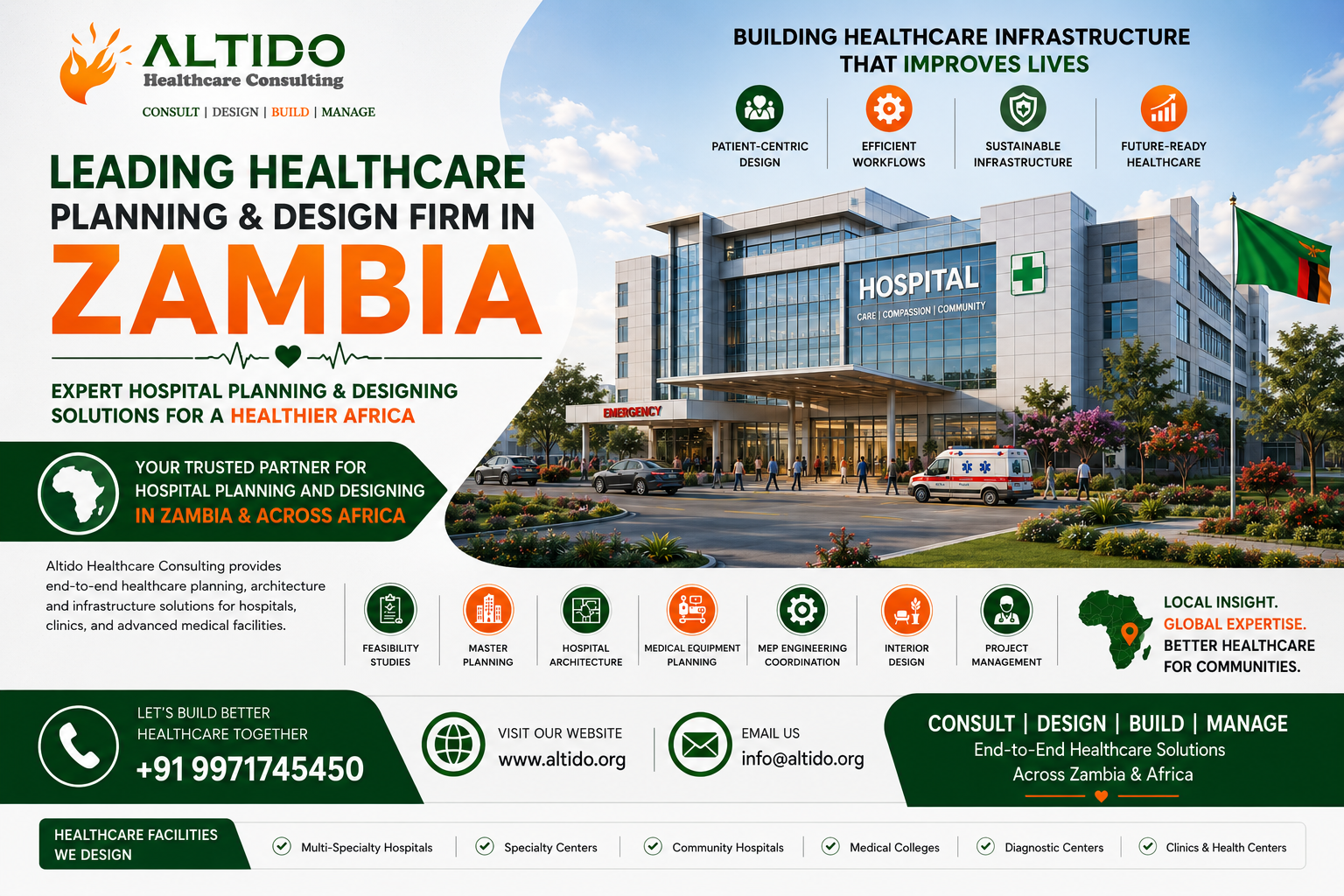
Healthcare infrastructure is a key driver of economic and social development. As Zambia continues to invest in improving its healthcare system, there is an increasing demand for modern hospitals, specialty healthcare facilities, diagnostic centers, and community health institutions. Developing these facilities requires more than construction—it requires strategic planning, innovative architecture, and efficient healthcare design.
Professional Hospital Planning and Designing in Zambia ensures that healthcare facilities are functional, patient-centric, sustainable, and prepared for future healthcare demands.
As a trusted healthcare consulting company, Altido Healthcare Consulting provides end-to-end healthcare planning, hospital architecture, and infrastructure solutions for clients across Africa, including Zambia. With expertise in healthcare facility planning, Altido helps governments, private healthcare providers, NGOs, and investors create world-class hospitals that improve patient outcomes and operational efficiency.
People Also Like to read this: 500-Bedded Hospital Design Company in India: Complete Planning & Architecture Solutions
Why Healthcare Planning is Essential in Zambia
The demand for quality healthcare services in Zambia continues to grow due to:
- Population growth
- Urbanization
- Rising healthcare awareness
- Increasing demand for specialty medical services
- Government investments in healthcare infrastructure
Modern hospitals must be designed to accommodate advanced medical technology, efficient workflows, and patient-centered care. Proper planning helps healthcare providers deliver better services while maximizing operational efficiency.
What is Hospital Planning and Designing?
Hospital planning and designing is the process of creating healthcare facilities that support efficient clinical operations, patient comfort, and future expansion. It involves planning every aspect of a hospital before construction begins.
These services include:
- Feasibility studies
- Hospital master planning
- Healthcare architecture
- Space planning
- Department planning
- Medical equipment planning
- MEP engineering coordination
- Interior design
- Project management
Professional planning ensures that every department functions efficiently while complying with international healthcare standards.
Hospital Planning and Designing in Zambia
Successful Hospital Planning and Designing in Zambia requires understanding local healthcare needs while incorporating global best practices.
A well-planned hospital provides:
- Efficient patient movement
- Comfortable healing environments
- Better infection control
- Optimized operational workflows
- Energy-efficient infrastructure
- Future-ready healthcare facilities
Whether developing a multi-specialty hospital, maternity hospital, oncology center, diagnostic facility, or medical college, proper planning ensures long-term success.
Role of a Hospital Planning and Designing Consultant in Africa
An experienced Hospital Planning and Designing Consultant in Africa provides strategic guidance throughout the project lifecycle.
Their responsibilities include:
Feasibility Study
Before beginning construction, consultants evaluate:
- Healthcare demand
- Demographics
- Market potential
- Financial viability
- Investment requirements
- Site suitability
This helps investors make informed decisions.
Hospital Master Planning
Master planning creates a long-term development strategy for healthcare campuses.
It includes:
- Site utilization
- Department zoning
- Traffic circulation
- Parking planning
- Utility infrastructure
- Future expansion
A comprehensive master plan ensures flexibility and operational efficiency.
Healthcare Architecture for Modern Hospitals
Healthcare architecture is different from conventional building design. Every hospital must be planned according to clinical workflows and patient care requirements.
Professional healthcare architects design:
- Patient-friendly layouts
- Efficient circulation
- Accessible facilities
- Safe environments
- Healing spaces
- Sustainable infrastructure
A well-designed hospital enhances both patient satisfaction and staff productivity.
Department Planning for Healthcare Facilities
Every department requires specialized planning.
Outpatient Department (OPD)
Planning includes:
- Reception
- Registration
- Waiting areas
- Consultation rooms
- Minor procedure rooms
Efficient OPD design improves patient flow and reduces waiting times.
Emergency Department
Emergency planning focuses on:
- Ambulance access
- Triage
- Trauma care
- Observation beds
- Emergency diagnostics
Quick access is essential for life-saving care.
Intensive Care Units (ICU)
ICUs require:
- Infection-controlled environments
- Advanced monitoring systems
- Medical gas supply
- Efficient staff movement
Proper ICU planning supports critical patient care.
Operation Theatre Complex
Modern operation theatres include:
- Modular OTs
- Sterile corridors
- Pre-operative areas
- Recovery rooms
- Equipment storage
Careful planning ensures patient safety and efficient surgical workflows.
Medical Equipment Planning
Medical technology is a significant investment. Equipment planning ensures that every diagnostic and treatment area is designed to accommodate advanced healthcare technology.
This includes planning for:
- MRI
- CT Scan
- X-Ray
- Cath Labs
- Laboratory Equipment
- Ultrasound
- Endoscopy Units
Equipment planning ensures compatibility with electrical, structural, and HVAC systems.
Infection Control in Hospital Design
Infection prevention is a critical component of healthcare architecture.
Design strategies include:
- Isolation rooms
- Air pressure control
- Sterile zones
- Hand hygiene stations
- Clean and dirty corridor separation
These measures improve patient safety and reduce healthcare-associated infections.
Sustainable Healthcare Design
Sustainable hospitals benefit both healthcare providers and the environment.
Green design features include:
- Energy-efficient HVAC systems
- Natural daylight
- Rainwater harvesting
- Solar energy integration
- Waste management systems
- Eco-friendly construction materials
Sustainability reduces operational costs and supports long-term healthcare goals.
Smart Hospital Planning
Technology is transforming healthcare delivery.
Modern hospitals incorporate:
- Electronic Medical Records (EMR)
- Building Management Systems (BMS)
- Smart nurse call systems
- Digital patient management
- Telemedicine infrastructure
- IoT-enabled monitoring
These technologies improve efficiency and enhance patient care.
Why Choose Altido Healthcare Consulting?
Altido Healthcare Consulting offers comprehensive healthcare consulting services for hospitals across India and Africa.
Our services include:
- Hospital Feasibility Studies
- Hospital Master Planning
- Hospital Planning and Designing
- Healthcare Architecture
- Medical Equipment Planning
- Interior Design
- MEP Engineering Coordination
- Healthcare Infrastructure Consulting
- Hospital Project Management
Our multidisciplinary team combines healthcare expertise with innovative architectural solutions to create hospitals that are efficient, scalable, and patient-focused.
Benefits of Professional Hospital Planning
Working with an experienced healthcare planning consultant offers numerous advantages:
- Better patient experience
- Optimized operational workflows
- Cost-effective infrastructure
- Compliance with healthcare standards
- Efficient department planning
- Sustainable building design
- Future expansion capability
- Improved healthcare outcomes
Healthcare Development Opportunities in Zambia
Zambia presents significant opportunities for healthcare infrastructure development, including:
- Multi-specialty hospitals
- District hospitals
- Specialty healthcare centers
- Cancer care facilities
- Eye hospitals
- Mother and child healthcare centers
- Diagnostic laboratories
- Medical colleges
- Rehabilitation centers
Professional healthcare planning ensures these facilities meet international standards while addressing local healthcare needs.
Conclusion
The future of healthcare in Zambia depends on well-planned, sustainable, and technologically advanced medical facilities. Choosing an experienced Hospital Planning and Designing Consultant in Africa ensures that healthcare projects are strategically designed for operational efficiency, patient safety, and long-term growth.
With expertise in Hospital Planning and Designing in Zambia, healthcare architecture, and healthcare infrastructure consulting, Altido Healthcare Consulting helps governments, healthcare providers, and investors develop world-class hospitals that improve lives and strengthen healthcare systems across Africa.
Altido Healthcare Consulting – Consult | Design | Build | Manage