
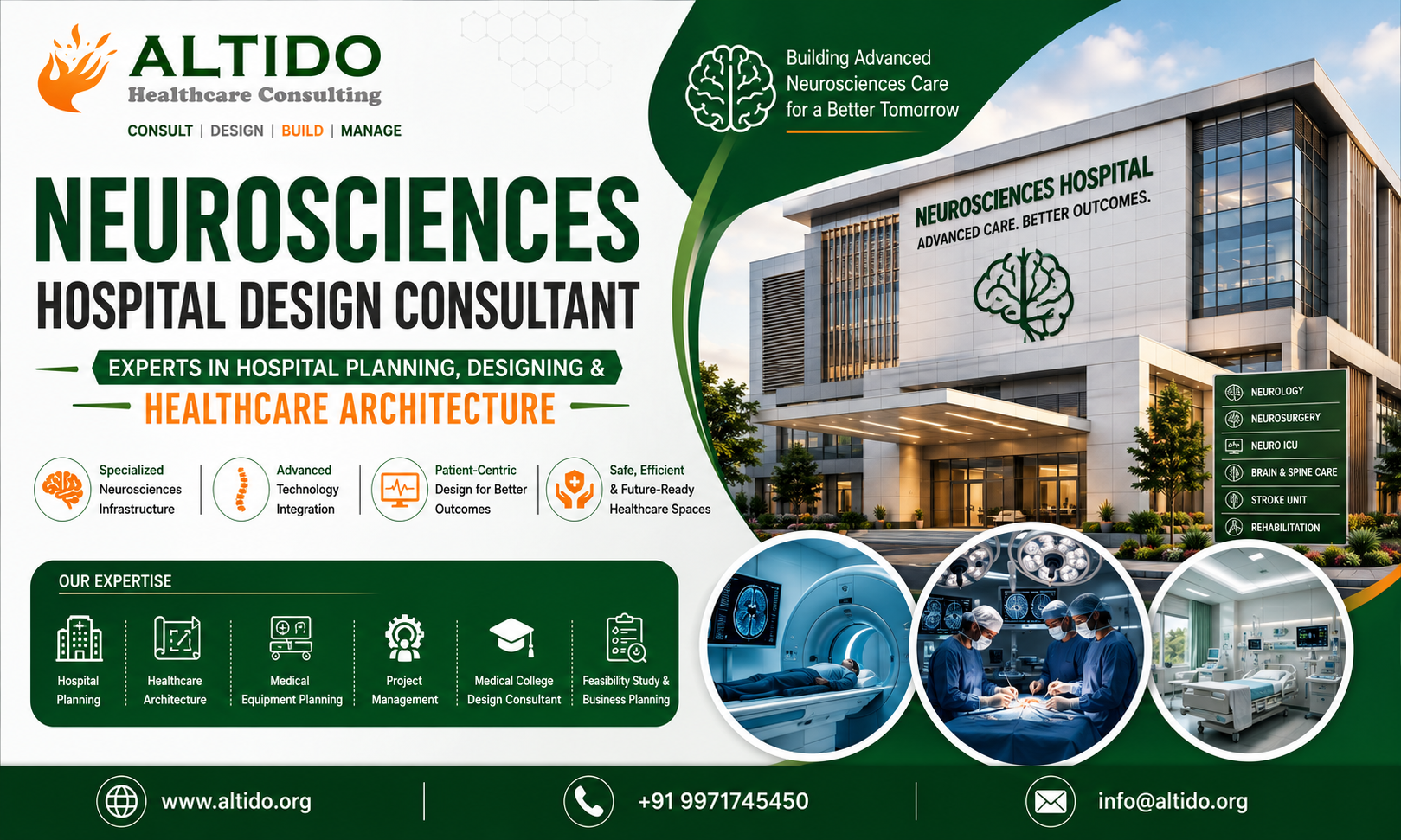
The demand for specialized neurosciences hospitals is increasing rapidly due to the growing prevalence of neurological disorders, stroke, brain injuries, spinal diseases, epilepsy, Parkinson’s disease, Alzheimer’s disease, and other complex neurological conditions. Developing a modern neurosciences hospital requires far more than constructing a healthcare building—it requires strategic planning, specialized clinical workflows, advanced medical technology, and patient-centered infrastructure.
A neurosciences hospital must integrate neurology, neurosurgery, neurocritical care, rehabilitation, diagnostic imaging, operation theatres, and emergency services into a seamless healthcare ecosystem. Every department should support efficient patient movement, infection control, medical equipment integration, and future expansion.
At Altido Healthcare Consulting, we specialize in hospital planning and design, healthcare architecture, feasibility studies, medical equipment planning, project management, and turnkey healthcare consulting. As an experienced Hospital Design and Planning Consultant, we help healthcare investors, hospitals, trusts, and medical institutions develop world-class neurosciences hospitals that meet international standards while supporting clinical excellence.
People Also Like to read this: Women’s Hospital Planning and Designing Consultant in India: A Complete Guide
Why Specialized Neurosciences Hospital Planning Matters
Neurological care involves complex diagnostics, emergency intervention, surgery, rehabilitation, and long-term patient management. Unlike a general hospital, a neurosciences facility requires highly coordinated infrastructure where multiple departments work together efficiently.
Professional planning helps achieve:
- Faster emergency response
- Better patient outcomes
- Optimized clinical workflows
- Advanced technology integration
- Efficient space utilization
- Reduced operational costs
- Future-ready infrastructure
- Enhanced patient and staff safety
Proper planning also supports hospital accreditation and long-term operational efficiency.
Key Departments in a Neurosciences Hospital
Neurology Outpatient Department (OPD)
The Neurology OPD is often the first point of contact for patients. It should provide comfortable consultation areas with efficient patient flow.
The OPD may include:
- Consultation rooms
- Examination rooms
- Procedure rooms
- Patient waiting areas
- Counseling rooms
- Registration and billing
- Diagnostic support
The layout should minimize patient movement and improve accessibility.
Neurosurgery Department
The neurosurgery department requires specialized infrastructure for brain and spine procedures.
Planning considerations include:
- Dedicated neurosurgery consultation rooms
- Pre-operative preparation
- Neurosurgical operation theatres
- Recovery areas
- Sterile circulation
- Intensive care connectivity
Efficient coordination between diagnostics, OT, ICU, and emergency services is essential.
Neuro Intensive Care Unit (Neuro ICU)
The Neuro ICU is one of the most critical departments.
It should include:
- Intensive monitoring systems
- Ventilator support
- Medical gas systems
- Isolation capability
- Nurse stations
- Family counseling areas
- Emergency access
The Neuro ICU should be located close to operation theatres and imaging departments.
Stroke Care Unit
Stroke treatment depends heavily on rapid diagnosis and intervention.
A Stroke Unit should provide:
- Immediate patient assessment
- Continuous monitoring
- Neurological observation
- Imaging connectivity
- Rehabilitation planning
The department should be integrated with emergency services and advanced imaging.
Diagnostic Imaging Department
Advanced diagnostics play a vital role in neurosciences care.
The imaging department may include:
- MRI
- CT Scan
- Digital X-ray
- PET-CT (where appropriate)
- Ultrasound
- Neuroangiography
- Functional imaging support
Equipment planning should consider structural loading, radiation safety, utilities, and patient accessibility.
Operation Theatre Complex
Modern neurosurgical procedures require highly specialized operation theatres.
The OT complex should include:
- Neurosurgery OT
- Modular operation theatre
- Sterile corridors
- Scrub areas
- Equipment storage
- Recovery rooms
- CSSD connectivity
- Medical gas systems
Operation theatres should support advanced surgical equipment such as operating microscopes and neuronavigation systems.
Rehabilitation Department
Recovery is a vital component of neurological care.
A rehabilitation center may include:
- Physiotherapy
- Occupational therapy
- Speech therapy
- Cognitive rehabilitation
- Mobility training
- Counseling services
Planning these departments within the hospital improves continuity of care.
Importance of Hospital Design and Planning
A successful neurosciences hospital begins with detailed planning.
As a Hospital Design and Planning Consultant, Altido Healthcare Consulting develops healthcare facilities that balance patient care, operational efficiency, and long-term sustainability.
Our planning services include:
- Hospital master planning
- Departmental planning
- Space programming
- Functional relationships
- Patient flow analysis
- Infection control planning
- Future expansion planning
- Emergency access planning
Every design decision is guided by clinical workflow and operational requirements.
Healthcare Architecture for Neurosciences Hospitals
Healthcare architecture differs significantly from conventional building design.
A specialized neurosciences hospital requires:
- Efficient circulation
- Safe patient transfer
- Barrier-free access
- Specialized structural planning
- Medical equipment integration
- Clinical zoning
- Staff workflow optimization
Well-designed healthcare architecture enhances patient safety and staff productivity.
Medical Equipment Planning
Medical equipment is central to a neurosciences hospital.
Planning may include:
- MRI
- CT Scanner
- EEG
- EMG
- Digital radiology
- Surgical microscopes
- Neuronavigation systems
- ICU equipment
- Patient monitoring systems
- Rehabilitation equipment
Equipment planning should begin during the design stage to ensure appropriate space, utilities, and future upgrades.
MEP Engineering Coordination
Mechanical, electrical, and plumbing systems must support the specialized needs of neurological care.
MEP planning includes:
- HVAC systems
- Medical gas pipeline systems
- Electrical distribution
- Backup power
- Fire protection
- Plumbing
- Water management
- Building management systems
Critical care areas require reliable engineering systems to ensure uninterrupted operation.
Sustainability in Neurosciences Hospital Design
Modern hospitals should also incorporate sustainable design principles.
Examples include:
- Energy-efficient HVAC systems
- LED lighting
- Natural daylight
- Water conservation
- Renewable energy integration
- Smart building management
- Sustainable materials
These strategies reduce operating costs while supporting environmental responsibility.
Future Expansion Planning
Healthcare needs evolve continuously.
A neurosciences hospital should allow for:
- Additional beds
- Expanded ICU capacity
- New diagnostic technologies
- Robotic surgery
- Telemedicine services
- Research facilities
- Academic programs
Planning for flexibility today reduces future renovation costs.
Medical College Design Consultant Services
Many neurosciences hospitals are associated with teaching institutions.
As a Medical College Design Consultant, Altido Healthcare Consulting supports the planning of integrated campuses that combine:
- Medical colleges
- Teaching hospitals
- Research laboratories
- Simulation centers
- Academic blocks
- Student hostels
- Faculty housing
- Skill development centers
Integrated planning strengthens education, research, and patient care while improving campus efficiency.
Why Choose Altido Healthcare Consulting?
Altido Healthcare Consulting provides end-to-end healthcare infrastructure consulting services.
Our expertise includes:
- Hospital Planning & Designing
- Neurosciences Hospital Design
- Hospital Feasibility Studies
- Healthcare Architecture
- Medical Equipment Planning
- Medical College Design
- MEP Engineering
Interior Design - Project Management Consultancy
- Turnkey Healthcare Projects
- Licensing & Regulatory Support
Our multidisciplinary team combines healthcare planning, architecture, engineering, technology, and project management to create hospitals that are efficient, sustainable, and future-ready.
Conclusion
A successful neurosciences hospital requires careful planning, specialized healthcare architecture, advanced medical technology, and integrated clinical workflows. From neurology OPD and neurosurgery operation theatres to Neuro ICU, imaging, rehabilitation, and research facilities, every department must work together seamlessly.
Partnering with an experienced Hospital Design and Planning Consultant ensures that your healthcare investment delivers long-term operational efficiency, patient safety, and clinical excellence.
Whether you are developing a standalone neurosciences hospital, expanding an existing healthcare facility, or planning an academic medical campus, Altido Healthcare Consulting offers comprehensive consulting services—from feasibility studies and master planning to healthcare architecture, medical equipment planning, project management, and turnkey execution.
Altido Healthcare Consulting – Consult | Design | Build | Manage