
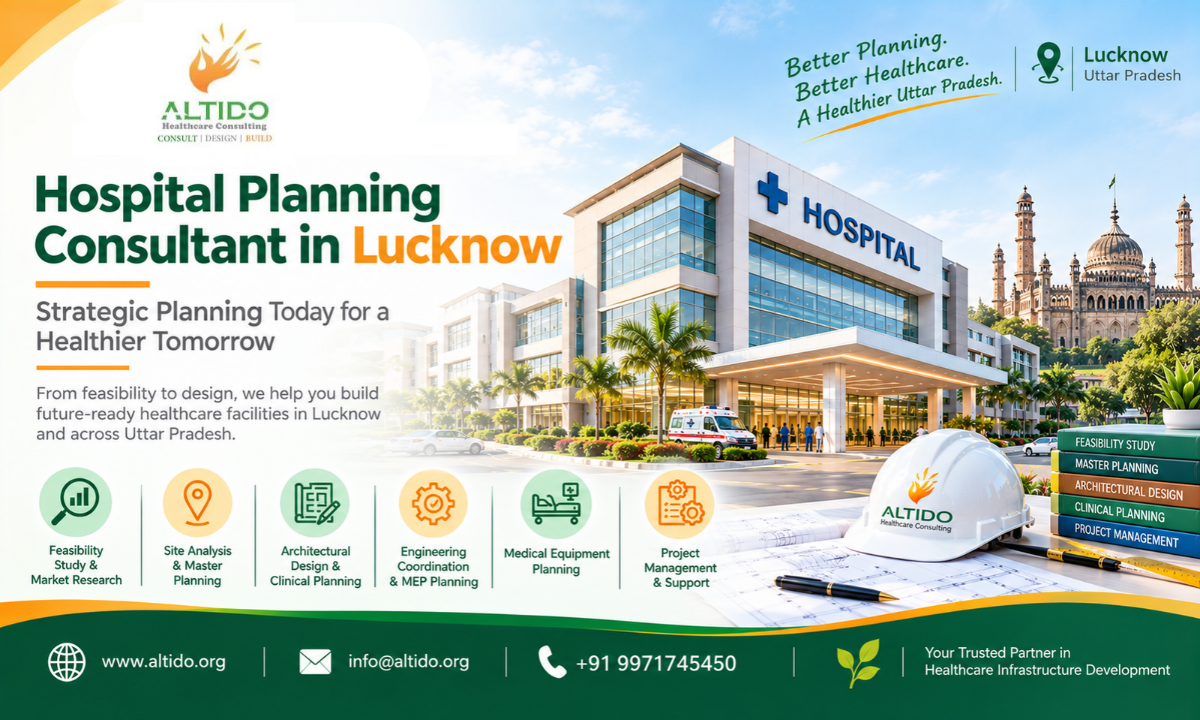
Lucknow is an important healthcare and medical education hub in Uttar Pradesh, creating opportunities for hospitals, specialty centres, diagnostic facilities, and other healthcare infrastructure projects. For doctors, investors, healthcare entrepreneurs, and developers planning a new hospital, success depends on more than selecting land and starting construction. It requires strategic planning, financial feasibility, efficient space utilization, and a clear understanding of healthcare demand.
Choosing an experienced Hospital Planning Consultant in Lucknow can help transform a healthcare investment idea into a practical, functional, and sustainable hospital project.
ALTIDO Healthcare Consulting provides integrated healthcare consultancy services, including hospital feasibility studies, business planning, architectural design, clinical planning, medical equipment planning, engineering coordination, and project management support.
People Also Like to read this: Hospital Design Consultant in Malawi: A Complete Guide to Hospital Planning and Architecture
Why Hospital Planning Is Important in Lucknow
Hospital development involves significant investment in land, construction, medical equipment, technology, staffing, and operational infrastructure. Without proper planning, a project may face budget overruns, inefficient layouts, underutilized departments, or difficulties meeting patient expectations.
A professional Hospital Planning Consultant in Lucknow helps investors evaluate the project’s requirements before committing substantial resources.
Important planning considerations include:
- Local healthcare demand and patient demographics.
- Existing hospitals and competing healthcare providers.
- Suitable bed capacity and specialty selection.
- Land suitability and site accessibility.
- Capital investment and operating expenses.
- Medical equipment and infrastructure requirements.
- Applicable statutory approvals and healthcare regulations.
- Future expansion and long-term operational sustainability.
A feasibility-led approach helps ensure that the hospital’s size, facilities, and investment align with its intended market.
What Does a Hospital Planning Consultant Do?
A hospital planning consultant coordinates the strategic, clinical, architectural, financial, and technical aspects of healthcare infrastructure development.
1. Hospital Feasibility Study and Market Research
A hospital feasibility study is the foundation of a successful healthcare project. It evaluates whether the proposed hospital is suitable for its location, target patients, service requirements, and investment objectives.
The assessment may include:
- Population and catchment-area analysis.
- Competitor mapping and healthcare gap assessment.
- Demand forecasting for medical specialties.
- Bed capacity and service-mix recommendations.
- Project cost estimation and financial modelling.
- Revenue projections and break-even analysis.
- Operational requirements and risk assessment.
ALTIDO Healthcare Consulting integrates feasibility studies with hospital planning and financial assessments to help clients make informed investment decisions.
2. Hospital Master Planning
Hospital master planning determines how the site will accommodate buildings, departments, circulation routes, parking, utilities, and future expansion.
The planning process may include:
- Building placement and site zoning.
- Emergency and ambulance access.
- Patient, visitor, staff, and service circulation.
- Parking and service areas.
- Utility infrastructure and plant rooms.
- Landscaping and outdoor spaces.
- Future development zones.
An effective master plan creates an organized hospital environment and reduces the risk of costly changes during later stages.
3. Clinical Planning and Department Layouts
Clinical planning focuses on how hospital departments function individually and connect with one another.
Depending on the proposed services, departments may include outpatient services, emergency care, inpatient wards, intensive care, operating theatres, diagnostic imaging, laboratories, maternity services, pharmacies, and administrative facilities.
The consultant evaluates patient movement, staff workflows, departmental adjacencies, clean and dirty circulation, infection prevention, and supporting spaces.
For example, emergency services should have convenient ambulance access and efficient connections to diagnostics and critical care. Operating theatre complexes require carefully planned sterile circulation, preparation areas, recovery spaces, and essential technical support.
Hospital Planning Consultant in Uttar Pradesh: Key Considerations
Healthcare projects across Uttar Pradesh require location-specific planning rather than a single approach for every city. A hospital proposed in Lucknow may have different patient demographics, competition, land costs, and specialty requirements from a project in another district.
A Hospital Planning Consultant in Uttar Pradesh should evaluate the local healthcare market, accessibility, infrastructure, patient expectations, and proposed service area before recommending the project configuration.
Location and Accessibility
The site should be assessed for road connectivity, surrounding population, public transport access, ambulance movement, land characteristics, utilities, and opportunities for future expansion.
The team should also review applicable land-use permissions and building requirements with the relevant authorities.
Bed Capacity and Specialty Selection
The right number of beds should be based on expected admissions, outpatient demand, specialty requirements, occupancy assumptions, staffing availability, and financial resources.
Investors should evaluate whether a general hospital, multispecialty hospital, mother and child hospital, or specialist centre best matches the identified demand.
Financial Planning
A realistic financial plan should include construction, interiors, medical equipment, furniture, IT infrastructure, staffing, utilities, maintenance, and pre-opening expenses.
Revenue assumptions should be supported by market research and realistic operating projections. This helps investors assess funding requirements, cash flow, break-even expectations, and financial risks.
Steps Involved in Planning a New Hospital in Lucknow
A structured development process helps connect the initial business concept with the final hospital design.
Step 1: Define the project vision. Establish the target patient group, ownership model, specialties, capacity, budget, and long-term objectives.
Step 2: Conduct a feasibility study. Assess market demand, competitors, site suitability, investment requirements, and financial viability.
Step 3: Develop the hospital brief. Determine the bed strength, clinical departments, room requirements, support facilities, and operational workflows.
Step 4: Prepare architectural and engineering designs. Develop functional layouts and coordinate electrical systems, plumbing, HVAC, fire safety, medical gases, and healthcare IT infrastructure.
Step 5: Plan medical equipment. Coordinate equipment selection, room dimensions, installation requirements, power loads, and supporting infrastructure.
Step 6: Coordinate implementation. Establish budgets, project schedules, procurement requirements, quality checks, and commissioning activities.
This integrated process helps reduce design conflicts and improves coordination between the hospital owner, architects, engineers, equipment suppliers, and contractors.
Why Choose ALTIDO Healthcare Consulting?
ALTIDO Healthcare Consulting supports healthcare investors, doctors, developers, and hospital owners with comprehensive planning and consultancy services.
Our services include:
- Hospital Feasibility Studies and Market Research.
- Hospital Business Planning and Financial Modelling.
- Hospital Master Planning.
- Hospital Architecture and Clinical Planning.
- Medical Equipment Planning and Procurement Support.
- MEP and Engineering Coordination.
- Healthcare Interior Design and Space Planning.
- Project Management Consultancy.
- Hospital Expansion and Renovation Planning.
- Commissioning and Implementation Support.
ALTIDO’s integrated approach connects feasibility, planning, architecture, engineering, and operational requirements throughout the project lifecycle. Our published hospital project consultancy services explain how these areas can be coordinated to support successful healthcare development.
For projects in Lucknow and across Uttar Pradesh, the scope of consultancy can be tailored to project requirements and coordinated with qualified local professionals where necessary.
Conclusion
Successful hospital development begins with strategic planning, not construction. Investors must understand local healthcare demand, determine the right bed capacity, select appropriate specialties, assess financial feasibility, and coordinate architectural and technical requirements before implementation.
Working with a professional Hospital Planning Consultant in Lucknow can help align these decisions and establish a foundation for an efficient, patient-focused, and financially sustainable healthcare facility.
Whether you are planning a new hospital, expanding an existing facility, or developing a specialty centre, ALTIDO Healthcare Consulting can support your project through feasibility studies, hospital planning, architectural design, equipment planning, and project management consultancy.
ALTIDO Healthcare Consulting
Consult | Design | Build | Manage
Email: info@altido.org
Phone: +91 9971745450