
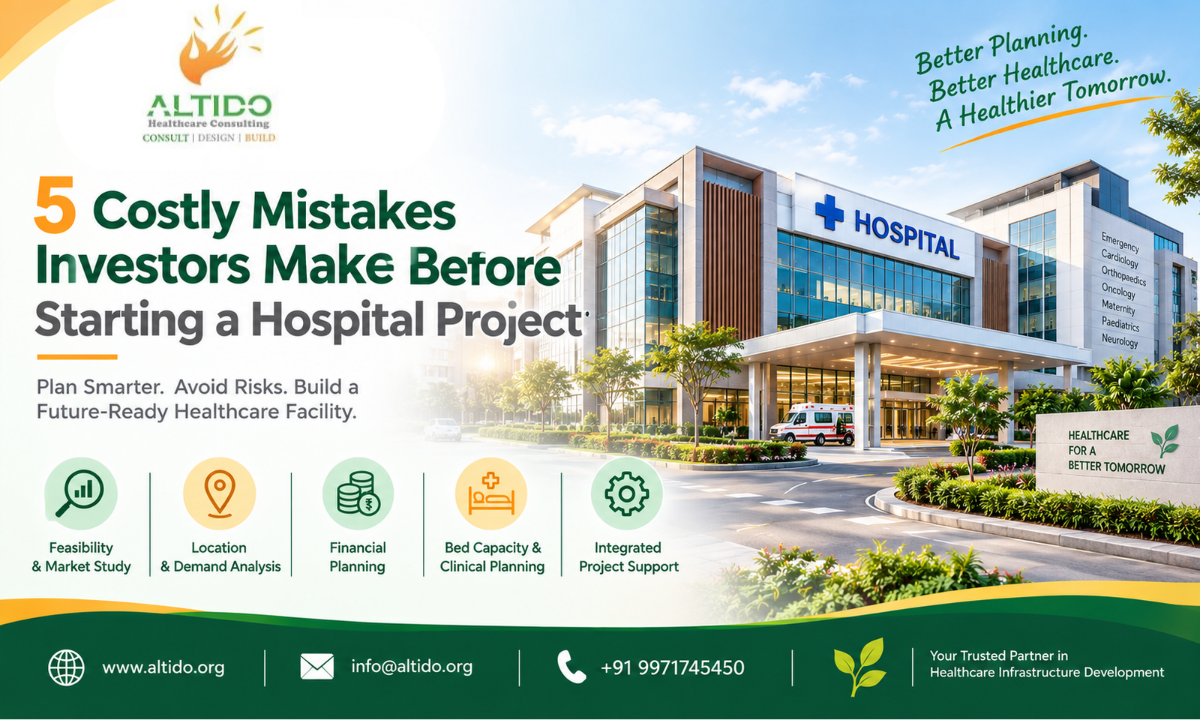
Starting a hospital is a significant investment that requires strategic planning, healthcare market knowledge, financial discipline, and a clear understanding of clinical operations. While many investors focus on land acquisition, construction, and medical equipment, the success of a hospital project depends on the decisions made long before construction begins.
A hospital may have a modern building and advanced equipment, but without the right location, suitable bed capacity, realistic financial projections, and efficient operational planning, it may struggle to achieve sustainable growth.
Avoiding common planning mistakes can help investors reduce financial risks, control project costs, and develop healthcare facilities that respond to actual patient needs.
ALTIDO Healthcare Consulting supports healthcare investors, doctors, hospital owners, and developers through hospital feasibility studies, business planning, architectural design, medical equipment planning, and project management consultancy.
Here are five costly mistakes investors should avoid before starting a hospital project.
People Also Like to read this: How to Decide the Right Number of Beds for a New Hospital
1. Starting Without a Detailed Hospital Feasibility Study
One of the most common mistakes is investing in a hospital project without first establishing whether it is commercially, operationally, and clinically viable.
Investors may select a location or decide on a hospital size based on personal assumptions, available land, or perceived market opportunities. However, these factors alone cannot establish whether the proposed hospital will attract enough patients to support its investment and operating costs.
A comprehensive hospital feasibility study should evaluate:
- Population and demographic characteristics
- Healthcare demand within the catchment area
- Existing hospitals and competitor services
- Specialty-wise market opportunities
- Recommended bed capacity and service mix
- Capital expenditure and operating costs
- Revenue projections and break-even expectations
- Project risks and regulatory requirements
For example, establishing a large multispecialty hospital in an area with limited demand or strong competition may create financial pressure if patient volumes do not meet expectations.
A feasibility study helps investors understand the opportunities and limitations before committing substantial capital. It also provides a foundation for business planning, financing, hospital design, and implementation.
How to avoid this mistake: Commission a detailed hospital feasibility study before purchasing land, finalizing bed strength, approaching lenders, or beginning architectural planning.
2. Choosing the Wrong Location and Underestimating Market Demand
Location plays a critical role in hospital performance. A site may appear attractive because of its size, accessibility, or price, but it may not be suitable for the intended healthcare services.
Investors sometimes choose land without thoroughly assessing patient accessibility, local healthcare demand, competing hospitals, infrastructure availability, or future development in the surrounding area.
A proper location assessment should consider:
Catchment population: Identify the population the hospital can realistically serve and understand its healthcare requirements.
Competition: Study existing hospitals, their specialties, capacity, service quality, and market positioning.
Accessibility: Evaluate road connectivity, public transport, ambulance access, parking, and travel times.
Infrastructure: Assess electricity, water supply, drainage, telecommunications, site conditions, and other essential utilities.
Future growth: Consider urban expansion, residential development, population changes, and the potential for future healthcare demand.
The best location is not necessarily the cheapest property or the largest available plot. It is a site that supports the proposed hospital model, patient access, infrastructure requirements, and long-term business objectives.
How to avoid this mistake: Conduct market research, competitor mapping, catchment analysis, and technical site assessment before finalizing the location.
3. Underestimating the Project Budget and Financial Requirements
Hospital projects involve far more than land and construction costs. Medical equipment, building services, interiors, information technology, staffing, commissioning, and pre-opening activities can substantially affect the total investment.
A common mistake is preparing a budget based on construction cost alone while overlooking supporting infrastructure and the working capital required to operate the hospital during its initial months.
A realistic financial plan should include:
- Land acquisition and site development
- Architectural and engineering consultancy
- Civil construction and interior fit-out
- Medical equipment and furniture
- HVAC, electrical, plumbing, fire safety, and medical gas systems
- Healthcare IT and digital infrastructure
- Recruitment, training, and pre-opening expenses
- Licensing and other applicable statutory requirements
- Working capital and contingency provisions
Investors should also distinguish between capital expenditure (CAPEX) and operating expenditure (OPEX).
CAPEX covers the investment required to develop and equip the facility. OPEX includes recurring expenses such as salaries, utilities, consumables, maintenance, and administration.
Financial modelling should estimate realistic patient volumes, department-wise revenue, operating margins, cash flow, break-even expectations, and investment returns. Different scenarios should be tested to understand how changes in occupancy, project cost, or operating expenses could affect financial performance.
A structured business plan and detailed project report can also help investors present the project to lenders and potential funding partners.
How to avoid this mistake: Prepare an integrated hospital project budget and financial feasibility model before making major financial commitments.
4. Planning the Wrong Bed Capacity and Specialty Mix
Another costly mistake is deciding the number of hospital beds without evaluating patient demand, expected occupancy, average length of stay, and specialty requirements.
More beds do not automatically mean higher profits. Excess capacity can increase construction and operating costs, while insufficient capacity may limit admissions and restrict future growth.
The hospital’s bed strength should be based on market research, projected admissions, patient demographics, and the clinical services planned for the facility.
Investors should also determine which specialties are appropriate for the target market. A hospital may require different combinations of general wards, private rooms, intensive care, maternity, pediatric care, surgical services, and other specialty departments.
Clinical planning must be coordinated with supporting facilities such as:
- Outpatient departments and emergency services
- Operation theatres and recovery areas
- Intensive care and high-dependency units
- Diagnostic imaging and laboratories
- Pharmacy and central sterile services
- Nursing stations and support departments
The location and relationship between these departments influence patient movement, staff efficiency, safety, and operational performance.
Poor planning may lead to unused spaces, overcrowded departments, inefficient circulation, or expensive modifications after construction.
How to avoid this mistake: Develop the clinical programme and bed-capacity plan through a feasibility-led approach, ensuring that hospital architecture, medical planning, equipment, and infrastructure work together.
5. Treating Hospital Development as Only a Construction Project
A hospital is not simply a building with beds and medical equipment. It is a complex healthcare environment that must support clinical workflows, patient safety, staffing, technology, maintenance, and regulatory requirements.
Investors who focus only on architectural appearance and construction progress may overlook important operational requirements.
For example, poorly coordinated emergency access, inefficient department layouts, inadequate utility planning, or insufficient space for medical equipment can create problems that are difficult and expensive to correct after construction.
Hospital development requires coordination between multiple disciplines, including:
- Healthcare feasibility and business planning
- Medical and clinical planning
- Hospital architecture and engineering
- Medical equipment planning and procurement
- Healthcare IT and digital systems
- Fire safety and other applicable statutory requirements
- Project management and construction coordination
- Testing, commissioning, and operational readiness
Planning should also consider the hospital’s staffing strategy, service protocols, patient flow, procurement needs, and maintenance arrangements.
Engaging different consultants without a coordinated project strategy can result in design conflicts, delays, duplicated work, and budget overruns.
An integrated consultancy approach helps align the hospital’s business objectives with its physical design and operational requirements.
How to avoid this mistake: Engage experienced healthcare consultants early and establish a coordinated roadmap from feasibility and design through execution, commissioning, and operational readiness.
Why Choose ALTIDO Healthcare Consulting?
ALTIDO Healthcare Consulting provides healthcare-focused consultancy solutions to help investors make informed decisions at every stage of hospital development.
Our services include:
- Hospital Feasibility Studies and Market Research
- Hospital Business Planning and Financial Modelling
- Site Assessment and Due Diligence
- Bed Capacity and Clinical Department Planning
- Hospital Architecture and Space Planning
- Medical Equipment Planning and Procurement Support
- MEP and Structural Engineering Coordination
- Project Management Consultancy
- Turnkey Healthcare Project Support
- Commissioning and Project Implementation Support
By connecting feasibility, financial planning, clinical requirements, architecture, and execution, ALTIDO helps clients establish a stronger foundation for their healthcare investments.
Whether you are planning a specialty hospital, a multispecialty facility, a medical college hospital, or an expansion project, a structured planning process can help identify risks before they become expensive problems.
Conclusion
Starting a hospital project requires more than investment capital and a suitable building site. Success depends on making the right decisions about feasibility, location, budget, bed capacity, clinical services, infrastructure, and operations before construction begins.
The five mistakes discussed above can create avoidable financial pressure, operational challenges, and delays. A comprehensive feasibility study, realistic financial modelling, coordinated hospital planning, and professional project consultancy can help investors approach these challenges with greater clarity.
ALTIDO Healthcare Consulting helps transform healthcare investment ideas into structured, practical, and future-ready hospital projects.
Planning a new hospital? Start with the right feasibility study and build your project on a strong foundation.
ALTIDO Healthcare Consulting
Consult | Design | Build | Manage