
Investing in a hospital or healthcare facility is a major long-term decision. Beyond construction and medical equipment, a successful healthcare project requires a clear understanding of market demand, patient catchment, clinical requirements, investment feasibility, financial performance, operational strategy, and long-term growth.
This is where Healthcare Investment & Project Feasibility Advisory becomes critical.
A structured advisory approach helps investors and healthcare organizations move from an initial concept to a commercially viable, operationally efficient, and future-ready healthcare facility. At ALTIDO Healthcare Consulting, we support healthcare projects through feasibility studies, market assessment, hospital planning, financial analysis, medical planning, equipment planning, project management, and strategic partnerships.
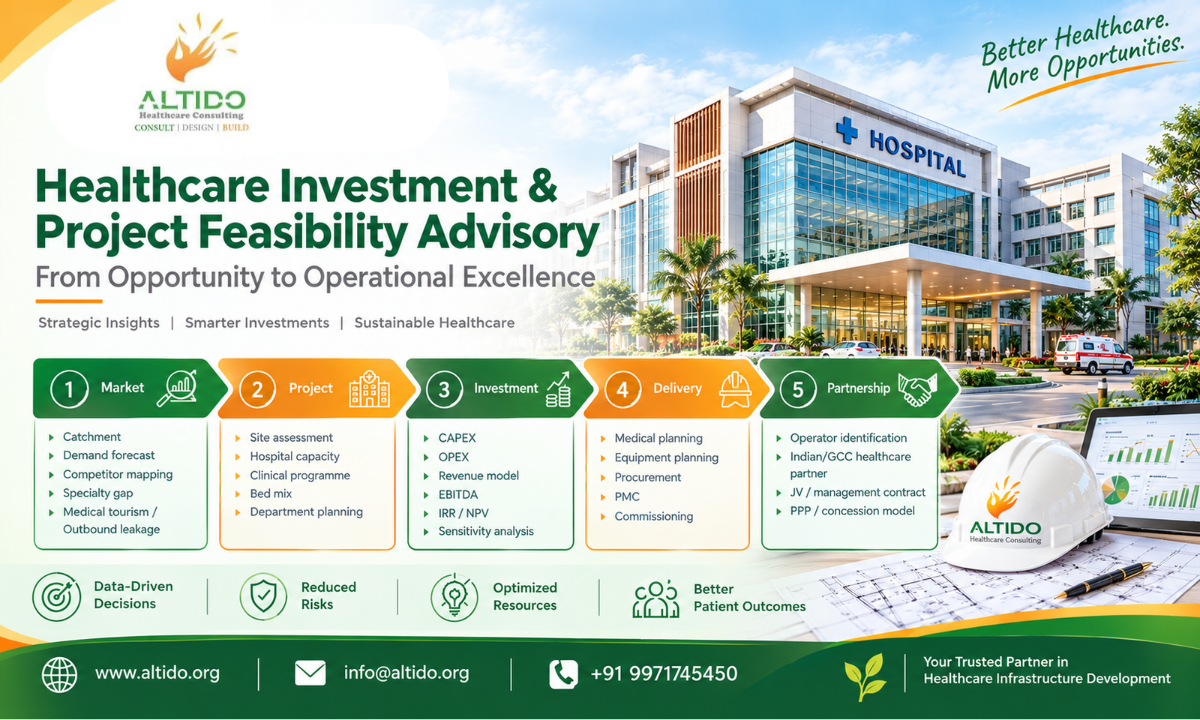
Our approach can be structured into five key stages: Market, Project, Investment, Delivery, and Partnership.
People Also Like to read this: 500-Bed Hospital Planning in India: Space Requirements, Area Planning & Design Guide
Stage 1 – Market: Understanding the Healthcare Opportunity
The first step in any healthcare investment is understanding whether a genuine market opportunity exists.
A detailed market assessment helps investors answer fundamental questions:
- Who are the potential patients?
- What healthcare services are currently available?
- Where are the gaps?
- Who are the major competitors?
- What specialties have growth potential?
- Is there medical tourism potential?
- How much healthcare demand is leaving the region?
Catchment Analysis
Catchment analysis identifies the geographical area from which a hospital is expected to attract patients.
The assessment can consider population, demographics, income levels, healthcare accessibility, existing facilities, transportation connectivity, disease patterns, and patient behavior.
Understanding the catchment helps determine the potential scale and positioning of the proposed hospital.
Demand Forecasting
Demand forecasting evaluates potential patient volumes across OPD, IPD, diagnostics, emergency, surgery, critical care, maternity, and specialty services.
This information is essential for determining the appropriate hospital capacity and service mix.
Competitor Mapping
Competitor analysis examines existing hospitals in the target market, including their:
- Bed capacity
- Specialties
- Pricing
- Infrastructure
- Patient volumes
- Brand positioning
- Service quality
- Geographic reach
This helps identify opportunities for differentiation.
Specialty Gap Analysis
Not every hospital needs to offer every specialty.
A market study can identify underserved specialties such as oncology, cardiology, orthopedics, fertility, neurosciences, dialysis, mother and child care, or advanced diagnostics.
Medical Tourism & Outbound Leakage
In some markets, patients travel outside their city, state, or country for specialized treatment.
Understanding this outbound healthcare leakage can reveal opportunities to develop services that retain patients locally.
For international healthcare projects, medical tourism analysis can also identify opportunities to attract patients from neighboring regions.
ALTIDO’s feasibility approach includes market assessment, demand analysis, competition, service-line planning, and identification of healthcare gaps.
Stage 2 – Project: Defining the Right Hospital Concept
Once the market opportunity is established, the next stage is translating the opportunity into a practical healthcare project.
Site Assessment
Site selection can significantly influence the long-term performance of a hospital.
A site assessment may examine:
- Accessibility and road connectivity
- Catchment population
- Land size
- Development regulations
- Parking requirements
- Utilities
- Emergency access
- Surrounding development
- Expansion potential
The site must be capable of supporting both current requirements and future growth.
Hospital Capacity
The appropriate number of beds should be determined through demand analysis rather than simply selecting a convenient number.
Capacity planning can consider:
- Inpatient beds
- ICU beds
- NICU/PICU
- Emergency beds
- Day-care beds
- Observation areas
- Specialty units
Proper capacity planning helps avoid both underutilization and overcrowding.
Clinical Programme
The clinical programme defines what healthcare services the hospital will provide.
It may include:
- OPD
- Emergency
- ICU
- Operation theatres
- Diagnostics
- Inpatient services
- Maternity
- Pediatrics
- Cardiology
- Oncology
- Orthopedics
- Neurosciences
- Dialysis
- Rehabilitation
Bed Mix & Department Planning
Bed mix should align with the hospital’s target market and clinical strategy.
Department planning then translates these requirements into functional areas, including clinical departments, support services, administration, circulation, engineering spaces, and future expansion zones.
Stage 3 – Investment: Evaluating Financial Viability
A healthcare project must be clinically meaningful and financially sustainable.
The investment stage converts the project concept into a financial model.
CAPEX
Capital expenditure may include:
- Land
- Civil construction
- Architecture and engineering
- Interiors
- Medical equipment
- IT infrastructure
- MEP systems
- Medical gases
- Furniture and fixtures
- Pre-operative expenses
OPEX
Operating expenditure may include:
- Salaries
- Utilities
- Maintenance
- Medical consumables
- Administration
- Insurance
- Marketing
- Facility management
- Technology and IT operations
Revenue Model
Revenue projections should consider different healthcare income streams such as:
- OPD consultations
- Inpatient services
- Surgery
- Diagnostics
- Pharmacy
- Emergency
- Critical care
- Health packages
- Corporate healthcare
- Specialty services
A detailed feasibility study can help develop realistic revenue assumptions and financial projections.
EBITDA, IRR & NPV
Financial evaluation may include EBITDA, IRR, and NPV to understand the project’s operating performance and investment attractiveness.
However, these indicators should be evaluated alongside assumptions such as occupancy, patient volumes, average revenue per patient, specialty mix, pricing, operating costs, capital investment, and financing structure.
Sensitivity Analysis
Healthcare projects are exposed to uncertainty.
Sensitivity analysis can test how changes in:
- Patient volumes
- Occupancy
- Revenue
- CAPEX
- OPEX
- Pricing
- Project timelines
could affect financial performance.
This allows investors to understand potential risks before committing significant capital.
Stage 4 – Delivery: Turning the Strategy into a Healthcare Facility
Once the project is financially and strategically validated, implementation planning begins.
Medical Planning
Medical planning converts the clinical programme into functional hospital layouts.
It considers:
- Departmental relationships
- Patient flow
- Staff circulation
- Material movement
- Infection-control principles
- Emergency access
- Clinical workflows
Equipment Planning
Medical equipment planning should be coordinated with architecture and engineering requirements.
Equipment affects room dimensions, structural requirements, electrical loads, HVAC, medical gases, plumbing, shielding, data infrastructure, and workflow.
Procurement
Procurement planning helps coordinate medical equipment, construction materials, technology, furniture, fixtures, and other project requirements.
Project Management Consultancy
A professional PMC structure helps coordinate consultants, contractors, vendors, timelines, quality, budgets, and project milestones.
Commissioning
Commissioning is the transition from construction to operational readiness.
It can involve equipment testing, engineering systems, clinical readiness, documentation, staff coordination, statutory requirements, and operational preparedness.
ALTIDO supports healthcare projects across planning, architecture, medical equipment planning, project management, and commissioning-related activities.
Stage 5 – Partnership: Building the Right Operating Model
A hospital’s success depends not only on infrastructure but also on the organization operating it.
Strategic partnerships can provide access to clinical expertise, management capabilities, technology, brand strength, and operational systems.
Operator Identification
Investors may evaluate established healthcare operators based on:
- Clinical expertise
- Brand reputation
- Operating experience
- Specialty strengths
- Geographic presence
- Management capabilities
Indian & GCC Healthcare Partners
For projects involving cross-border investment or development, strategic healthcare partnerships can create opportunities to combine local market knowledge with established healthcare expertise.
JV & Management Contract
A Joint Venture (JV) can combine capital, healthcare expertise, infrastructure, and market access.
A management contract may allow the asset owner to partner with an experienced healthcare operator for hospital operations and management.
PPP & Concession Models
Public-Private Partnership and concession structures can provide alternative approaches for healthcare infrastructure projects where public and private stakeholders collaborate.
The appropriate structure depends on the project objectives, ownership model, regulatory framework, investment requirements, and operational responsibilities. ALTIDO’s healthcare financing guidance also recognizes PPP as one potential structure for suitable healthcare infrastructure projects.
Why Healthcare Investment Advisory Matters
Healthcare projects involve interconnected decisions. A change in market demand can affect bed capacity. Bed capacity affects space requirements. Space affects CAPEX. CAPEX affects financing. Financing affects financial returns. The operating model then influences revenue and long-term sustainability.
Therefore, these decisions should not be made independently.
An integrated advisory approach creates a connection between:
Market → Project → Investment → Delivery → Partnership
This helps investors develop a clear roadmap before major commitments are made.
Why Choose ALTIDO Healthcare Consulting?
ALTIDO Healthcare Consulting provides integrated healthcare consulting solutions for investors, hospital promoters, developers, healthcare organizations, and institutions.
Our services include:
- Healthcare Market Research
- Hospital Feasibility Studies
- Investment & Financial Feasibility
- Hospital Business Planning
- Site & Location Assessment
- Hospital Capacity Planning
- Medical Planning
- Hospital Architecture & Design
- Space Programming
- Medical Equipment Planning
- Procurement Support
- Project Management Consultancy
- Commissioning Support
- Healthcare Partnership Advisory
- Hospital Expansion Planning
- Turnkey Healthcare Solutions
Our objective is to help clients make informed decisions before committing significant resources to healthcare infrastructure development. ALTIDO’s published feasibility methodology similarly emphasizes market demand, competition, capacity planning, financial viability, site assessment, infrastructure, and risk evaluation.
Conclusion
Healthcare investment is not simply a construction decision. It is a long-term strategic investment involving market opportunity, clinical planning, financial performance, infrastructure, operations, and partnerships.
A structured Healthcare Investment & Project Feasibility Advisory process helps investors understand the opportunity before moving into implementation.
From catchment and demand forecasting to CAPEX, OPEX, EBITDA, IRR, NPV, medical planning, procurement, PMC, commissioning, and strategic partnerships, every stage contributes to the overall success of the project.
ALTIDO Healthcare Consulting helps transform healthcare investment concepts into structured, feasible, and future-ready projects through an integrated Consult | Design | Build | Manage approach.