
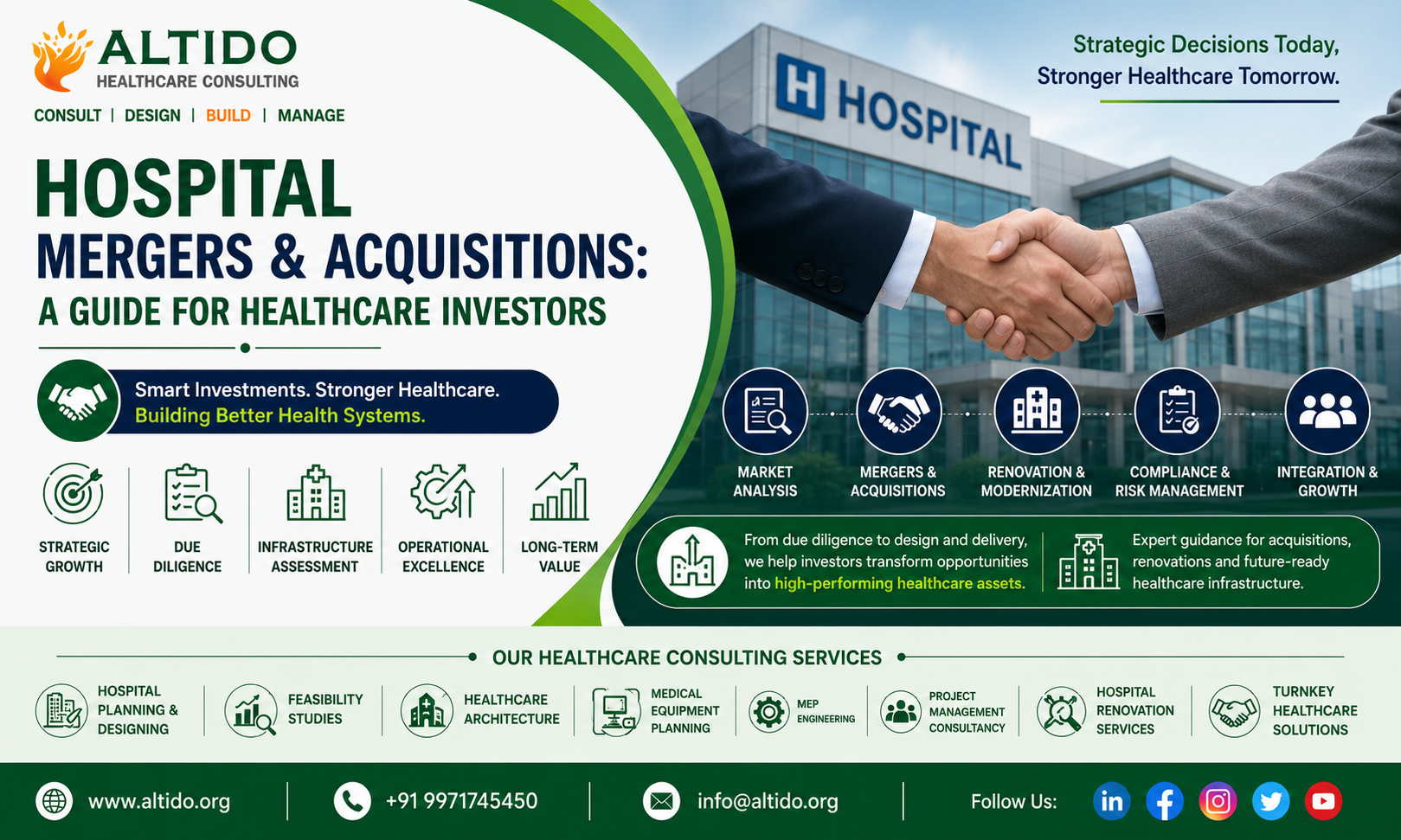
Hospital mergers and acquisitions (M&A) have become an important strategy for healthcare investors, hospital operators, and healthcare organizations looking to expand their presence, improve operational efficiency, enter new markets, or strengthen existing healthcare facilities. However, acquiring or merging with a hospital is considerably more complex than a conventional business transaction.
A successful healthcare M&A requires detailed due diligence, financial assessment, operational analysis, infrastructure evaluation, regulatory review, and a clear post-acquisition development strategy.
For investors considering an existing hospital acquisition, understanding the physical condition of the facility is equally important. An acquired hospital may require modernization, expansion, reconfiguration, or renovation to meet current clinical, operational, and patient-care requirements. This is where professional healthcare planning and Hospital Renovation Services become an important part of the investment strategy.
Altido Healthcare Consulting supports healthcare investors and organizations with feasibility studies, due diligence, hospital planning and design, renovation planning, medical equipment planning, project management, and healthcare infrastructure solutions.
People Also like to read this: Hospital Design Consultant in Iraq: Building the Future of Healthcare Through Smart Design
What Are Hospital Mergers and Acquisitions?
A hospital merger occurs when two healthcare organizations combine their operations, assets, resources, or management structures. An acquisition occurs when one organization or investor purchases or takes control of another healthcare facility or healthcare business.
Healthcare M&A may involve:
- Hospitals
- Specialty hospitals
- Diagnostic centers
- Clinics
- Day-care centers
- Medical colleges
- Rehabilitation facilities
- Healthcare networks
The objective may be to increase market share, expand services, improve operational efficiency, access new technology, or create a larger healthcare network.
Why Healthcare Investors Consider Hospital M&A
There are several reasons investors may consider acquiring or merging with an existing hospital.
Market Expansion
Acquiring an existing facility can provide access to an established location, patient base, workforce, and referral network.
Faster Market Entry
Developing a new hospital can require significant time for planning, approvals, construction, equipment procurement, and commissioning. An existing hospital may provide a faster route to market, subject to appropriate due diligence and regulatory requirements.
Expansion of Medical Services
An acquired hospital may provide an opportunity to introduce new specialties such as:
- Cardiology
- Oncology
- Neurology
- Orthopedics
- Gastroenterology
- Nephrology
- Critical care
- Emergency medicine
Infrastructure Optimization
An existing facility may have underutilized areas that can be redesigned or repurposed to improve capacity and service delivery.
Importance of Healthcare Due Diligence
Before completing a hospital acquisition, investors should conduct comprehensive due diligence.
Healthcare due diligence can cover:
- Financial performance
- Legal documentation
- Regulatory compliance
- Licenses and approvals
- Land and property
- Building condition
- Medical equipment
- Clinical services
- Staffing
- Patient volumes
- Operational performance
- Infrastructure
- Existing liabilities
- Expansion potential
A multidisciplinary due diligence process helps investors identify risks and understand the actual condition and future potential of the hospital.
Assessing the Hospital Building
The physical condition of an acquired hospital can have a major impact on the overall investment.
A professional infrastructure assessment can review:
- Building structure
- Floor plans
- Department layouts
- Electrical systems
- HVAC systems
- Plumbing
- Medical gases
- Fire protection
- Accessibility
- Infection-control requirements
- Vertical transportation
- Parking
- Utility systems
This assessment helps determine whether the facility can continue operating in its current condition or requires renovation and modernization.
Role of a Hospital Renovation Company
An existing hospital may not always require complete redevelopment. In many cases, targeted renovation can significantly improve functionality and patient experience.
A professional Hospital Renovation Company can help evaluate the existing facility and develop a renovation strategy based on clinical requirements, budget, operational priorities, and future growth.
Hospital renovation may include:
- OPD renovation
- Emergency department upgrades
- ICU modernization
- OT renovation
- Patient room upgrades
- Reception redesign
- Diagnostic department upgrades
- Pharmacy renovation
- Waiting-area improvements
- MEP upgrades
- Interior modernization
The objective is to improve the facility without unnecessarily disrupting critical healthcare operations.
Hospital Renovation Services After Acquisition
Hospital Renovation Services can become an important component of post-acquisition transformation.
A renovation program may focus on:
Clinical Areas
Existing departments can be reconfigured to improve workflow, patient circulation, staff movement, and department relationships.
Patient Areas
Patient rooms, waiting areas, reception spaces, corridors, and public areas can be upgraded to improve comfort and the overall patient experience.
Engineering Infrastructure
Older hospitals may require upgrades to HVAC, electrical systems, medical gases, plumbing, fire safety, and backup power systems.
Medical Technology
Renovation can provide appropriate infrastructure for new diagnostic and treatment equipment.
Creating a Post-Acquisition Hospital Development Plan
Once an acquisition is completed, investors should establish a structured development roadmap.
The plan may include:
- Existing facility assessment
- Clinical service review
- Market opportunity assessment
- Capacity analysis
- Renovation requirements
- Medical equipment requirements
- Technology upgrades
- Staffing requirements
- Capital expenditure planning
- Implementation schedule
This allows investors to prioritize improvements based on financial return, patient demand, clinical importance, and operational requirements.
Financial Planning for Hospital M&A
Healthcare acquisitions require careful financial analysis beyond the purchase price.
Investors should consider:
- Acquisition cost
- Existing liabilities
- Renovation expenditure
- Medical equipment investment
- Technology investment
- Working capital
- Staffing costs
- Operating expenses
- Marketing costs
- Regulatory compliance costs
- Future expansion costs
A comprehensive financial model should consider both immediate investment requirements and long-term operational performance.
Medical Equipment Assessment
Existing medical equipment should be evaluated as part of the acquisition process.
The assessment can determine:
- Equipment age
- Technical condition
- Maintenance history
- Remaining useful life
- Technology relevance
- Replacement requirements
- Space requirements
- Utility requirements
Some equipment may be retained, while obsolete or inefficient equipment may need to be replaced.
Proper medical equipment planning can help investors avoid unexpected capital expenditure after acquisition.
Hospital Capacity and Service Mix
An important part of M&A planning is evaluating whether the existing hospital has the right service mix for its market.
The assessment may consider:
- Number of beds
- Occupancy
- OPD volumes
- Emergency volumes
- Surgical procedures
- ICU utilization
- Diagnostic volumes
- Specialty demand
- Referral patterns
Based on the findings, investors may decide to expand existing services, introduce new specialties, or reconfigure underutilized areas.
Renovation vs. New Hospital Development
One of the most important decisions after acquiring a hospital is whether to renovate the existing facility or develop a new one.
Renovation may be suitable when:
- The building structure is sound
- The location has strong market potential
- Existing infrastructure can be upgraded
- The hospital has sufficient expansion potential
- Renovation provides better financial value
A new hospital may be more appropriate when:
- Existing infrastructure is severely outdated
- The building cannot support modern clinical requirements
- Expansion is significantly restricted
- Major structural limitations exist
- Long-term redevelopment provides better value
A detailed feasibility and infrastructure assessment can help investors make this decision.
Project Management for Hospital Transformation
Hospital renovation and modernization require careful execution because healthcare services may need to continue during construction.
Project management can include:
- Phasing strategy
- Design coordination
- Contractor coordination
- Cost management
- Schedule management
- Quality control
- Infection-control coordination
- Temporary relocation planning
- Equipment coordination
- Commissioning
Phased renovation can allow essential hospital services to continue while improvements are implemented.
Why Choose Altido Healthcare Consulting?
Altido Healthcare Consulting provides integrated healthcare consulting solutions for investors and healthcare organizations.
Our services include:
- Healthcare Due Diligence
- Hospital Feasibility Studies
- Hospital Business Planning
- Hospital Planning & Designing
- Healthcare Architecture
- Hospital Renovation Planning
- Medical Equipment Planning
- MEP Coordination
- Healthcare IT Planning
- Project Management Consultancy
- Licensing & Accreditation Support
- Turnkey Healthcare Solutions
Our multidisciplinary approach allows investors to evaluate both the business and infrastructure aspects of a healthcare acquisition.
Conclusion
Hospital mergers and acquisitions can create significant opportunities for healthcare investors, but successful transactions require careful evaluation of financial, operational, regulatory, clinical, and infrastructure factors.
An acquired hospital may have strong market potential but still require modernization, renovation, equipment replacement, or workflow improvements. Professional Hospital Renovation Services can help transform an existing facility into a more efficient, patient-centered, and future-ready healthcare environment.
Whether an investor is evaluating a hospital acquisition, planning post-merger integration, renovating an existing facility, or considering redevelopment, Altido Healthcare Consulting can provide support across feasibility, due diligence, hospital planning, renovation, medical equipment, project management, and healthcare infrastructure development.
With the right strategy, hospital M&A can go beyond acquiring an existing facility—it can become an opportunity to create a stronger, more efficient, and better-equipped healthcare organization.
Altido Healthcare Consulting
Consult | Design | Build | Manage