
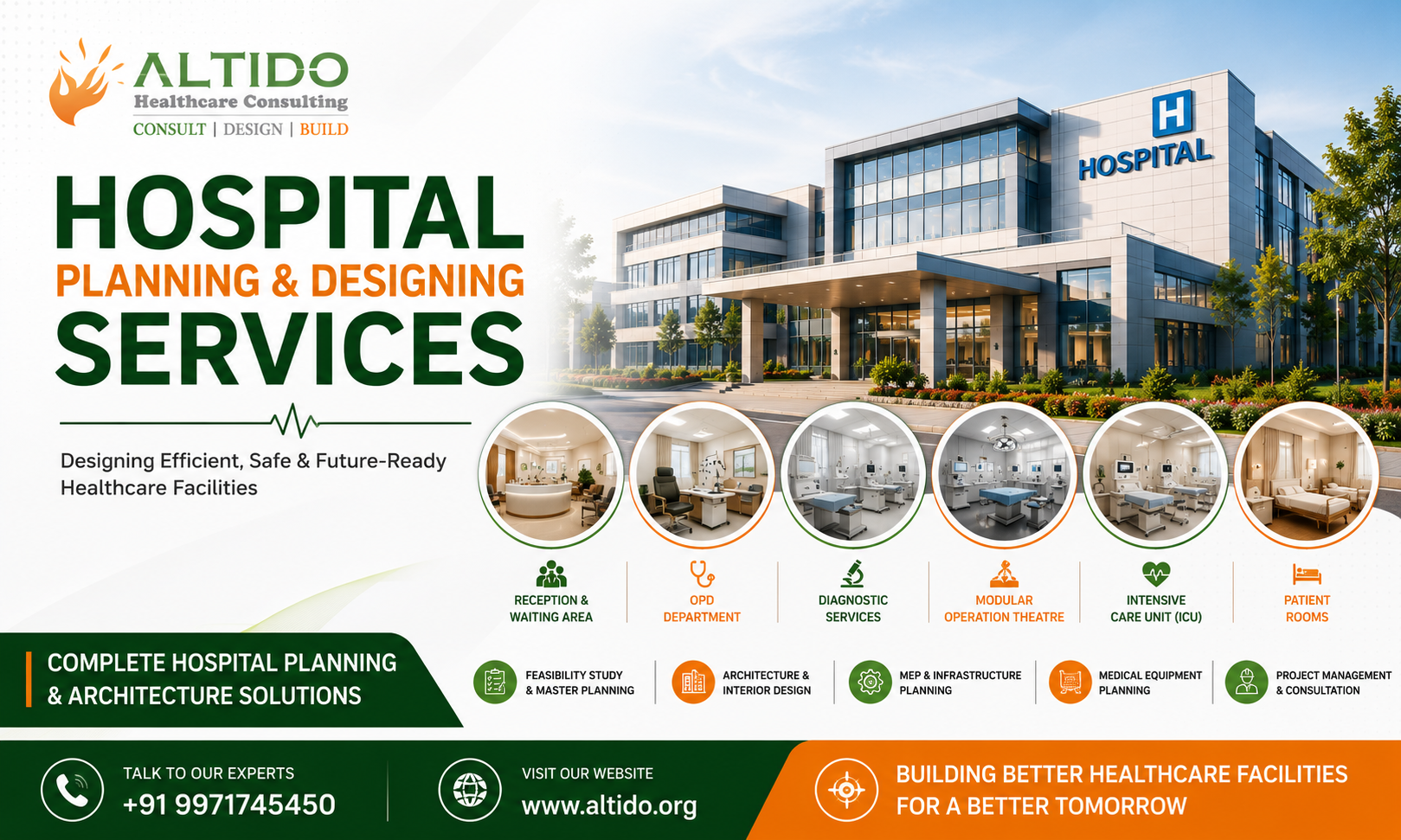
The healthcare industry is continuously evolving with advancements in medical technology, increasing patient expectations, and the growing demand for high-quality healthcare services. Building a successful hospital requires much more than constructing a building; it requires strategic planning, functional design, operational efficiency, and a deep understanding of healthcare workflows.
Professional Hospital Planning & Designing Services play a vital role in developing hospitals that are safe, efficient, patient-friendly, and capable of meeting future healthcare demands.
Altido Healthcare Consulting provides comprehensive hospital planning, healthcare architecture, and infrastructure consulting solutions to help healthcare organizations create modern and sustainable healthcare facilities.
People Also Like to read this: Best Eye Hospital Design Consultant in India | Expert Eye Hospital Architect
What Are Hospital Planning & Designing Services?
Hospital Planning & Designing Services involve the complete process of developing a healthcare facility from concept to completion. It includes analyzing healthcare requirements, creating functional layouts, designing departments, planning medical infrastructure, and ensuring smooth hospital operations.
Hospital planning focuses on:
- Efficient patient flow
- Clinical department coordination
- Space utilization
- Infection control
- Medical equipment planning
- Future expansion
- Patient comfort
A well-planned hospital improves healthcare delivery and creates a better experience for patients and healthcare professionals.
Importance of Hospital Planning Before Construction
Starting a hospital project without proper planning can lead to operational difficulties, increased costs, and inefficient workflows.
Professional hospital planning helps in:
1. Defining Hospital Vision
Every healthcare project has different goals. Planning helps define:
- Type of hospital
- Number of beds
- Medical specialties
- Target patients
- Service offerings
It ensures the hospital design matches the business and healthcare objectives.
2. Optimizing Space Utilization
Hospitals require different spaces for:
- OPD
- Emergency
- ICU
- Operation Theatre
- Diagnostic departments
- Patient rooms
- Administration
- Support services
Hospital planners create layouts that maximize efficiency and avoid unnecessary space wastage.
3. Improving Patient Experience
Modern hospitals focus on patient-centered design.
Good planning includes:
- Comfortable waiting areas
- Easy navigation
- Clear signage
- Accessible facilities
- Stress-free environments
A well-designed hospital helps patients feel safe and comfortable.
Role of Hospital Architects in India
Experienced hospital architects in India understand the complexity of healthcare facilities and design hospitals according to medical, technical, and operational requirements.
Healthcare architects work on:
- Hospital master planning
- Architectural design
- Department layouts
- Interior planning
- Infrastructure coordination
- Safety compliance
Unlike general buildings, hospitals require specialized planning because they involve medical procedures, advanced equipment, and strict safety standards.
Hospital Master Planning Services
Hospital master planning creates a complete roadmap for healthcare development.
It includes:
Site Planning
Site evaluation considers:
- Location
- Accessibility
- Traffic movement
- Parking
- Future expansion
A suitable site ensures smooth hospital operations.
Department Zoning
Hospitals require proper zoning to separate different activities.
Examples:
- Public areas
- Clinical areas
- Restricted areas
- Support areas
Proper zoning improves workflow and infection control.
Hospital Architecture Design Services
Hospital architecture combines functionality, technology, and aesthetics.
Architectural planning includes:
Outpatient Department (OPD)
OPD planning focuses on:
- Consultation rooms
- Waiting areas
- Registration
- Patient movement
Efficient OPD design reduces waiting time.
Emergency Department Planning
Emergency areas require:
- Quick access
- Ambulance entry
- Treatment zones
- Critical care facilities
Proper emergency planning can improve response time.
Operation Theatre Planning
Operation theatres require specialized design for:
- Sterile zones
- Surgical workflow
- Medical equipment
- Infection prevention
A well-designed OT supports safe surgical procedures.
ICU Planning
ICU design requires:
- Patient monitoring
- Medical support systems
- Infection control
- Staff visibility
Planning ensures better patient care and safety.
Medical Equipment Planning
Modern hospitals depend on advanced medical technology.
Hospital planning services include medical equipment coordination for:
- MRI
- CT Scan
- X-Ray
- Ultrasound
- Laboratory equipment
- Surgical systems
Equipment planning ensures:
- Correct room sizes
- Proper electrical requirements
- Smooth installation
- Easy maintenance
MEP and Infrastructure Planning
Mechanical, Electrical, and Plumbing systems are essential for hospital functionality.
Hospital infrastructure planning includes:
HVAC Systems
Healthcare HVAC helps maintain:
- Air quality
- Temperature control
- Infection prevention
Electrical Planning
Includes:
- Power supply
- Backup systems
- Medical equipment support
Plumbing Systems
Includes:
- Water supply
- Drainage
- Medical requirements
Integrated infrastructure planning creates reliable hospital operations.
Infection Control Design in Hospitals
Infection prevention is one of the most important aspects of hospital design.
Planning strategies include:
- Clean and dirty zone separation
- Proper ventilation
- Isolation areas
- Controlled circulation
A well-designed hospital reduces infection risks and improves safety.
Sustainable Hospital Design
Modern healthcare facilities focus on sustainability.
Sustainable hospital design includes:
- Energy-efficient systems
- Natural lighting
- Water conservation
- Eco-friendly materials
Benefits include:
- Reduced operational costs
- Better environmental performance
- Long-term savings
Smart Hospital Planning
Technology is changing the future of healthcare.
Smart hospital planning includes:
- Digital patient management
- Automated systems
- Smart monitoring
- Integrated technology solutions
Future-ready hospitals are designed to adapt to changing healthcare needs.
Why Choose Altido Healthcare Consulting?
Altido Healthcare Consulting provides complete healthcare planning and design solutions for hospitals, clinics, and healthcare facilities.
Our services include:
- Hospital Feasibility Studies
- Hospital Master Planning
- Hospital Architecture Design
- Healthcare Interior Design
- Medical Equipment Planning
- MEP & Infrastructure Planning
- Project Management Consulting
- Healthcare Facility Development
Our team focuses on creating hospitals that are functional, efficient, and patient-centered.
Benefits of Professional Hospital Planning
Choosing expert hospital planning services provides:
Better Workflow
Improves movement of:
- Patients
- Doctors
- Nurses
- Support staff
Cost Control
Proper planning reduces:
- Design changes
- Construction issues
- Operational challenges
Future Expansion
Flexible planning allows hospitals to grow with future requirements.
Future of Hospital Design in India
The future of healthcare architecture will focus on:
- Smart hospitals
- Digital healthcare
- Sustainable buildings
- Advanced patient care
- Flexible infrastructure
Healthcare facilities must be designed to support innovation and changing medical needs.
Conclusion
Professional Hospital Planning & Designing Services are essential for creating successful healthcare facilities. From initial planning to final implementation, expert healthcare consultants and architects ensure that hospitals deliver efficient, safe, and high-quality patient care.
With expertise in healthcare architecture and hospital development, Altido Healthcare Consulting helps healthcare organizations build modern, sustainable, and future-ready hospitals.
Altido Healthcare Consulting – Consult | Design | Build | Manage