
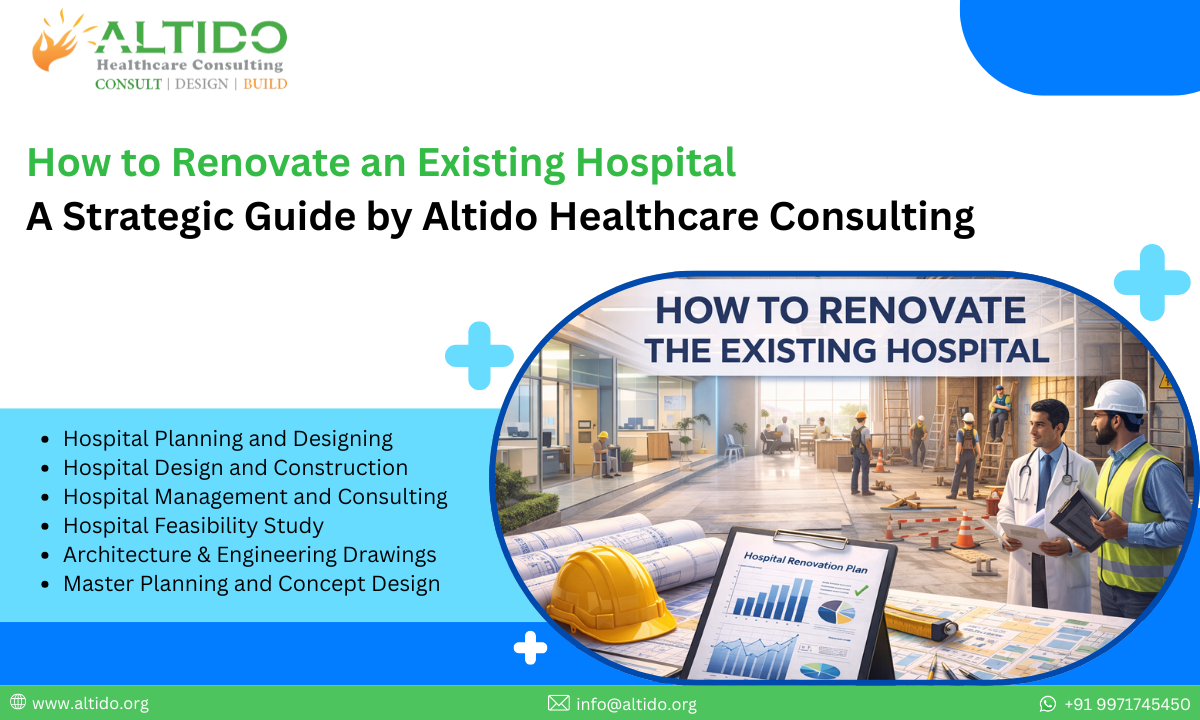
Renovating an existing hospital is a complex but highly rewarding process. With rapidly evolving healthcare technologies, rising patient expectations, and stricter regulatory requirements, hospitals must continuously upgrade their infrastructure to remain efficient, safe, and competitive. Unlike new hospital construction, renovation requires careful planning to minimize disruption to ongoing medical services while improving functionality and patient experience.
At Altido Healthcare Consulting, we specialize in strategic hospital renovation planning that balances clinical efficiency, patient comfort, compliance, and cost-effectiveness. This guide explains how to renovate an existing hospital successfully, step by step.
People Also Like to read this: Feasibility Study in Hospital Planning: A Foundation for Successful Healthcare Projects
1. Understand the Need for Hospital Renovation
The first step in hospital renovation is identifying why renovation is necessary. Common reasons include:
- Aging infrastructure and outdated interiors
- Inefficient department layouts and workflows
- Increased patient load and service expansion
- Compliance gaps with NABH, JCI, or local regulations
- Upgradation of medical equipment and technology
- Improving patient comfort and healing environment
A clear understanding of renovation goals helps define scope, budget, and timelines.
2. Conduct a Detailed Hospital Assessment
Before starting any renovation, a comprehensive assessment of the existing facility is essential. This includes:
Infrastructure Audit
- Structural stability
- Electrical and HVAC systems
- Plumbing and medical gas pipelines
- Fire safety systems
Clinical Workflow Analysis
- Patient movement
- Staff circulation
- Equipment flow
- Emergency access routes
Space Utilization Study
- Underutilized areas
- Congested departments
- Expansion opportunities
Altido Healthcare Consulting conducts detailed hospital audits and gap analyses to ensure renovation decisions are data-driven and practical.
3.Prepare a Phased Renovation Plan
One of the biggest challenges in hospital renovation is continuing operations during construction. A phased renovation approach helps avoid service disruption.
Key Strategies:
- Renovate department-wise or floor-wise
- Shift services temporarily to alternate areas
- Schedule noisy or invasive work during off-peak hours
- Ensure patient and staff safety at all times
Phased planning ensures uninterrupted healthcare delivery while modernization progresses smoothly.
4. Replan Hospital Zoning and Layouts
Outdated hospital layouts often result in inefficiencies and patient dissatisfaction. Renovation is the ideal time to redesign zoning.
Key Zoning Improvements:
- Clear separation of OPD, IPD, diagnostics, and emergency
- Dedicated clean and dirty corridors
- Separate patient, staff, and material circulation
- Improved wayfinding and signage
Optimized zoning reduces cross-infection risks, improves turnaround time, and enhances patient experience.
5.Upgrade Critical Departments First
Renovation should prioritize high-impact and high-risk areas, such as:
- Emergency Department
- Operation Theatres
- ICU and Critical Care Units
- Diagnostics and Imaging
- Infection Control Zones
Upgrading these departments improves safety, efficiency, and clinical outcomes. Altido Healthcare Consulting ensures that all upgrades align with international healthcare design standards.
6. Integrate Modern Medical Technology
Hospital renovation is incomplete without technology integration. This includes:
- New diagnostic and treatment equipment
- Telemedicine infrastructure
- HIS, PACS, and digital record systems
- Smart nurse call and monitoring systems
Renovation plans must accommodate equipment dimensions, power loads, HVAC needs, and workflow integration. Our biomedical planning expertise ensures seamless technology adoption.
7. Focus on Patient-Centric Interior Design
Modern hospitals are no longer just clinical spaces—they are healing environments.
Interior Design Enhancements:
- Natural light and calming color palettes
- Noise reduction materials
- Comfortable waiting areas
- Patient-friendly signage
- Barrier-free accessibility
Patient-centric interiors improve satisfaction, recovery time, and hospital reputation.
8. Ensure Compliance and Safety Standards
Renovation must comply with all applicable regulations and standards, including:
- NABH / JCI guidelines
- Fire and life safety norms
- Infection prevention protocols
- Accessibility standards
- Biomedical waste management rules
Altido Healthcare Consulting ensures that renovation designs meet all statutory and accreditation requirements, reducing future compliance risks.
9. Budgeting and Cost Control
Hospital renovation requires precise financial planning. Key cost components include:
- Civil and interior works
- MEP upgrades
- Equipment relocation or replacement
- Temporary arrangements during renovation
- Contingency provisions
A feasibility-driven renovation plan helps control costs while maximizing return on investment. We assist hospitals in budget planning, cost optimization, and vendor coordination.
10. Project Management and Execution
Effective project management is critical for timely and successful renovation.
Best Practices:
- Appoint a single-point healthcare consultant
- Coordinate architects, engineers, contractors, and hospital teams
- Monitor quality, timelines, and safety compliance
- Conduct regular progress reviews
Altido Healthcare Consulting provides end-to-end hospital renovation project management, ensuring accountability and quality execution.
11. Post-Renovation Evaluation and Optimization
Once renovation is complete, performance evaluation is essential:
- Workflow efficiency review
- Patient and staff feedback
- Equipment performance checks
- Compliance audits
Post-renovation optimization helps hospitals fully realize the benefits of their investment.
Why Choose Altido Healthcare Consulting for Hospital Renovation?
At Altido Healthcare Consulting, we bring a multidisciplinary approach to hospital renovation, combining:
- Healthcare architecture and interior design
- Hospital planning and zoning expertise
- Biomedical and MEP coordination
- Feasibility and financial analysis
- Regulatory and accreditation guidance
Our goal is to transform existing hospitals into efficient, future-ready, patient-centric healthcare facilities without disrupting ongoing operations.
Conclusion
Renovating an existing hospital is not just about upgrading infrastructure—it is about improving care delivery, operational efficiency, and patient experience. With the right planning, expert guidance, and phased execution, hospital renovation can significantly enhance clinical outcomes and business sustainability.
Altido Healthcare Consulting stands as a trusted partner in hospital renovation, helping healthcare providers modernize their facilities with confidence and clarity.