
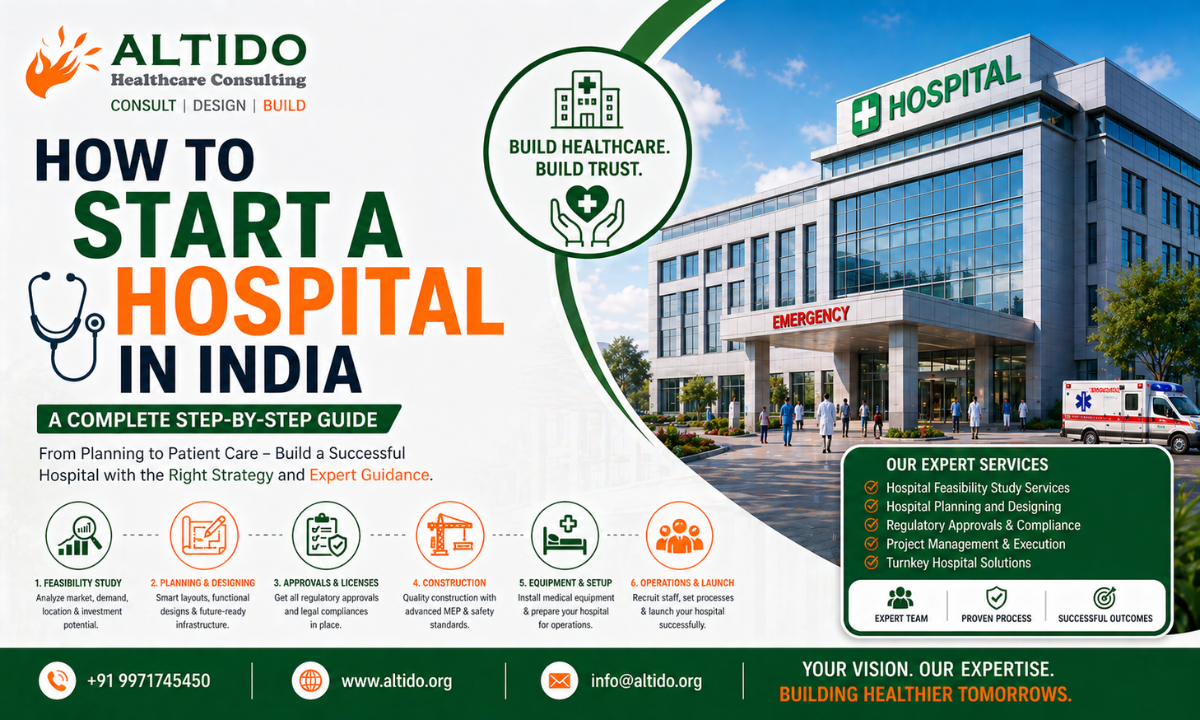
India’s healthcare industry is one of the fastest-growing sectors, driven by increasing population demand, rising health awareness, medical tourism, and the need for quality healthcare infrastructure. For doctors, investors, trusts, and healthcare entrepreneurs, understanding how to start a hospital in India is the first step toward building a successful and sustainable healthcare business.
Starting a hospital is a major investment that requires strategic planning, regulatory approvals, infrastructure development, staffing, and operational readiness. At Altido Healthcare Consulting, we provide end-to-end support in Hospital Planning and Designing, project execution, and Hospital Feasibility Study Consultant services to help clients launch profitable and patient-centric healthcare facilities.
People Also Like to read this: Hospital Construction Company: Building Advanced Healthcare Infrastructure in India
Why Invest in a Hospital in India?
India has a large and growing demand for hospitals due to:
- Increasing urban and rural healthcare needs
- Growth of health insurance coverage
- Rising chronic diseases and lifestyle disorders
- Expansion of medical tourism
- Demand for quality private healthcare
This makes hospital development a strong long-term investment opportunity.
Step 1: Define the Hospital Vision and Model
Before beginning, decide what type of hospital you want to establish.
Options include:
- Multi-specialty hospital
- Super-specialty hospital
- Maternity hospital
- Orthopedic hospital
- Cardiac center
- Cancer hospital
- Day care center
- Diagnostic hospital model
Understanding how to start a hospital in India begins with choosing the right healthcare model based on market demand and budget.
Step 2: Conduct a Hospital Feasibility Study
A hospital project should always begin with a professional feasibility study. This is where a Hospital Feasibility Study Consultant plays a critical role.
A proper feasibility study includes:
- Location analysis
- Demographic study
- Competitor analysis
- Bed strength recommendations
- Revenue projections
- Investment requirement
- Break-even analysis
- Risk assessment
At Altido Healthcare Consulting, our Hospital feasibility study services help investors make confident decisions before investing.
Step 3: Select the Right Location
Location is one of the most important factors in hospital success.
Ideal factors include:
- Good road connectivity
- Population density
- Lack of nearby competition
- Availability of utilities
- Parking space
- Future area growth potential
Choosing the right site significantly impacts patient inflow and long-term profitability.
Step 4: Budget Planning and Funding
Hospital projects require careful financial planning.
Typical cost heads include:
- Land cost
- Civil construction
- Interior works
- Medical equipment
- HVAC / MEP systems
- Licensing & approvals
Recruitment - Pre-opening marketing
- Working capital
Professional Hospital feasibility study services help estimate realistic budgets and funding needs.
Funding options may include:
- Self investment
- Bank loans
- Investor partnerships
- Private equity
- CSR / trust models
Step 5: Hospital Planning and Designing
A hospital must be designed differently from standard commercial buildings. This is why Hospital Planning and Designing is essential.
Important planning areas include:
- OPD flow planning
- Emergency department design
- ICU layout
- Operation theatre planning
- Ward & private room design
- Diagnostics zoning
- Pharmacy & support services
- Infection control pathways
At Altido Healthcare Consulting, we create smart healthcare layouts that improve operations and patient experience.
Step 6: Legal Approvals and Compliance
To understand how to start a hospital in India, legal approvals are mandatory.
Common approvals include:
- Land use approval
- Building sanction plan
- Fire NOC
- Pollution clearance
- Biomedical waste authorization
- Clinical establishment registration
- PNDT license (if applicable)
- Pharmacy license
- Lift and electrical approvals
Working with experts helps speed up approvals and avoid delays.
Step 7: Construction and Engineering
Hospital construction needs technical precision.
Key systems include:
- HVAC systems
- Medical gas pipeline systems
- Fire safety systems
- Electrical backup systems
- Plumbing systems
- Water treatment systems
Professional project management ensures timely completion and quality standards.
Step 8: Medical Equipment Planning
Equipment selection should match the hospital’s specialty and budget.
Examples include:
- ICU equipment
- OT tables and lights
- X-ray / CT / MRI
- Lab equipment
- Beds and furniture
- Nurse call systems
Improper equipment planning can waste capital. Our Hospital feasibility study services align equipment planning with ROI goals.
Step 9: Recruitment and HR Planning
A hospital needs skilled manpower before launch.
Typical hiring includes:
- Doctors and specialists
- Nurses
- Technicians
- Admin staff
- Billing team
- Housekeeping
- Security
Staffing should begin several months before opening.
Step 10: SOPs and Operational Readiness
Before launch, systems must be ready.
We help create:
- Standard operating procedures
- Infection control protocols
- Emergency response systems
- Billing systems
- Patient registration systems
- Clinical workflows
This ensures a smooth start from day one.
Step 11: Branding and Marketing Launch
A new hospital must build trust quickly.
Launch strategies include:
- Brand identity creation
- Website and SEO
- Google Maps listing
- Doctor referral network
- Social media marketing
- Health camps
- Local outreach programs
Marketing is essential when learning how to start a hospital in India successfully.
Why Hire a Hospital Feasibility Study Consultant?
Many hospital projects fail because of wrong planning, poor location, or unrealistic projections.
A professional Hospital Feasibility Study Consultant helps with:
- Data-driven decisions
- Investment clarity
- Reduced financial risk
- Correct bed capacity planning
- Strong launch strategy
Altido Healthcare Consulting provides practical and investor-focused guidance.
Why Choose Altido Healthcare Consulting?
We offer complete support for clients looking to know how to start a hospital in India.
Our Services:
- Hospital feasibility study services
- Hospital Planning and Designing
- Architecture and engineering planning
- Medical equipment planning
- Licensing guidance
- Recruitment support
- Branding and launch strategy
- Commissioning support
We help turn healthcare ideas into profitable operating hospitals.
Common Mistakes to Avoid
When starting a hospital, avoid:
- Wrong location selection
- Overbuilding beyond market demand
- Poor layouts
- Underestimating working capital
- Delayed hiring
- Weak branding
- No feasibility study
These mistakes can be expensive and difficult to fix later.
Conclusion
Understanding how to start a hospital in India requires much more than constructing a building. It requires strategy, planning, compliance, infrastructure, staffing, and financial clarity.
With expert support from Altido Healthcare Consulting, investors and healthcare entrepreneurs can confidently launch successful hospitals. Our expertise in Hospital Planning and Designing, Hospital Feasibility Study Consultant services, and Hospital feasibility study services ensures your project is practical, efficient, and future-ready.
If you are planning to build a healthcare facility, partner with Altido Healthcare Consulting to start strong and grow successfully.