
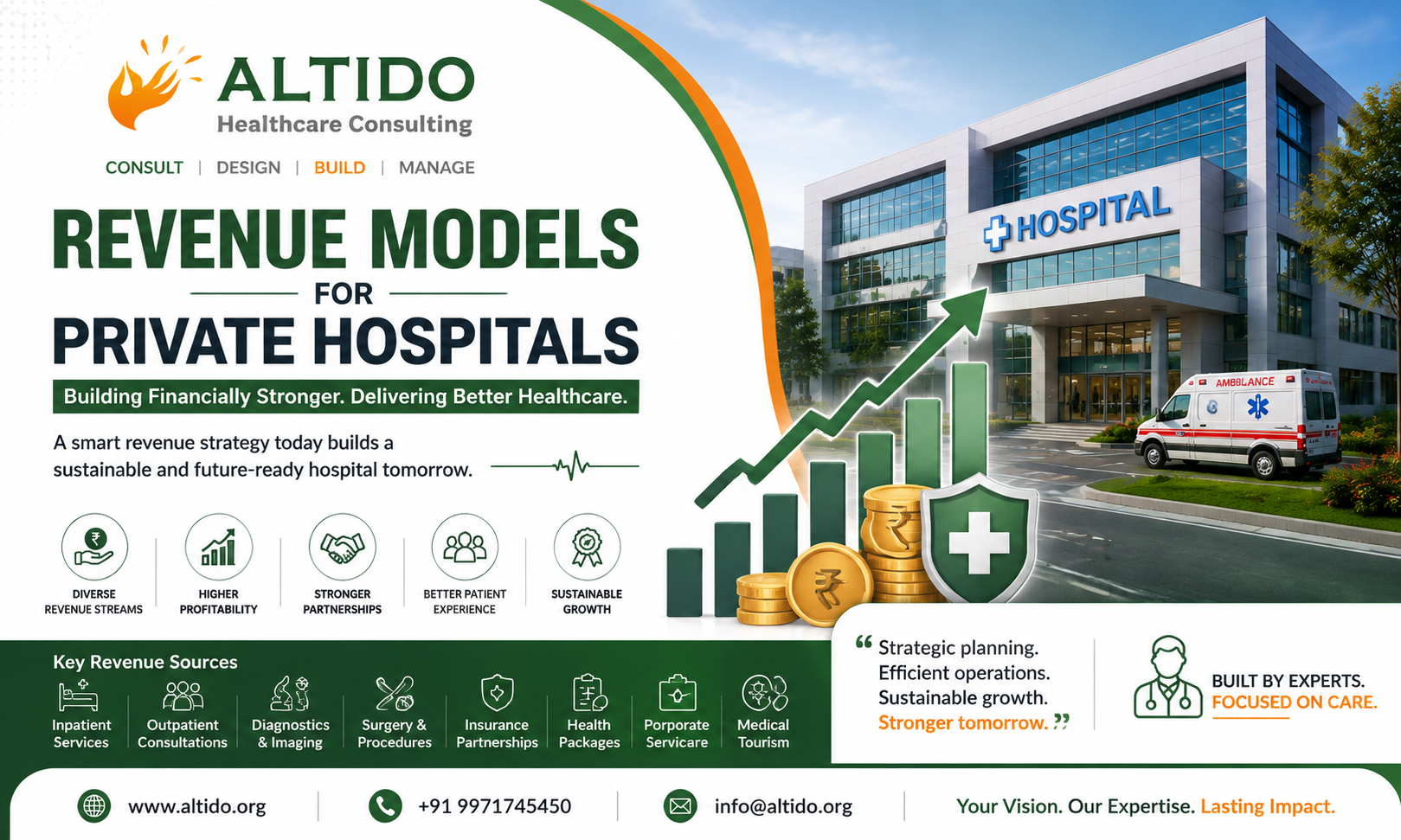
The healthcare industry is continuously evolving, and private hospitals are under increasing pressure to deliver high-quality patient care while maintaining financial sustainability. A successful hospital is not only dependent on clinical excellence but also on an effective revenue strategy that balances patient needs, operational efficiency, and long-term growth.
Developing the right revenue model for private hospitals helps healthcare organizations improve profitability, optimize resources, expand services, and create a strong foundation for future investments.
Altido Healthcare Consulting supports hospitals and healthcare investors with hospital feasibility studies, business planning, financial modeling, hospital planning and design, operational strategies, and healthcare management consultancy to build successful and sustainable healthcare facilities.
People Also Like to read this: Medical Equipment Planning Consultants: The Key to Efficient and Future-Ready Hospitals
Understanding Hospital Revenue Models
A hospital revenue model defines how a healthcare organization generates income through its services, facilities, partnerships, and operational activities.
Private hospitals generally generate revenue from multiple sources, including:
- Inpatient services
- Outpatient consultations
- Diagnostic services
- Surgical procedures
- Emergency care
- Pharmacy services
- Health packages
- Corporate healthcare contracts
- Insurance partnerships
- Specialty centers
- Medical tourism
A diversified revenue model reduces dependency on a single income source and helps hospitals manage financial risks.
Importance of a Strong Revenue Model for Private Hospitals
A well-planned revenue strategy helps hospitals:
- Improve financial stability
- Increase operational efficiency
- Optimize bed utilization
- Expand healthcare services
- Invest in advanced technology
- Improve patient experience
- Support infrastructure development
- Increase profitability
For new hospitals, selecting the right revenue model during the planning stage is critical for achieving sustainable growth.
Key Revenue Models for Private Hospitals
1. Fee-for-Service Model
The fee-for-service model is one of the most common revenue models used by private hospitals.
Under this model, patients pay separately for each healthcare service they receive.
Revenue sources include:
- Doctor consultation fees
- Diagnostic tests
- Surgical procedures
- Room charges
- Pharmacy sales
- Nursing services
- Medical procedures
This model provides flexibility because hospitals can charge based on the complexity and type of services provided.
However, hospitals need efficient billing systems and cost management practices to maintain profitability.
2. Insurance and Third-Party Payer Model
Insurance partnerships are a major revenue source for private hospitals.
Hospitals collaborate with:
- Health insurance companies
- Corporate insurance providers
- Government health schemes
- Third-party administrators
Benefits of insurance-based revenue include:
- Increased patient access
- Higher patient volumes
- Better financial predictability
- Long-term partnerships
3. Package-Based Healthcare Services
Many private hospitals generate revenue through predefined healthcare packages.
Examples include:
- Preventive health checkups
- Executive health packages
- Maternity packages
- Surgery packages
- Wellness programs
- Corporate health packages
Package models encourage patients to choose planned healthcare services and create predictable revenue streams.
4. Specialty Center Revenue Model
Developing specialized centers can significantly increase hospital revenue.
Examples include:
- Cancer care centers
- Cardiac centers
- Spine centers
- Orthopedic centers
- Fertility centers
- Neuroscience centers
- Women’s health centers
- Pediatric centers
Specialty centers attract targeted patient groups and allow hospitals to build expertise in high-demand healthcare areas.
5. Diagnostic and Laboratory Revenue Model
Diagnostic services are an important revenue contributor for private hospitals.
Revenue can come from:
- Pathology tests
- Imaging services
- MRI
- CT scans
- Ultrasound
- Health screening programs
- Laboratory packages
Investing in advanced diagnostic infrastructure can improve patient convenience and increase hospital revenue.
6. Pharmacy Revenue Model
Hospital pharmacies provide another important income stream.
Revenue opportunities include:
- In-house pharmacy
- Specialty medicines
- Discharge medication packages
- Chronic disease medication programs
- Home delivery services
A well-managed pharmacy improves patient convenience while contributing to hospital profitability.
7. Corporate Healthcare Model
Private hospitals can develop partnerships with organizations to provide healthcare services for employees.
Corporate healthcare programs may include:
- Employee health checkups
- Annual medical packages
- Occupational health services
- Wellness programs
- Emergency support agreements
Corporate contracts provide consistent patient flow and recurring revenue opportunities.
8. Medical Tourism Revenue Model
Hospitals located in regions with competitive healthcare costs can generate revenue through medical tourism.
Services may include:
- International patient management
- Travel assistance
- Accommodation support
- Specialized treatments
- International patient coordination
Medical tourism requires strong clinical reputation, quality standards, communication systems, and patient support services.
9. Hospital Franchise and Network Model
Healthcare organizations can expand revenue through hospital networks and franchise models.
Benefits include:
- Brand expansion
- Shared resources
- Standardized operations
- Increased market presence
- Better purchasing power
This model allows healthcare brands to expand without managing every facility independently.
10. Asset-Light Healthcare Models
Modern healthcare organizations are also exploring asset-light revenue models.
Examples include:
- Day-care surgery centers
- Specialty clinics
- Diagnostic centers
- Telemedicine platforms
- Home healthcare services
These models require lower investment compared to large hospitals while creating additional revenue channels.
Factors Affecting Hospital Revenue Generation
Several factors influence the financial performance of a private hospital.
Location and Market Demand
A hospital’s location affects patient demographics, competition, and service demand.
Market research helps determine:
- Target patient groups
- Healthcare gaps
- Competitor analysis
- Specialty opportunities
Bed Capacity and Occupancy
Bed utilization directly impacts hospital revenue.
Important indicators include:
- Bed occupancy rate
- Average length of stay
- Patient turnover
- Admission patterns
Effective capacity planning ensures optimal utilization of hospital resources.
Service Mix Planning
The right combination of specialties can improve revenue performance.
Hospitals should evaluate:
- Local healthcare demand
- Competitive advantages
- Investment requirements
- Revenue potential
- Operational complexity
Operational Efficiency
Revenue growth is closely connected with operational performance.
Hospitals should focus on:
- Reduced waiting times
- Efficient patient flow
- Digital healthcare systems
- Cost control
- Resource optimization
Role of Hospital Business Planning
Before developing a private hospital, investors should prepare a detailed hospital business plan.
A business plan evaluates:
- Investment requirements
- Revenue projections
- Operating expenses
- Staffing requirements
- Equipment investment
- Marketing strategy
- Break-even analysis
- Return on investment
Professional healthcare consultants help investors create realistic financial models based on market conditions.
Technology and Digital Revenue Opportunities
Technology is creating new opportunities for private hospital revenue growth.
Digital healthcare solutions include:
- Telemedicine consultations
- Online appointment systems
- Digital health packages
- Remote monitoring
- Patient engagement platforms
- Electronic medical records
Technology improves accessibility while creating additional service opportunities.
Improving Revenue Through Patient Experience
Patient satisfaction directly influences hospital growth.
Hospitals can improve revenue by focusing on:
- Quality healthcare services
- Shorter waiting times
- Comfortable facilities
- Transparent billing
- Better communication
- Personalized care
Satisfied patients are more likely to return and recommend healthcare services.
Why Choose Altido Healthcare Consulting?
Altido Healthcare Consulting provides comprehensive healthcare consulting solutions for private hospitals, investors, and healthcare organizations.
Our services include:
- Hospital Feasibility Study
- Hospital Business Planning
- Revenue Model Development
- Market Research
- Hospital Planning & Designing
- Healthcare Architecture
- Medical Equipment Planning
- Operational Consulting
- Project Management Consultancy
- Healthcare IT Planning
- Hospital Expansion Planning
- Turnkey Healthcare Solutions
Our expertise helps healthcare organizations develop financially sustainable, operationally efficient, and future-ready hospitals.
Conclusion
A successful private hospital requires more than excellent medical services. A strong and diversified revenue model is essential for long-term financial sustainability and growth.
By combining multiple revenue streams such as clinical services, diagnostics, specialty centers, insurance partnerships, corporate healthcare, and digital solutions, private hospitals can improve profitability while delivering better patient care.
Strategic planning, efficient operations, and expert healthcare consultancy play a vital role in building successful healthcare organizations.
Altido Healthcare Consulting helps healthcare investors and hospital owners transform ideas into successful healthcare projects through strategic planning, design, management, and operational expertise.
Altido Healthcare Consulting
Consult | Design | Build | Manage