
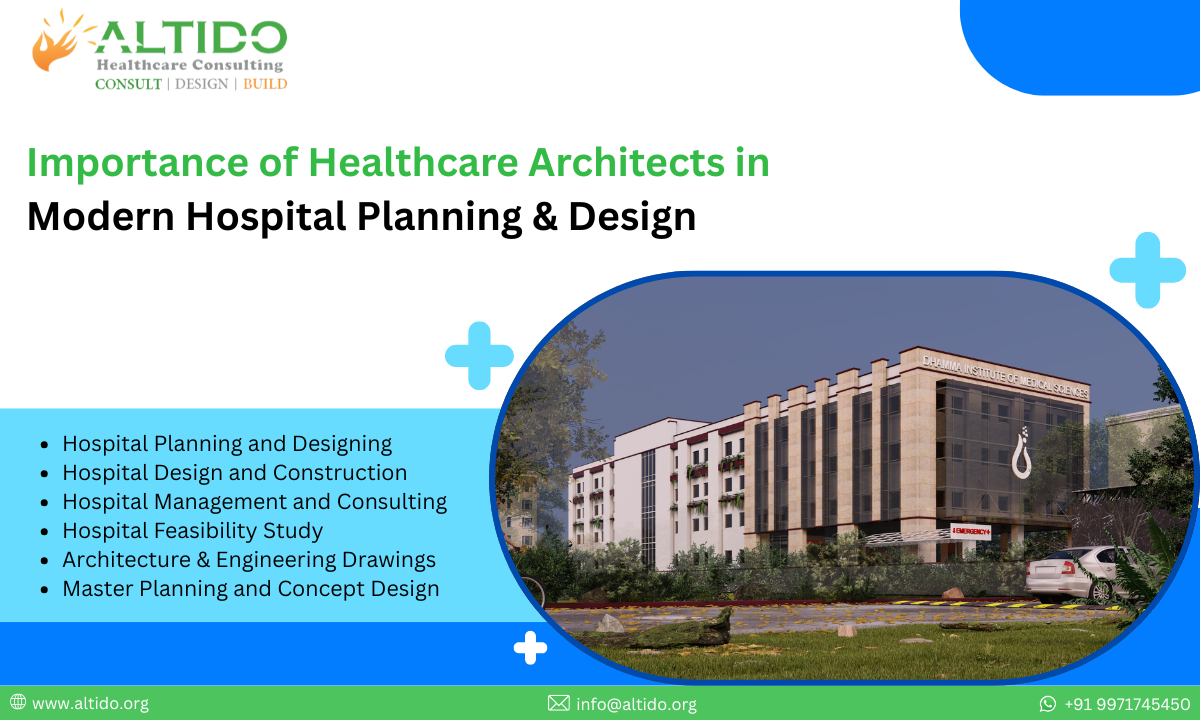
Healthcare facilities are among the most complex building types, requiring a perfect balance of clinical functionality, patient comfort, regulatory compliance, and operational efficiency. At the center of this complexity stands the healthcare architect—a specialist professional responsible for transforming medical requirements into efficient, safe, and future-ready hospital environments.
At Altido Healthcare Consulting LLP, healthcare architects play a pivotal role in planning and designing hospitals that support quality patient care while ensuring long-term operational sustainability. This blog explores the critical role healthcare architects play throughout the hospital planning and design process.
People Also Like to read this: From Blueprint to Beds: Hospital Design and Planning Essentials
Understanding the Role of a Healthcare Architect
A healthcare architect is not just a designer of buildings but a strategic partner in healthcare infrastructure development. Unlike conventional architects, healthcare architects possess deep knowledge of medical workflows, infection control, equipment integration, and healthcare regulations.
Their role spans across:
- Strategic planning
- Medical and functional zoning
- Architectural and engineering coordination
- Regulatory compliance
- Patient-centric design
Step 1: Strategic Planning & Vision Alignment
The healthcare architect begins by understanding the project vision, clinical objectives, and long-term goals of hospital promoters. This stage involves close collaboration with doctors, administrators, and investors.
Key responsibilities include:
- Interpreting healthcare delivery models
- Aligning architecture with business strategy
- Supporting hospital feasibility studies
- Planning for future growth and scalability
At Altido Healthcare Consulting LLP, this strategic alignment ensures hospitals are clinically effective and financially viable.
Step 2: Hospital Master Planning
Master planning is the backbone of hospital planning and designing. Healthcare architects develop comprehensive master plans that organize the entire hospital site logically and efficiently.
Master planning includes:
- Land utilization and zoning
- Patient, staff, and service circulation
- Emergency and critical care access
- Infection control zoning
- Future expansion planning
Effective master planning minimizes operational bottlenecks and enhances patient safety.
Step 3: Medical Planning & Functional Zoning
Medical planning is a core responsibility of healthcare architects. It involves organizing departments based on clinical relationships and patient flow.
Key aspects include:
- OPD, IPD, ICU, OT, and diagnostic layouts
- Adjacency planning between departments
- Optimized patient and staff movement
- Equipment-driven space planning
Healthcare architects at Altido Healthcare Consulting LLP ensure that hospital layouts support efficient workflows and reduce patient waiting times.
Step 4: Architectural Design & Compliance
Healthcare architects translate medical plans into architectural designs that comply with statutory requirements and accreditation standards.
This stage covers:
- Space planning and room sizing
- Building codes and local bylaws
- NABH, NABL, and fire safety compliance
- Universal accessibility standards
Compliance-driven design reduces approval delays and operational risks.
Step 5: Engineering Coordination (MEP Integration)
Hospitals depend heavily on engineering systems for uninterrupted operations. Healthcare architects coordinate closely with engineering teams to integrate:
- HVAC systems for infection control
- Electrical systems and backup power
- Plumbing and drainage systems
- Medical Gas Pipeline Systems (MGPS)
- Fire detection and suppression systems
Early coordination prevents design conflicts and costly modifications during construction.
Step 6: Interior Design for Healing Environments
Interior design plays a significant role in patient recovery and staff well-being. Healthcare architects ensure interiors are both functional and therapeutic.
Interior planning focuses on:
- Infection-resistant materials
- Comfort-focused lighting and acoustics
- Clear wayfinding and signage
- Ergonomic furniture and finishes
At Altido Healthcare Consulting LLP, interior design aligns aesthetics with clinical performance.
Step 7: Equipment Planning & Technology Integration
Modern hospitals are technology-driven. Healthcare architects collaborate with biomedical engineers to integrate medical equipment seamlessly into architectural designs.
Responsibilities include:
- Equipment layout planning
- Load and utility coordination
- Radiation safety planning
- Future technology adaptability
This ensures smooth equipment installation and efficient hospital operations.
Step 8: Project Management & Turnkey Support
In turnkey hospital projects, healthcare architects work closely with project management teams to ensure design intent is maintained during execution.
Key contributions include:
- Design coordination during construction
- Site inspections and quality checks
- Resolution of design-related issues
- Support during commissioning and handover
Altido Healthcare Consulting LLP provides integrated project management support to deliver hospitals on time and within budget.
Step 9: Commissioning & Operational Readiness
The healthcare architect’s role continues until the hospital becomes operational. During commissioning, architects assist in:
- Final layout verificatio
- System testing coordination
- Regulatory approvals
- Operational readiness planning
This ensures a smooth transition from construction to patient care.
The Future Role of Healthcare Architects
As healthcare evolves, so does the role of healthcare architects. Emerging trends include:
- Smart hospitals and digital integration
- Sustainable and green healthcare design
- Modular and flexible infrastructure
- Patient-centric and wellness-focused environments
Healthcare architects are shaping the future of hospitals by integrating innovation with human-centered design.
Why Choose Altido Healthcare Consulting LLP?
Altido Healthcare Consulting LLP is a leading healthcare consultancy firm specializing in hospital planning and designing. Our healthcare architects bring:
- Deep domain expertise
- Multidisciplinary coordination
- Compliance-driven design
- Turnkey project experience
With projects delivered across India and internationally, Altido is trusted for creating efficient, patient-focused, and future-ready hospitals.
Conclusion
The role of a healthcare architect in planning and designing hospitals is fundamental to the success of any healthcare project. From strategic planning to commissioning, healthcare architects ensure that hospitals are safe, efficient, compliant, and adaptable to future needs.
At Altido Healthcare Consulting LLP, our healthcare architects combine medical insight, architectural excellence, and project execution expertise to deliver hospitals that truly serve patients, clinicians, and communities.
Consult | Design | Build – Transforming healthcare infrastructure with purpose.