
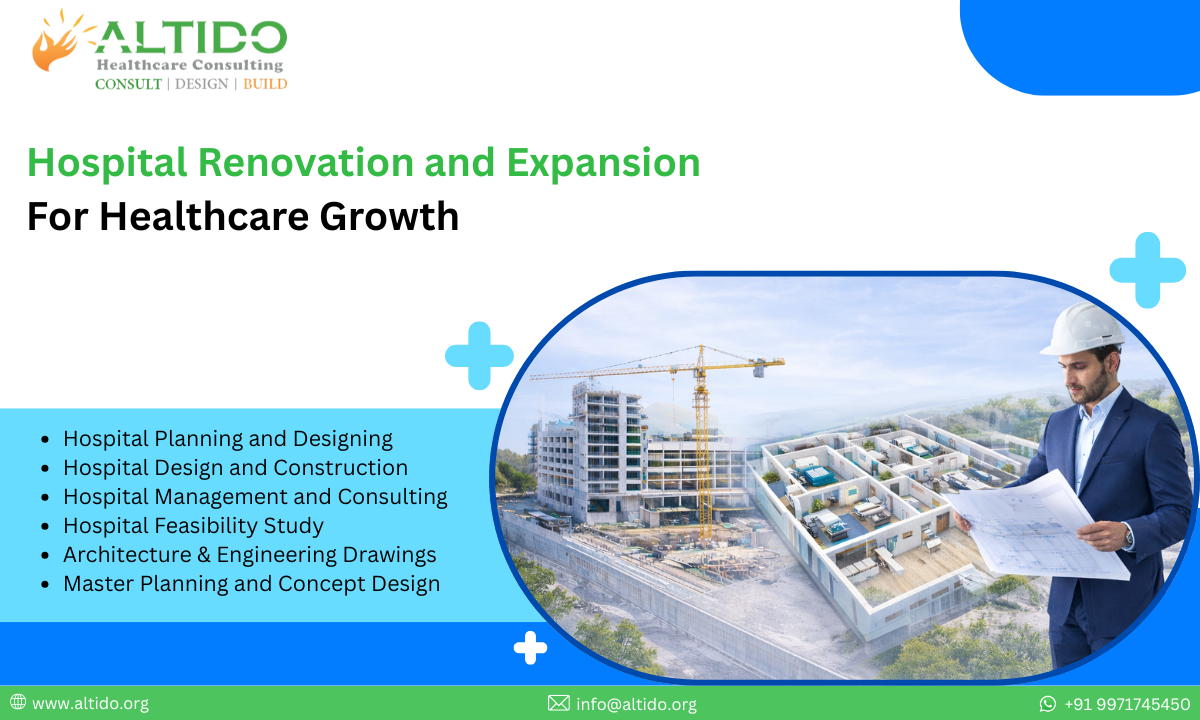
Healthcare facilities today face increasing pressure to grow—driven by rising patient volumes, advancements in medical technology, regulatory changes, and evolving patient expectations. For many hospitals, renovation and expansion are not optional but essential strategies to remain competitive, compliant, and future-ready.
However, hospital renovation and expansion projects are complex. They must balance clinical continuity, patient safety, regulatory compliance, cost control, and long-term strategic goals. At Altido Healthcare Consulting, we specialize in guiding hospitals through structured, phased, and sustainable growth strategies that minimize disruption while maximizing value.
This article explores key strategies for successfully managing hospital renovation and expansion projects.
People Also Like to read this: Best Architects in India for Hospital Design: Creating Future-Ready Healthcare Facilities
Understanding the Need for Renovation and Expansion
Hospitals typically pursue renovation or expansion due to:
- Increased patient load and service demand
- Introduction of new specialties or advanced medical equipment
- Aging infrastructure and outdated layouts
- Compliance with NABH, JCI, or local regulatory standards
- Need for improved patient experience and operational efficiency
Renovation focuses on upgrading existing spaces, while expansion adds new built-up areas, floors, or blocks. Often, hospitals require a hybrid approach combining both.
Strategic Planning: The Foundation of Successful Growth
Every successful hospital expansion begins with strategic planning. Without a clear roadmap, projects risk cost overruns, workflow inefficiencies, and regulatory setbacks.
Key Planning Components:
- Demand analysis & service mix planning
- Bed capacity and department sizing
- Future growth projections (5–10 years)
- Clinical workflow optimization
- Financial feasibility and ROI analysis
Altido Healthcare Consulting conducts detailed hospital feasibility studies and master planning to ensure that expansion aligns with both current needs and long-term vision.
Phased Development to Minimize Disruption
One of the biggest challenges in hospital renovation is continuing operations during construction. Poor planning can disrupt patient care, staff workflows, and emergency services.
Best Practices:
- Implement phased renovation plans
- Separate construction zones from patient areas
- Schedule high-impact work during off-peak hours
- Maintain clear wayfinding and safety signage
- Ensure infection control protocols during construction
A phased approach allows hospitals to remain fully functional while gradually upgrading or expanding infrastructure.
Optimizing Space Through Smart Design
Expansion is not always about adding more square footage. Many hospitals can significantly improve capacity and efficiency through intelligent space reconfiguration.
Design Strategies:
- Reorganizing OPDs for better patient flow
- Creating modular wards and ICUs
- Centralizing diagnostics for faster turnaroun
- Improving vertical and horizontal circulation
- Enhancing staff support and back-of-house areas
At Altido, we focus on evidence-based hospital design, ensuring that every square meter supports clinical efficiency and patient comfort.
Integrating Technology and Future-Ready Infrastructure
Hospital expansion is the ideal time to integrate modern medical technology and digital systems.
Key Considerations:
- Medical equipment planning and room sizing
- IT and HIS integration
- Telemedicine and digital health readiness
- Smart building systems (HVAC, lighting, access control)
- Energy-efficient and sustainable design solutions
Future-ready hospitals are designed to adapt easily to new technologies without major structural changes.
Regulatory Compliance and Accreditation Readiness
Renovation and expansion projects must comply with multiple regulations, including:
- NABH / JCI guidelines
- Fire and life safety norms
- Local building and zoning regulation
- Biomedical waste management standards
- Accessibility and patient safety codes
Non-compliance can delay licensing, increase costs, or restrict operations. Altido Healthcare Consulting ensures design-to-compliance alignment from concept to execution, reducing approval risks.
Financial Planning and Cost Control
Hospital expansion is a significant capital investment. Without proper financial planning, projects can strain cash flow and delay returns.
Financial Strategies:
- Capital budgeting and cost benchmarking
- Phased investment planning
- Value engineering without compromising quality
- Opex optimization through efficient layouts
- Vendor and contractor coordination
A well-planned expansion improves operational efficiency, leading to higher occupancy, better throughput, and long-term financial sustainability.
Stakeholder Coordination and Change Management
Successful hospital expansion requires alignment among multiple stakeholders:
- Hospital promoters and management
- Doctors and clinical teams
- Nursing and support staff
- Architects, engineers, and contractors
- Regulatory authorities
Change management is critical. Staff must be trained and prepared for new layouts, workflows, and technologies. Clear communication helps reduce resistance and ensures smooth transitions.
Altido acts as a single-point healthcare consulting partner, coordinating between stakeholders to keep projects on track.
Sustainability and Patient-Centric Design
Modern hospital expansion is no longer just about size—it’s about quality, sustainability, and patient experience.
Focus Areas:
- Natural light and healing environments
- Noise control and privacy
- Efficient HVAC and energy systems
- Green building practices
- Improved waiting areas and patient amenities
Patient-centric design improves satisfaction, clinical outcomes, and brand perception.
Post-Expansion Evaluation and Continuous Improvement
Expansion does not end with construction completion. Hospitals should evaluate:
- Workflow efficiency
- Patient turnaround times
- Staff productivity
- Utility and maintenance costs
- Patient feedback and satisfaction
Continuous monitoring allows hospitals to fine-tune operations and fully realize the benefits of expansion.
How Altido Healthcare Consulting Supports Hospital Growth
At Altido Healthcare Consulting, we provide end-to-end hospital planning, renovation, and expansion consulting, including:
- Hospital feasibility studies
- Master planning and concept design
- Architecture & engineering coordination
- Medical equipment planning
- Regulatory and accreditation alignment
- Project monitoring and advisory
Our holistic approach ensures that hospital expansion is strategic, compliant, cost-effective, and future-ready.
Conclusion
Hospital renovation and expansion are critical steps in managing growth in today’s evolving healthcare landscape. With the right strategy, expert planning, and phased execution, hospitals can expand capacity, enhance care quality, and improve financial performance—without disrupting ongoing operations.
Partnering with experienced healthcare consultants like Altido Healthcare Consulting ensures that growth is not just bigger, but smarter and more sustainable.