
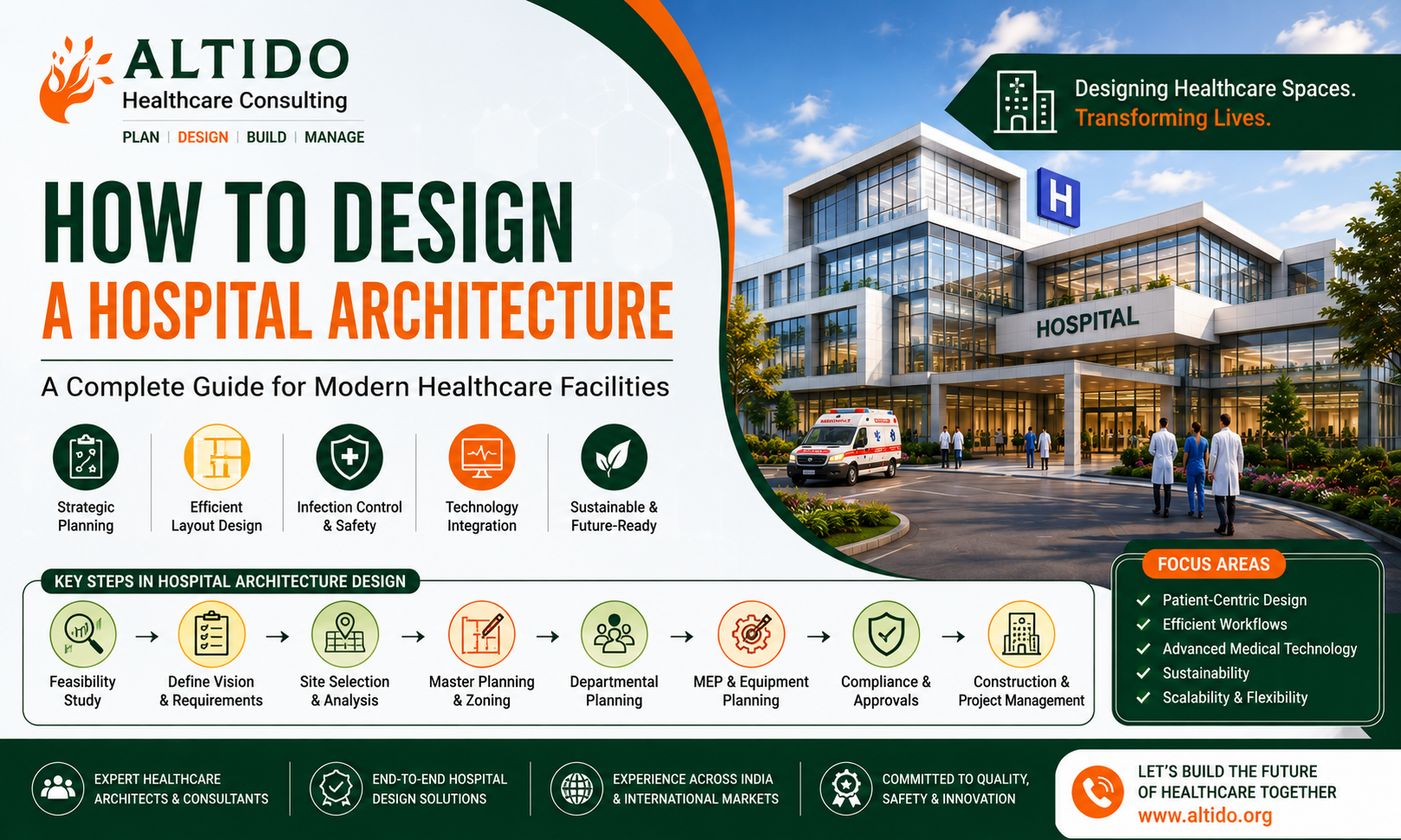
Designing a hospital is one of the most complex and specialized areas of architecture. Unlike commercial or residential buildings, hospitals must accommodate patient care, advanced medical technologies, healthcare workflows, infection control measures, and future expansion requirements—all while creating safe and healing environments.
A well-designed hospital improves patient outcomes, enhances staff efficiency, optimizes operational workflows, and ensures long-term sustainability. As a leading healthcare consulting and design firm, Altido Healthcare Consulting specializes in creating modern, future-ready healthcare facilities that meet international healthcare standards.
This guide explains the key steps involved in designing hospital architecture and highlights the essential factors that contribute to successful healthcare infrastructure development.
People Also Like to read this: Why Altido Healthcare is One of the Best Hospital Architecture Companies in India
Understanding Hospital Architecture
Hospital architecture is the process of planning, designing, and developing healthcare facilities that support efficient medical services and patient-centered care.
Modern hospital architecture focuses on:
- Patient safety and comfort
- Efficient clinical workflows
- Medical technology integration
- Infection control
- Sustainability
- Regulatory compliance
- Future scalability
Every design decision directly impacts healthcare delivery and operational performance.
Step 1: Conduct a Hospital Feasibility Study
The first step in hospital architecture design is conducting a comprehensive feasibility study.
A feasibility study helps determine:
- Healthcare demand in the region
- Target patient population
- Competitive healthcare landscape
- Investment requirements
- Revenue potential
- Project viability
A detailed feasibility analysis ensures informed decision-making before development begins.
Key Components
- Market assessment
- Demographic analysis
- Service planning
- Financial projections
- Risk assessment
This phase lays the foundation for a successful healthcare project.
Step 2: Define the Hospital Vision and Objectives
Every healthcare project should begin with clear goals.
Hospital owners and stakeholders must identify:
- Type of healthcare facility
- Number of beds
- Medical specialties
- Target patient groups
- Future expansion plans
Examples include:
- Multispeciality hospitals
- Super-speciality hospitals
- Mother and child hospitals
- Cancer hospitals
- Diagnostic centers
Clearly defined objectives guide the entire planning and design process.
Step 3: Select the Right Site
Site selection significantly impacts hospital operations and accessibility.
Important factors include:
Accessibility
The hospital should be easily accessible by:
- Public transportation
- Ambulances
- Private vehicles
Infrastructure Availability
Access to:
- Water supply
- Electricity
- Sewerage systems
- Telecommunications
is essential for smooth hospital operations.
Expansion Potential
Future growth should always be considered during site selection.
A strategically chosen site supports long-term development.
Step 4: Develop a Hospital Master Plan
Master planning creates a blueprint for the entire healthcare campus.
The master plan includes:
- Building placement
- Departmental zoning
- Road networks
- Utility infrastructure
- Parking facilities
- Future expansion areas
A well-developed master plan ensures operational efficiency and flexibility.
Step 5: Plan Clinical Departments
Departmental planning is one of the most important aspects of hospital architecture.
Each department has unique functional requirements.
Outpatient Department (OPD)
The OPD should provide:
- Easy patient access
- Efficient registration processes
- Comfortable waiting areas
- Convenient consultation rooms
Emergency Department
Emergency facilities require:
- Dedicated ambulance access
- Trauma care areas
- Rapid patient movement
- Immediate treatment capabilities
Inpatient Wards
Patient wards should focus on:
- Privacy
- Comfort
- Infection prevention
- Accessibility
Intensive Care Units (ICU)
ICUs require:
- Continuous patient monitoring
- Specialized infrastructure
- Controlled environments
Efficient departmental planning enhances healthcare delivery.
Step 6: Optimize Patient and Staff Flow
Hospital design should minimize unnecessary movement while improving operational efficiency.
Separate circulation pathways should be provided for:
- Patients
- Doctors
- Nurses
- Visitors
- Supplies
- Biomedical waste
Proper circulation planning reduces congestion and supports infection control.
Step 7: Design for Infection Control
Infection prevention is a critical consideration in hospital architecture.
Design strategies include:
- Isolation rooms
- Sterile zones
- Controlled airflows
- Touchless technologies
- Dedicated waste routes
Modern healthcare facilities incorporate infection control measures throughout the design process.
Step 8: Integrate Medical Equipment Planning
Hospitals rely on advanced medical technologies that require careful planning.
Medical equipment planning includes:
- Space allocation
- Structural support requirements
- Utility connections
- Workflow coordination
Equipment such as MRI, CT scanners, cath labs, and radiotherapy systems often require specialized infrastructure.
Early coordination prevents costly modifications later.
Step 9: Plan Mechanical, Electrical, and Plumbing Systems
MEP systems form the backbone of healthcare infrastructure.
Mechanical Systems
Include:
- HVAC systems
- Ventilation
- Air filtration
Healthcare facilities require precise temperature and air quality control.
Electrical Systems
Must support:
- Critical care equipment
- Emergency backup systems
- Lighting systems
- IT infrastructure
Plumbing Systems
Include:
- Water supply
- Drainage systems
- Medical gas networks
Integrated MEP planning ensures reliable operations.
Step 10: Focus on Patient-Centered Design
Modern hospitals prioritize patient comfort and healing.
Patient-centered design elements include:
- Natural daylight
- Green spaces
- Comfortable interiors
- Noise reduction
- Intuitive wayfinding
These features create positive healthcare experiences and contribute to better recovery outcomes.
Step 11: Incorporate Smart Hospital Technologies
Digital transformation is reshaping healthcare infrastructure.
Modern hospitals increasingly integrate:
- Electronic Medical Records (EMR)
- Telemedicine systems
- Smart building controls
- Digital patient monitoring
- Automated facility management
Technology-ready infrastructure supports future healthcare innovation.
Step 12: Design Sustainable Healthcare Facilities
Sustainability is becoming a major priority in healthcare architecture.
Green design strategies include:
- Energy-efficient HVAC systems
- Solar energy integration
- Water conservation systems
- Sustainable building materials
- Waste management solutions
Sustainable hospitals reduce operating costs and environmental impact.
Step 13: Ensure Regulatory Compliance
Healthcare facilities must comply with various regulations and standards.
These may include:
- NABH guidelines
- Fire safety standards
- Building codes
- Accessibility regulations
- Infection control standards
Compliance ensures safety and operational excellence.
Step 14: Future-Proof the Hospital Design
Healthcare demands continue to evolve rapidly.
Future-ready hospitals should allow:
- Service expansion
- Technology upgrades
- Capacity growth
- Flexible departmental layouts
Designing for future adaptability protects long-term investments.
Common Challenges in Hospital Architecture
Hospital projects often face challenges such as:
- Budget constraints
- Complex clinical requirements
- Technology integration
- Regulatory compliance
- Operational workflow planning
Working with experienced healthcare consultants helps overcome these challenges efficiently.
Why Professional Healthcare Consultants Matter
Designing a hospital requires specialized expertise that goes beyond conventional architecture.
Professional healthcare consultants provide:
- Strategic planning
- Clinical workflow analysis
- Healthcare design expertise
- Engineering coordination
- Project management support
This integrated approach improves project outcomes and minimizes risks.
Why Choose Altido Healthcare Consulting?
Altido Healthcare Consulting offers comprehensive healthcare planning and design solutions tailored to modern healthcare requirements.
Our services include:
- Hospital Feasibility Studies
- Healthcare Master Planning
- Hospital Architecture Design
- Interior Design
- Medical Equipment Planning
- MEP Engineering
- Turnkey Hospital Consulting
With extensive experience across India, the Middle East, and Africa, Altido delivers innovative healthcare infrastructure solutions that support clinical excellence and long-term growth.
Conclusion
Designing a hospital architecture requires careful planning, technical expertise, and a deep understanding of healthcare operations. From feasibility studies and master planning to medical equipment integration and sustainable design, every step contributes to the success of the healthcare facility.
By partnering with experienced healthcare consultants such as Altido Healthcare Consulting, healthcare providers can create future-ready hospitals that improve patient care, enhance operational efficiency, and support long-term healthcare excellence.
A well-designed hospital is not just a building—it is a foundation for better healthcare delivery and healthier communities.