
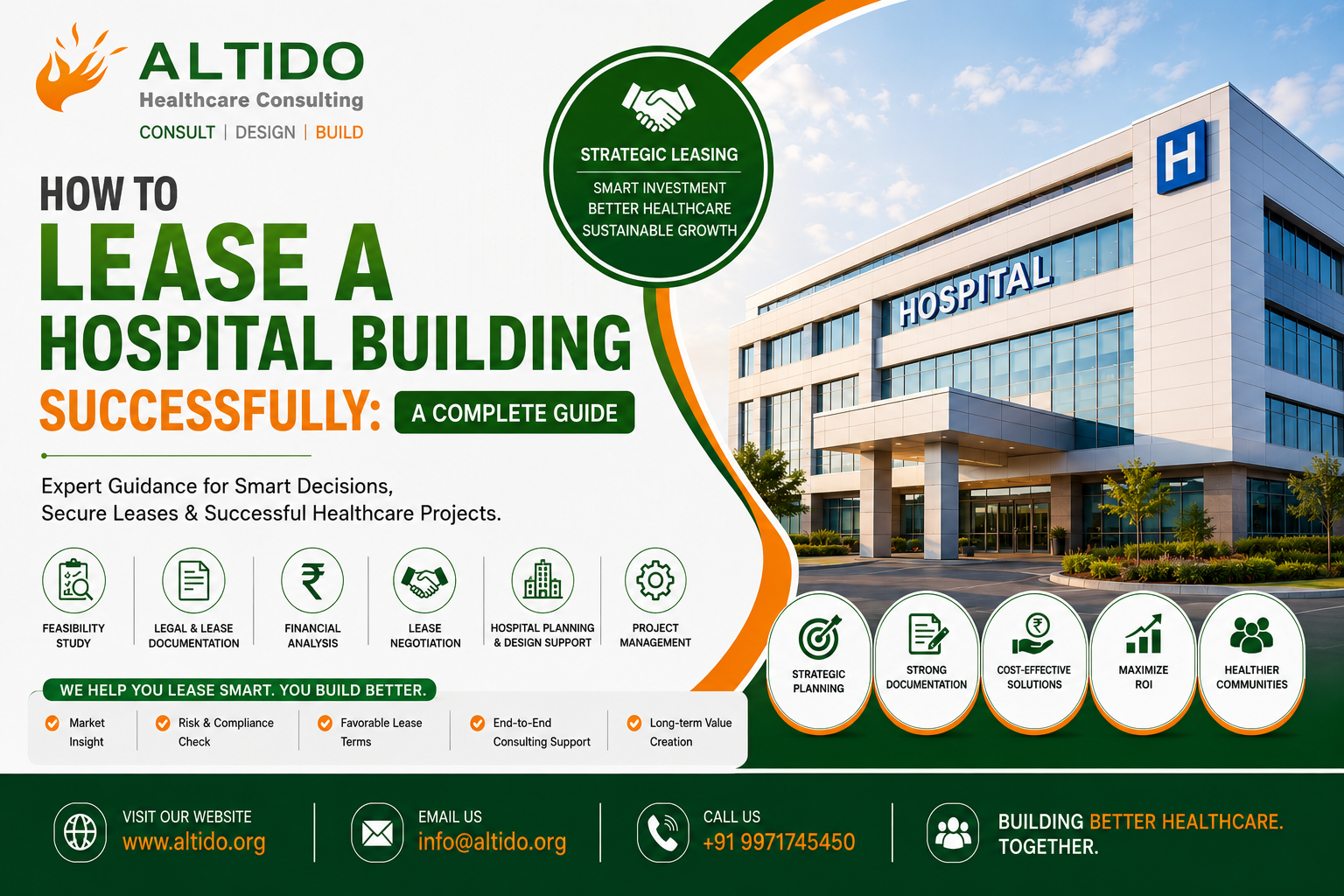
Leasing a hospital building can be an attractive option for healthcare investors, hospital operators, doctors, and healthcare organizations that want to establish a new facility without purchasing land and constructing an entire building from the beginning. However, leasing a healthcare facility is significantly more complex than leasing a conventional commercial property.
A hospital building must support clinical operations, medical equipment, infection control, patient safety, emergency services, engineering systems, regulatory requirements, and future expansion. Therefore, before signing a lease agreement, the property should be evaluated from technical, financial, operational, legal, and healthcare planning perspectives.
At Altido Healthcare Consulting, we support healthcare investors and operators with hospital feasibility studies, hospital planning and design, healthcare architecture, medical equipment planning, project documentation, and project management. Our expertise can help organizations evaluate whether a leased hospital property is suitable for their intended healthcare operations.
People Also Like to read this: How to Finance a New Hospital Project: A Complete Guide for Investors
What Does Leasing a Hospital Building Mean?
Leasing a hospital building involves taking an existing healthcare facility or suitable building on a contractual lease arrangement for a defined period.
Depending on the property, the building may already have:
- Patient rooms
- Operation theatres
- ICU areas
- OPD departments
- Diagnostic facilities
- Emergency department
- Medical gas systems
- HVAC systems
- Electrical infrastructure
- Fire safety systems
However, an existing building does not automatically mean it is ready for hospital operations. A detailed technical and functional assessment is essential before entering into a long-term agreement.
Why Lease a Hospital Building?
Leasing can provide several advantages compared with developing a hospital from scratch.
Faster Project Start
An existing building can potentially reduce the time required for construction and initial development.
Lower Initial Capital Requirement
Instead of purchasing land and constructing a complete facility, the operator can allocate capital toward:
- Medical equipment
- Interior modifications
- Technology
- Staffing
- Marketing
- Working capital
Existing Infrastructure
Some leased facilities may already contain essential infrastructure, reducing the amount of new development required.
Strategic Location
Leased hospital properties may be available in established locations with:
- Strong patient catchments
- Road connectivity
- Public transportation
- Nearby residential communities
- Existing healthcare ecosystems
Step 1: Conduct a Hospital Feasibility Study
Before signing a lease, conduct a detailed hospital feasibility study.
The study should evaluate:
- Local healthcare demand
- Population demographics
- Competitor hospitals
- Specialty requirements
- Patient catchment
- Expected patient volumes
- Bed capacity
- Revenue potential
- Operating expenses
- Investment requirements
This helps determine whether the hospital business model is commercially viable.
A property may appear attractive from a real-estate perspective but may not be financially suitable for healthcare operations.
Step 2: Evaluate the Hospital Building
A comprehensive technical assessment should be performed before finalizing the lease.
The assessment should cover:
Building Structure
Check:
- Structural condition
- Floor loading capacity
- Building age
- Vertical expansion possibilities
- Seismic considerations where applicable
Floor Planning
Evaluate:
- Department sizes
- Circulation
- Patient movement
- Staff movement
- Public circulation
- Service circulation
Engineering Infrastructure
Review:
- Electrical capacity
- HVAC systems
- Plumbing
- Water supply
- Drainage
- Medical gases
- Backup power
- Fire protection
Healthcare Infrastructure
Assess the suitability of:
- Operation theatres
- ICU
- Emergency
- Radiology
- Laboratory
- Pharmacy
- CSSD
- Inpatient departments
Step 3: Assess Regulatory and Approval Requirements
Healthcare facilities have specific regulatory requirements. The leased property should be assessed against applicable local and national regulations before the lease is finalized.
Depending on the facility and location, requirements may include:
- Building approvals
- Fire safety approvals
- Biomedical waste management
- Pollution control requirements
- Clinical establishment registration
- Pharmacy licensing
- Diagnostic laboratory requirements
- Medical gas safety
Accessibility requirements
The exact approvals vary by state, facility type, and services offered.
A consultant can help identify potential compliance gaps before the operator commits to the property.
Step 4: Review the Lease Agreement Carefully
The lease agreement is one of the most important parts of the project.
Healthcare operators should carefully review:
- Lease tenure
- Rent structure
- Security deposit
- Escalation clauses
- Renewal options
- Lock-in period
- Maintenance responsibilities
- Property tax responsibilities
- Insurance responsibilities
- Repair obligations
- Renovation permissions
- Signage rights
- Parking rights
- Exit conditions
The agreement should clearly establish who is responsible for modifications required for hospital operations.
Step 5: Calculate the Total Hospital Investment
The lease rent is only one component of the total project cost.
The operator should consider:
- Security deposit
- Advance rent
- Interior modifications
- Civil works
- MEP modifications
- Medical equipment
- Furniture
- IT infrastructure
- Hospital information systems
- Licensing and approvals
- Pre-opening expenses
- Recruitment
- Marketing
- Working capital
A detailed financial model can help determine whether the project remains viable after all these expenses.
Step 6: Plan the Hospital Layout
A leased building may not have been originally designed for the proposed healthcare services.
Therefore, a Hospital Planning and Designing Consultant should assess whether the building can be adapted efficiently.
Planning may cover:
- OPD
- IPD
- Emergency
- ICU
- Operation theatres
- Diagnostics
- Pharmacy
- Administration
- Patient waiting
- Staff areas
- Service areas
The objective is to create efficient patient and staff workflows without unnecessary construction expenditure.
Step 7: Assess Medical Equipment Requirements
Medical equipment planning should be performed according to the proposed clinical services.
Depending on the hospital type, equipment may include:
- Patient monitors
- Ventilators
- Operation theatre systems
- Imaging equipment
- Laboratory equipment
- Ultrasound
- X-ray
- Endoscopy systems
- ICU equipment
The building should have sufficient electrical, HVAC, structural, and medical gas infrastructure to support the proposed equipment.
Step 8: Evaluate the Financial Feasibility
Financial feasibility is critical before committing to a long-term lease.
The financial model should consider:
- Lease expenses
- Capital expenditure
- Staffing costs
- Utilities
- Medical consumables
- Maintenance
- Marketing
- Insurance
- Administrative expenses
- Expected patient revenue
The operator should also analyze the expected break-even period and cash-flow requirements.
A realistic financial feasibility study helps determine whether leasing is better than constructing or purchasing a hospital property.
Step 9: Plan Renovation and Fit-Out Work
Most leased hospital buildings require some degree of modification.
Typical work can include:
- Interior design
- Department reconfiguration
- Flooring
- Wall finishes
- HVAC modifications
- Electrical upgrades
- Plumbing
- Medical gas systems
- Fire safety upgrades
- IT infrastructure
A detailed scope of work and cost estimate should be prepared before signing the final agreement.
Step 10: Plan for Long-Term Operations
A successful hospital lease should not only address the opening phase but also future operations.
Consider:
- Expansion possibilities
- Equipment replacement
- Technology upgrades
- Additional departments
- Changing patient demand
- Lease renewal
- Future rent escalation
The lease tenure should ideally support the hospital’s investment recovery and long-term business strategy.
Common Mistakes When Leasing a Hospital Building
Healthcare operators should avoid:
Choosing a Property Only on Rent
Low rent does not necessarily mean low project cost. A cheaper building may require significant renovation and infrastructure investment.
Ignoring Building Compliance
A building may look suitable but fail to meet healthcare-specific requirements.
Underestimating Renovation Costs
Civil, MEP, fire safety, medical gas, and HVAC modifications can substantially increase investment.
Poor Patient Flow
An inefficient layout can negatively affect staff productivity and patient experience.
Not Checking Lease Terms
Restrictions on renovation, signage, expansion, or termination can create problems later.
Ignoring Future Expansion
A hospital should ideally have opportunities for future growth.
How Altido Healthcare Consulting Can Help
At Altido Healthcare Consulting, we provide end-to-end consulting support for organizations planning to lease, establish, expand, or operate healthcare facilities.
Our services include:
- Hospital Feasibility Studies
- Hospital Business Plans
- Hospital Building Assessment
- Hospital Planning & Designing
- Healthcare Architecture
- Medical Equipment Planning
- MEP Coordination
- Interior & Landscape Design
- Project Management Consultancy
- Project Documentation
- Licensing & Accreditation Support
- Turnkey Healthcare Solutions
Our multidisciplinary approach helps investors evaluate the business, building, infrastructure, financial, and operational aspects of a leased hospital property.
Conclusion
Leasing a hospital building can provide healthcare investors with an opportunity to enter the market faster and potentially reduce the initial investment associated with land acquisition and new construction. However, successful hospital leasing requires much more than finding a suitable building and negotiating rent.
A proper feasibility study, technical building assessment, hospital planning, financial analysis, regulatory review, equipment planning, and carefully structured lease agreement are essential before committing to the project.
With professional support from Altido Healthcare Consulting, healthcare investors and operators can make informed decisions about leased hospital properties and develop facilities that are operationally efficient, financially viable, compliant, and patient-focused.
Altido Healthcare Consulting – Consult | Design | Build | Manage