
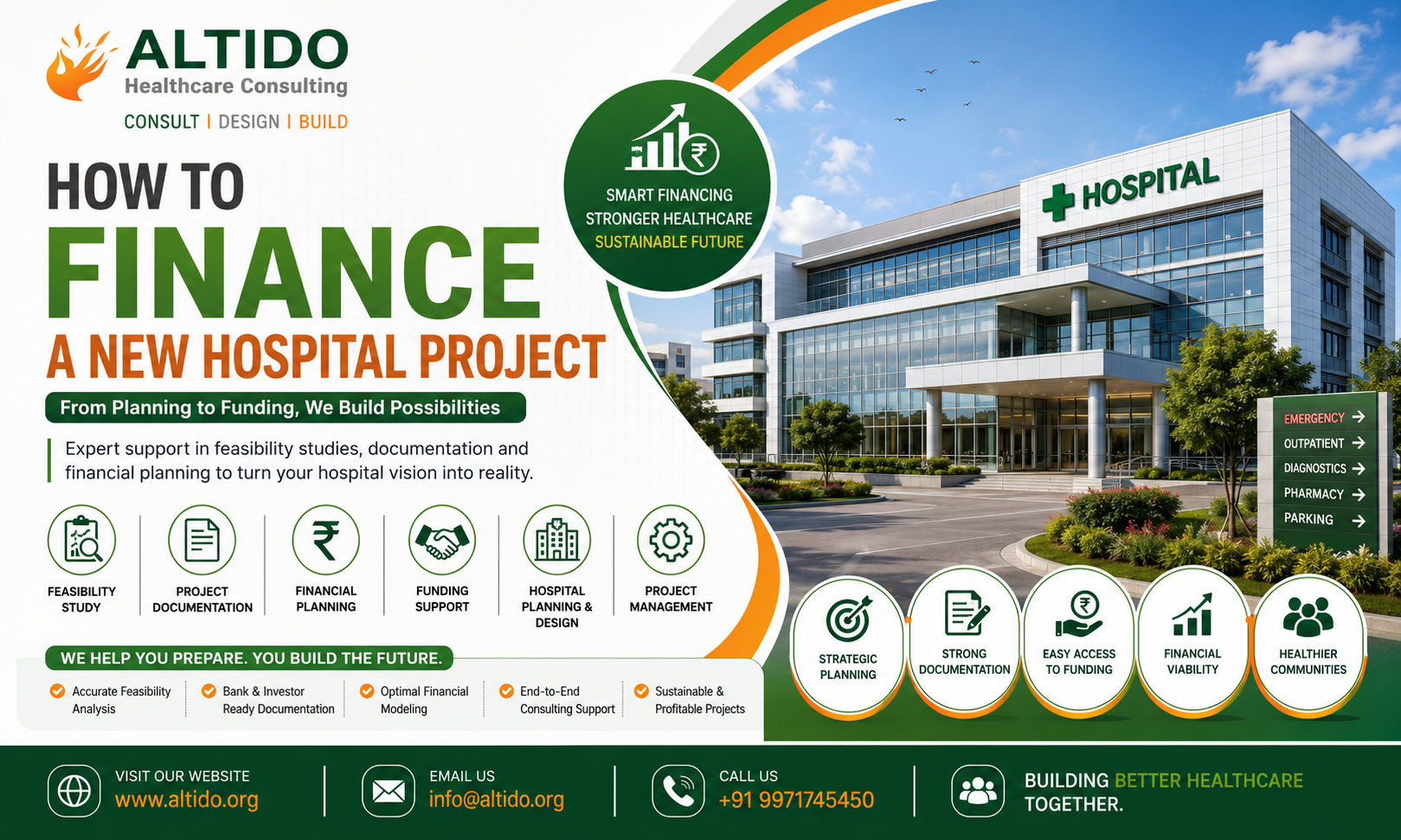
Setting up a new hospital is a major investment that requires careful financial planning, market analysis, infrastructure development, and operational strategy. Whether you are planning a 50-bed hospital, 100-bed multispecialty hospital, 200-bed healthcare facility, or a large tertiary-care hospital, securing the right financing structure is one of the most important steps toward project success.
Hospital projects require significant capital for land, construction, medical equipment, interiors, technology, staffing, and pre-operative expenses. Before approaching banks, financial institutions, investors, or government funding programs, the project should have a strong feasibility study, business plan, financial model, and project documentation.
At Altido Healthcare Consulting, we help healthcare investors and promoters prepare the essential documentation and feasibility studies required for new hospital projects. Our expertise covers hospital feasibility studies, hospital business plans, financial feasibility, hospital planning and designing, medical equipment planning, healthcare architecture, and project management.
People Also Like to read this: PPP Model for Hospital Development: Opportunities and Challenges
Why Financing Planning is Important for a New Hospital
Hospital financing is not simply about arranging funds for construction. Investors need to understand the complete lifecycle of the project.
Financial planning helps determine:
- Total project investment
- Land and construction requirements
- Medical equipment investment
- Working capital requirements
- Expected revenue
- Operating expenses
- Funding requirements
- Debt repayment capacity
- Break-even expectations
- Long-term financial sustainability
A properly prepared financial plan gives investors and lenders confidence that the proposed hospital is commercially and operationally viable.
How to Finance a New Hospital Project
There are several financing options available depending on the project’s size, location, promoter profile, and financial feasibility.
1. Promoter’s Own Investment
Promoter equity is usually the starting point for hospital financing.
The promoter may invest in:
- Land
- Initial project development
- Architectural planning
- Feasibility studies
- Construction
- Medical equipment
- Pre-operative expenses
A strong equity contribution can also improve the project’s credibility when approaching financial institutions.
2. Bank and Financial Institution Loans
Hospital projects can be financed through term loans and other structured financing options offered by banks and financial institutions, subject to lender eligibility and applicable policies.
Loan requirements may include:
- Detailed Project Report (DPR)
- Hospital feasibility study
- Business plan
- Promoter profile
- Financial projections
- Projected cash flows
- Land documents
- Construction estimates
- Equipment quotations
- Statutory approvals
This is why proper documentation should be prepared before approaching lenders.
3.Private Investors and Strategic Partners
Healthcare entrepreneurs may also raise capital through private investors or strategic partners.
Potential partners can include:
- Healthcare operators
- Investment groups
- Doctors
- Hospital chains
- Strategic healthcare companies
- Institutional investors
Investors generally evaluate the project’s market potential, location, management team, financial projections, and expected returns before committing capital.
4. Public-Private Partnership (PPP)
For certain healthcare infrastructure projects, the Public-Private Partnership (PPP) model can provide an alternative financing and development structure.
Under a PPP arrangement, public authorities and private organizations may collaborate in areas such as:
- Land or infrastructure
- Financing
- Hospital development
- Operations
- Healthcare services
- Facility management
The exact structure depends on the project and applicable government framework.
5. Project-Based Financing
A hospital can also be evaluated as a project with financing linked to its projected cash flows and business performance.
This requires detailed assessment of:
- Patient volumes
- Average revenue per patient
- Bed occupancy
- Specialty mix
- OPD volumes
- Diagnostic revenue
- Surgery volumes
- Operating expenses
A professional feasibility study helps develop realistic assumptions for these projections.
What Documentation is Required for Hospital Financing?
One of the biggest challenges for new hospital promoters is preparing complete and convincing documentation.
Common documents include:
1. Hospital Feasibility Study
The feasibility study evaluates whether the proposed hospital is technically, commercially, financially, and operationally viable.
It typically covers:
- Market assessment
- Catchment analysis
- Competition
- Demand estimation
- Hospital capacity
- Specialty planning
- Investment requirements
- Revenue projections
- Risk analysis
2. Hospital Business Plan
A business plan explains how the hospital will operate and generate sustainable revenue.
It covers:
- Business model
- Clinical services
- Target market
- Organization structure
- Marketing strategy
- Financial projections
- Growth strategy
3. Detailed Project Report (DPR)
A DPR provides a detailed overview of the proposed project and may include:
- Project concept
- Site details
- Hospital capacity
- Architectural planning
- Construction requirements
- Equipment requirements
- Project cost
- Implementation schedule
- Financial projections
4. Financial Projections
Financial projections may include:
- Projected Profit & Loss
- Cash Flow Statement
- Balance Sheet
- Revenue assumptions
- Operating expenses
- Debt servicing analysis
- Sensitivity analysis
These projections help lenders and investors understand the financial potential and risks of the project.
Importance of Hospital Feasibility Study
Before raising funds, investors should determine whether the proposed hospital can realistically succeed in the selected market.
A comprehensive feasibility study examines:
Market Feasibility → Technical Feasibility → Financial Feasibility → Operational Feasibility
The study helps answer important questions:
- Is there sufficient healthcare demand?
- What specialties should be offered?
- How many beds are appropriate?
- What is the competitive environment?
- What infrastructure is required?
- What investment is needed?
- What revenue can reasonably be expected?
- What are the major project risks?
This information provides the foundation for financing discussions.
Hospital Planning and Designing Before Financing
Hospital planning should ideally begin before construction financing is finalized.
A professional Hospital Planning and Designing Consultant can help develop:
- Hospital master plan
- Department layouts
- Patient flow
- Clinical zoning
- Emergency planning
- Operation theatre planning
- ICU planning
- Diagnostic department planning
- Medical equipment planning
- MEP requirements
- Future expansion strategy
Better planning can prevent expensive modifications during construction.
Medical Equipment Planning and Financing
Medical equipment represents a significant part of hospital investment.
Equipment planning should consider:
- Clinical requirements
- Technology level
- Equipment lifecycle
- Vendor support
- Maintenance
- Replacement requirements
- Space requirements
- Utility requirements
Altido Healthcare Consulting can support investors in developing a structured medical equipment plan aligned with the hospital’s clinical strategy and overall project budget.
How Altido Healthcare Helps Investors
At Altido Healthcare Consulting, we understand that investors need more than architectural drawings to finance a hospital.
We help develop the information and documentation required to evaluate and present a healthcare project professionally.
Our services include:
Hospital Feasibility Study
We assess market demand, competition, location, service mix, investment requirements, and financial viability.
Hospital Business Plan
We create a structured business strategy covering operations, market positioning, revenue opportunities, and growth.
Financial Feasibility
We assist with project cost estimation, revenue assumptions, operating expenses, financial projections, and investment analysis.
Detailed Project Report
We help organize technical, financial, operational, and project information into a comprehensive DPR.
Hospital Planning & Designing
Our healthcare planning approach connects financial objectives with functional hospital infrastructure.
Medical Equipment Planning
We help define equipment requirements according to clinical departments and hospital capacity.
Project Management
We can support project implementation through coordinated planning, design, engineering, and execution.
Common Mistakes Investors Should Avoid
Hospital promoters should avoid approaching financing institutions without adequate project preparation.
Common mistakes include:
- Starting construction without a feasibility study
- Underestimating project requirements
- Overestimating patient volumes
- Ignoring working capital
- Selecting the wrong hospital size
- Poor equipment planning
- Incomplete financial projections
- Insufficient contingency planning
- Ignoring regulatory requirements
A professional consultant can identify these issues before they become costly problems.
Conclusion
Financing a new hospital project requires much more than finding a source of capital. Investors need a viable business concept, strong feasibility study, detailed project documentation, realistic financial projections, and professionally planned healthcare infrastructure.
A well-prepared hospital feasibility study and business plan can help investors understand the project’s market potential, investment requirements, risks, and financial sustainability before approaching lenders or investment partners.
Altido Healthcare Consulting supports healthcare investors throughout this preparation process. From feasibility studies and financial planning to hospital planning, healthcare architecture, medical equipment planning, documentation, and project management, our team provides integrated consulting solutions for new hospital projects.
If you are planning to establish a new hospital and need help with hospital documentation, feasibility study, business planning, or hospital planning and designing, Altido Healthcare Consulting can help you prepare your project for the next stage of investment and development.
Altido Healthcare Consulting – Consult | Design | Build | Manage