
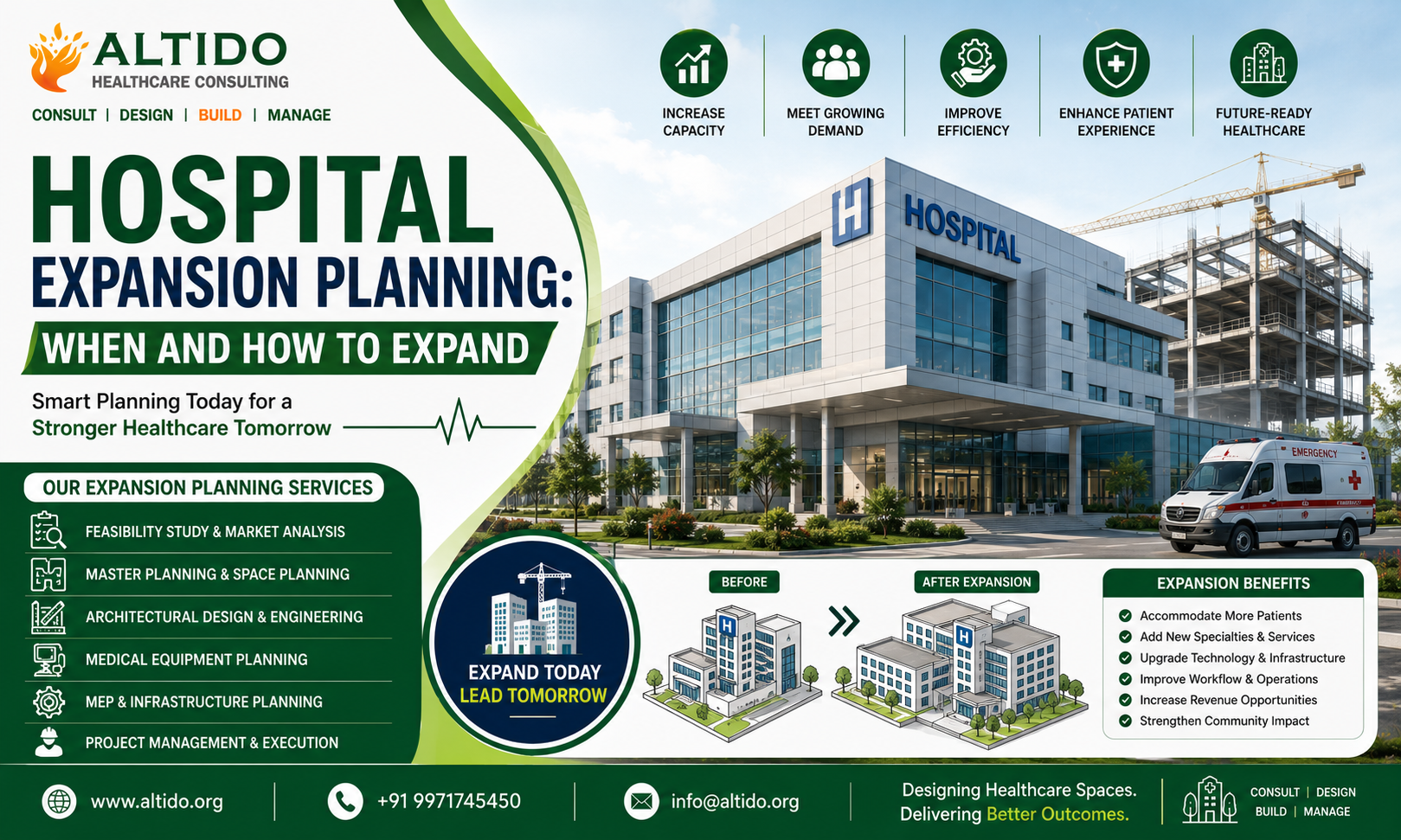
Healthcare demand is constantly changing. As patient volumes increase, medical services expand, technology advances, and communities grow, existing hospitals may eventually reach the limits of their current capacity. At this stage, hospital expansion becomes an important strategic decision.
However, hospital expansion is not simply about adding more beds or constructing another building. It requires careful assessment of clinical demand, existing infrastructure, financial feasibility, operational requirements, medical technology, and future healthcare needs.
Working with an experienced Hospital Expansion Planning Company can help hospital owners and healthcare organizations develop a structured expansion strategy that improves capacity while maintaining efficient hospital operations.
Altido Healthcare Consulting provides integrated healthcare planning and consulting services, supporting hospitals with feasibility studies, master planning, functional planning, architectural design, medical equipment planning, infrastructure assessment, project management, and healthcare development strategies.
People Also Like to read this: Hospital Mergers and Acquisitions: A Guide for Healthcare Investors
What Is Hospital Expansion Planning?
Hospital expansion planning is the process of evaluating an existing healthcare facility and developing a strategy to increase its capacity, services, infrastructure, or operational capabilities.
Expansion may involve:
- Adding new hospital beds
- Constructing additional floors
- Developing a new hospital block
- Expanding emergency services
- Increasing ICU capacity
- Adding operation theatres
- Expanding diagnostic facilities
- Developing new specialty departments
- Increasing OPD capacity
- Expanding parking and support infrastructure
- Upgrading medical equipment
- Modernizing existing departments
The right expansion strategy depends on the hospital’s current performance, available land, infrastructure capacity, investment potential, and future market demand.
When Should a Hospital Consider Expansion?
One of the most important questions for hospital management is knowing when expansion is necessary.
1. Increasing Bed Occupancy
Consistently high bed occupancy can indicate that existing capacity is insufficient.
If patients frequently experience delays in admission because beds are unavailable, management should evaluate whether additional capacity is required.
However, bed occupancy should be studied along with:
- Patient demand
- Average length of stay
- Seasonal variations
- Specialty-wise utilization
- Emergency admissions
- Discharge patterns
A professional feasibility assessment can determine whether additional beds are financially and operationally justified.
2. Growing Outpatient Demand
Increasing OPD volumes can create congestion in consultation rooms, registration areas, waiting spaces, diagnostics, and pharmacy services.
Expansion may be required when:
- Consultation rooms are consistently occupied
- Waiting times increase
- Patient circulation becomes inefficient
- Existing OPD space cannot accommodate additional specialties
An OPD expansion can improve patient flow without necessarily requiring a major increase in inpatient beds.
3. Demand for New Medical Specialties
Hospitals may expand when there is growing demand for specialized services such as:
- Cardiology
- Oncology
- Neurology
- Orthopedics
- Nephrology
- Gastroenterology
- Urology
- Pediatrics
- Women’s health
- Critical care
Introducing new specialties can require additional clinical areas, equipment, staff, support services, and infrastructure.
Assessing Existing Hospital Infrastructure
Before starting an expansion project, the existing facility should be carefully assessed.
An infrastructure assessment may include:
- Building condition
- Structural capacity
- Floor plans
- Electrical systems
- HVAC
- Plumbing
- Medical gases
- Fire protection
- Water supply
- Drainage
- Vertical transportation
- Parking
- Utility capacity
- Biomedical waste systems
The assessment helps determine whether existing infrastructure can support the proposed expansion.
For example, adding several new clinical departments may require additional electrical load, HVAC capacity, medical gases, water supply, and backup power.
Hospital Expansion Feasibility Study
A feasibility study is an important first step before committing to expansion.
Altido Healthcare Consulting can support feasibility studies covering:
- Market demand
- Patient volume analysis
- Competitor assessment
- Existing hospital performance
- Bed capacity
- Specialty demand
- Site assessment
- Expansion potential
- Capital investment
- Operating costs
- Revenue projections
- Return on investment
- Risk assessment
The feasibility study helps hospital owners determine whether expansion is required and which expansion model is most appropriate.
Types of Hospital Expansion
Hospital expansion can take different forms depending on the site’s physical and operational conditions.
Vertical Expansion
Vertical expansion involves adding floors to an existing building or developing additional levels.
It can be useful when land availability is limited. However, structural capacity, fire safety, vertical transportation, MEP systems, and evacuation requirements must be carefully evaluated.
Horizontal Expansion
Horizontal expansion involves constructing new areas adjacent to the existing hospital.
This approach can provide greater flexibility for departments such as:
- OPD
- Emergency
- Diagnostics
- Wards
- Administrative areas
- Support services
New Hospital Block
A new block can be developed as an extension of the existing hospital.
This can be particularly useful for specialty services or departments that require dedicated infrastructure.
New Hospital Campus
In some situations, constructing a completely new healthcare campus may provide better long-term value than continuously expanding an old facility.
A detailed comparison between renovation, expansion, and new construction should be conducted before making the final decision.
Functional Planning for Hospital Expansion
Functional planning establishes how different departments should be arranged and connected.
An effective expansion plan considers:
- Patient circulation
- Staff circulation
- Material movement
- Emergency access
- Department adjacencies
- Infection control
- Public areas
- Service access
- Vertical transportation
- Future flexibility
For example, an ICU expansion should have appropriate relationships with emergency services, operation theatres, diagnostics, and critical care support areas.
Similarly, an expanded OPD should consider registration, waiting, consultation, diagnostics, pharmacy, and exit routes.
Medical Equipment Planning
Hospital expansion frequently involves investment in new medical equipment.
Equipment planning should be completed before finalizing the architectural layout.
Planning may cover:
- Equipment selection
- Equipment quantity
- Room requirements
- Equipment dimensions
- Utility requirements
- Electrical loads
- Medical gases
- HVAC requirements
- Installation requirements
- Future replacement
Early coordination between medical equipment and architecture helps avoid costly modifications during construction.
MEP Requirements for Expansion
Expansion projects can place significant additional demand on existing engineering systems.
MEP assessment should consider:
- Electrical load
- HVAC capacity
- Medical gases
- Water supply
- Drainage
- Fire protection
- Backup power
- Solar systems
- Communication systems
- Building management systems
A hospital should not expand clinical capacity without confirming that its essential infrastructure can support the additional load.
Financial Planning for Hospital Expansion
Hospital expansion requires substantial capital investment. Financial planning should therefore be integrated into the development strategy.
Investment areas may include:
- Construction
- Architecture and engineering
- Medical equipment
- Furniture
- IT infrastructure
- MEP systems
- Interior design
- Licensing
- Project management
- Staff recruitment
- Marketing
- Working capital
A financial feasibility model can help management compare different expansion scenarios and prioritize investments.
Role of Hospital Expansion Planning Firms
Professional Hospital Expansion Planning firms bring together healthcare planners, architects, engineers, medical equipment specialists, and project management professionals.
Their role can include:
- Existing facility assessment
- Demand analysis
- Feasibility studies
- Master planning
- Space programming
- Functional planning
- Architectural design
- Medical equipment planning
- MEP coordination
- Cost estimation
- Phasing strategy
- Project management
A multidisciplinary approach reduces the risk of designing an expansion that is difficult or expensive to operate.
Phased Hospital Expansion
Hospital expansion does not always need to happen in one phase.
A phased development strategy can allow hospitals to:
- Expand the most critical services first
- Continue existing clinical operations
- Manage capital expenditure
- Respond to changing demand
- Introduce new specialties gradually
- Plan future expansion areas
Phasing should be established during master planning rather than after construction begins.
Minimizing Disruption During Expansion
One of the biggest challenges in hospital expansion is continuing patient care while construction takes place.
A well-planned expansion should consider:
- Temporary department relocation
- Separate construction access
- Patient safety
- Noise and dust control
- Infection prevention
- Emergency access
- Utility shutdown planning
- Staff circulation
- Construction phasing
Healthcare construction requires careful coordination because even temporary disruptions can affect critical services.
Sustainability in Hospital Expansion
Expansion projects provide an opportunity to improve the environmental performance of existing hospitals.
Strategies may include:
- Energy-efficient HVAC
- LED lighting
- Solar power
- Water-efficient systems
- Rainwater harvesting
- Natural daylight
- Sustainable materials
- Efficient waste management
- Green landscaping
Sustainable expansion can improve resource efficiency while supporting long-term operational savings.
Smart Hospital Expansion
Modern expansion projects should also consider future healthcare technology.
Infrastructure can be designed to support:
- Hospital Information Systems
- Electronic Medical Records
- Telemedicine
- IoT devices
- Real-Time Location Systems
- Digital wayfinding
- Smart building management
- Integrated security
Planning technology infrastructure during expansion makes it easier for the hospital to adopt new solutions in the future.
Why Choose Altido Healthcare Consulting?
Altido Healthcare Consulting provides end-to-end healthcare planning and infrastructure consultancy for hospital expansion and development projects.
Our services include:
- Hospital Expansion Planning
- Hospital Feasibility Studies
- Healthcare Market Research
- Hospital Master Planning
- Functional Planning
- Healthcare Architecture
- Medical Equipment Planning
- MEP Coordination
- Hospital Renovation Planning
- Healthcare IT Planning
- Project Management Consultancy
- Licensing & Accreditation Support
- Turnkey Healthcare Solutions
Our multidisciplinary approach helps hospital owners make informed decisions and develop expansion projects aligned with clinical, operational, financial, and infrastructure requirements.
Conclusion
Hospital expansion should be based on more than increasing physical capacity. It should be driven by healthcare demand, operational performance, financial feasibility, infrastructure capability, and long-term strategic objectives.
An experienced Hospital Expansion Planning Consultant can help healthcare organizations determine when expansion is required, what type of expansion is appropriate, how much capacity should be added, and how the project can be implemented with minimum disruption.
Whether the requirement involves additional beds, a new specialty department, an expanded OPD, ICU, emergency department, diagnostic center, or a completely new hospital block, professional planning provides a structured path from concept to implementation.
Altido Healthcare Consulting supports healthcare organizations with integrated planning, design, feasibility, medical equipment, engineering coordination, and project management solutions—helping hospitals expand intelligently and build better healthcare infrastructure for the future.
Altido Healthcare Consulting
Consult | Design | Build | Manage