
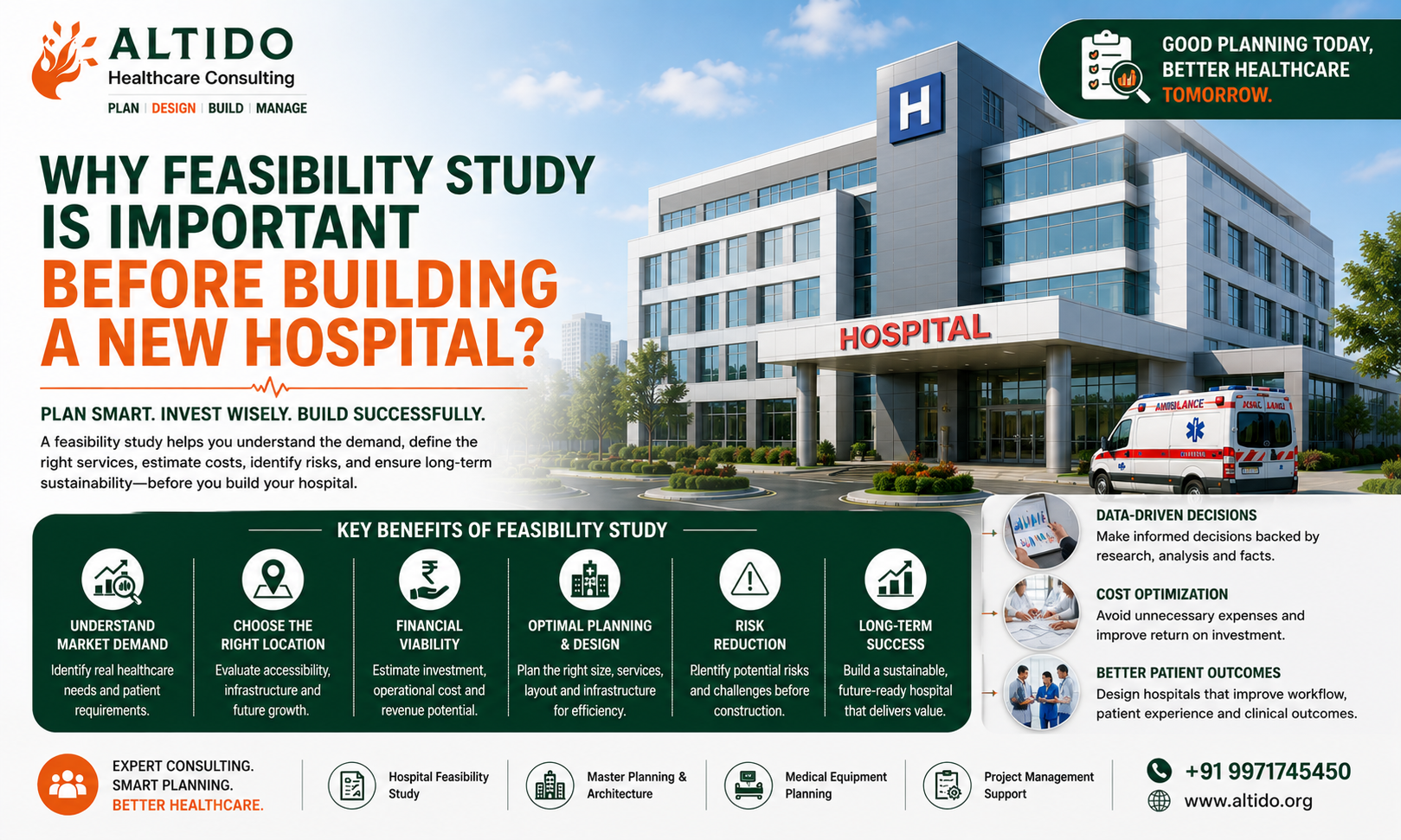
A Complete Guide by Altido Healthcare Consulting
Building a new hospital is a major investment that requires careful planning, strategic decisions, and a clear understanding of healthcare needs. A hospital is not just a construction project; it is a long-term healthcare facility that must support patients, doctors, medical technology, and operational requirements for many years.
Before starting the design and construction process, one of the most important steps is conducting a hospital feasibility study.
A feasibility study helps healthcare investors, developers, and organizations understand whether a hospital project is practical, financially sustainable, and capable of delivering quality healthcare services.
Altido Healthcare Consulting provides expert hospital feasibility studies, healthcare planning, hospital architecture, and infrastructure consulting solutions to help healthcare organizations build successful and future-ready hospitals.
People Also Like to read this: Hospital Emergency Department Planning & Design: Creating Efficient Emergency Care Facilities
What is a Hospital Feasibility Study?
A hospital feasibility study is a detailed assessment conducted before developing a healthcare facility. It evaluates the technical, financial, operational, and market aspects of the project.
The purpose of the study is to determine:
- Whether the hospital project is viable
- What type of hospital should be developed
- How much investment is required
- What services should be provided
- What risks may affect the project
A feasibility study creates a strong foundation for hospital planning and prevents costly mistakes during development.
Why Feasibility Study is Important Before Building a New Hospital
1. Understanding Healthcare Market Demand
The first step in hospital development is understanding whether there is a real healthcare need in the selected location.
A feasibility study analyzes:
- Population growth
- Patient demographics
- Disease patterns
- Existing healthcare facilities
- Future healthcare demand
This helps determine the right hospital model and prevents creating a facility that does not match market requirements.
For example, a location may require a multispecialty hospital, while another area may have greater demand for:
- Diagnostic centers
- Specialty clinics
- Emergency facilities
- Day-care hospitals
Market analysis helps make informed decisions.
2. Selecting the Right Location
Location plays a critical role in hospital success.
A feasibility study evaluates the suitability of the site based on:
Accessibility
The hospital should be easily accessible for:
- Patients
- Ambulances
- Visitors
- Medical professionals
Infrastructure Availability
The location should have:
- Road connectivity
- Electricity supply
- Water availability
- Communication systems
Future Expansion Potential
The site should allow future development such as:
- Additional beds
- New departments
- Advanced healthcare services
A proper location study reduces future operational challenges.
3. Defining Hospital Vision and Objectives
Before designing a hospital, the project vision must be clearly defined.
A feasibility study helps answer:
- What type of hospital is required?
- Who are the target patients?
- Which specialties should be included?
- What level of healthcare services should be offered?
Possible hospital categories include:
- General hospitals
- Multispecialty hospitals
- Super-specialty hospitals
- Women and child hospitals
- Diagnostic centers
Clear objectives guide the entire planning process.
4. Determining Hospital Size and Capacity
A common challenge in hospital projects is deciding the correct size.
A feasibility study helps determine:
- Number of beds
- Department requirements
- OPD capacity
- ICU requirements
- Emergency capacity
Over-sized hospitals can create:
- High operational costs
- Low utilization
- Financial pressure
Under-sized hospitals can result in:
- Space limitations
- Poor patient experience
- Expansion difficulties
Proper capacity planning creates balance.
5. Financial Feasibility and Investment Planning
Hospital projects require significant investment.
A feasibility study evaluates the financial aspects including:
Capital Investment
Includes:
- Land cost
- Construction cost
- Medical equipment
- Interiors
- Technology systems
Operational Expenses
Includes:
- Staff costs
- Maintenance
- Utilities
- Administration
Revenue Forecasting
Analyzes income potential from:
- Consultations
- Diagnostics
- Procedures
- Inpatient services
Financial planning helps investors understand project profitability and sustainability.
6. Hospital Service Planning
A hospital must offer services based on patient needs.
Feasibility studies help identify required departments such as:
Clinical Departments
- OPD
- Emergency
- ICU
- Operation Theatre
- Inpatient wards
Diagnostic Services
- Radiology
- Laboratory
- Imaging facilities
Support Services
- Pharmacy
- Laundry
- Kitchen
- Biomedical waste management
Service planning ensures efficient hospital operations.
7. Creating an Efficient Hospital Layout Plan
After feasibility analysis, the next stage is hospital planning and architecture.
The study provides information required for:
- Space planning
- Department zoning
- Patient flow
- Staff movement
- Equipment placement
A good hospital layout improves:
- Workflow efficiency
- Patient safety
- Infection control
8. Identifying Risks Before Construction
Every hospital project involves risks.
A feasibility study identifies potential challenges such as:
- Financial risks
- Location issues
- Competition
- Operational difficulties
- Regulatory requirements
Early identification allows better risk management.
It helps avoid expensive changes after construction begins.
9. Medical Equipment Planning
Modern hospitals depend on advanced technology.
A feasibility study helps plan equipment requirements including:
- MRI
- CT Scan
- X-Ray
- Laboratory systems
- Surgical equipment
This ensures:
- Correct space allocation
- Proper infrastructure
- Cost optimization
Equipment planning should happen before architectural design.
10. Regulatory and Compliance Planning
Hospitals must follow healthcare standards and regulations.
A feasibility study considers requirements related to:
- Building approvals
- Fire safety
- Healthcare guidelines
- Infection control
- Quality standards
Early compliance planning helps avoid delays during project execution.
11. Planning Future Growth
Healthcare needs continue changing.
A feasibility study supports future-ready planning by considering:
- Expansion possibilities
- New technologies
- Additional departments
- Increasing patient capacity
A hospital designed today should remain functional for decades.
Role of Healthcare Consultants in Feasibility Studies
Healthcare consultants bring specialized knowledge and experience to hospital projects.
They analyze:
- Healthcare demand
- Project strategy
- Operations
- Financial viability
- Architecture requirements
Their expertise helps transform ideas into successful healthcare facilities.
Why Choose Altido Healthcare Consulting?
Altido Healthcare Consulting provides complete healthcare consulting solutions for hospitals and medical facilities.
Our expertise includes:
- Hospital Feasibility Studies
- Healthcare Master Planning
- Hospital Architecture Design
- Space Planning
- Medical Equipment Planning
- Healthcare Infrastructure Consulting
- Hospital Operations Planning
We help healthcare organizations make confident decisions before investing in hospital development.
Future of Hospital Development
Modern healthcare projects require smarter planning, advanced technology, and patient-focused design.
Future hospitals will focus on:
- Smart healthcare systems
- Sustainable buildings
- Digital integration
- Efficient operations
- Better patient experiences
A feasibility study ensures that hospitals are prepared for future healthcare challenges.
Conclusion
A feasibility study before building a new hospital is one of the most important steps in healthcare project development. It provides clarity about demand, investment, location, services, risks, and future opportunities.
Starting a hospital without proper feasibility analysis can lead to financial and operational challenges.
With professional guidance from Altido Healthcare Consulting, healthcare providers can develop hospitals that are efficient, sustainable, and designed for long-term success.