
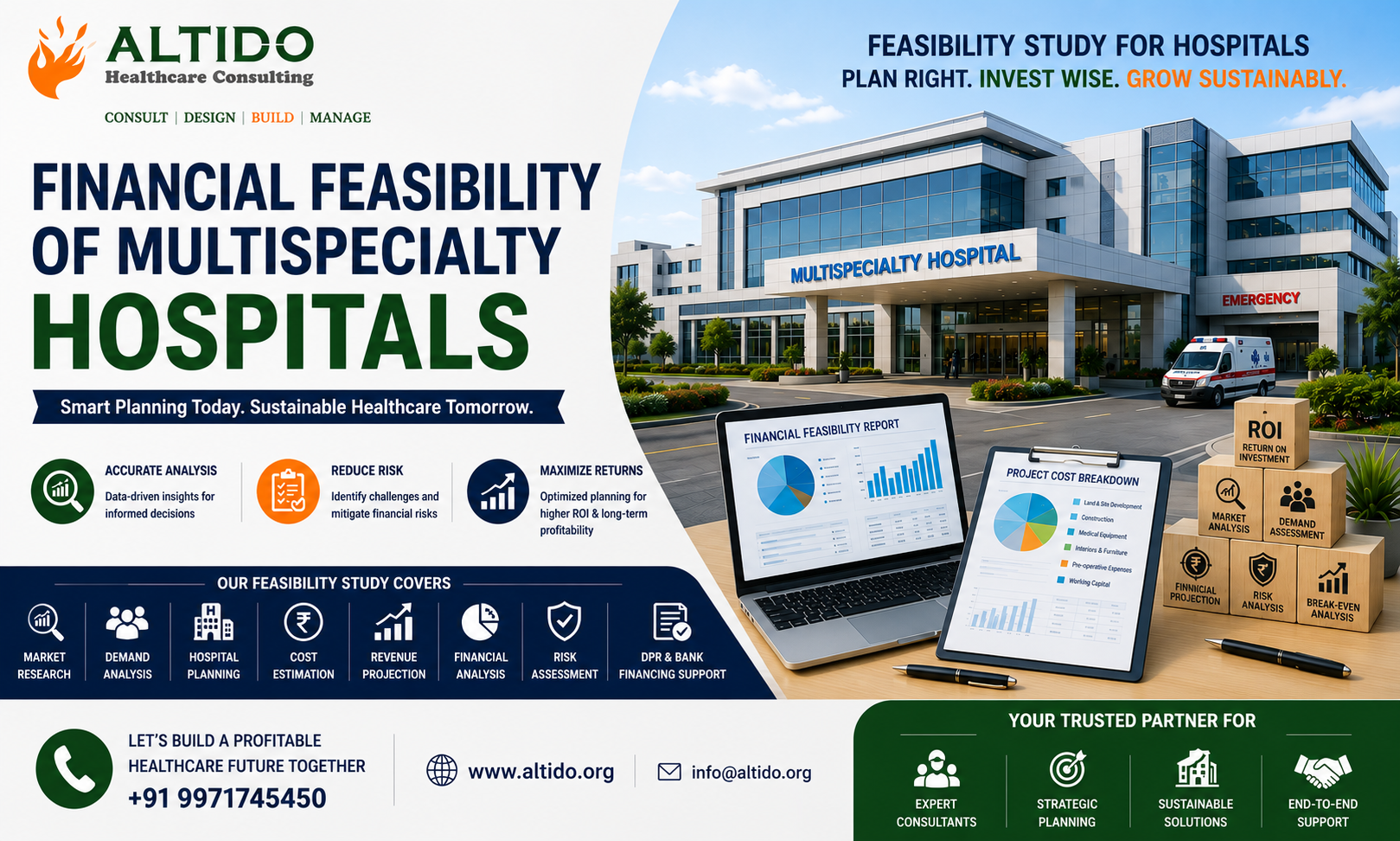
India’s healthcare sector is witnessing rapid expansion due to increasing population, rising healthcare awareness, medical tourism, government initiatives, and growing private investments. As a result, the demand for modern multispecialty hospitals continues to increase across metropolitan cities, Tier-II cities, and emerging healthcare hubs.
However, developing a multispecialty hospital requires significant financial investment. Before investing in land acquisition, hospital planning, construction, medical equipment, and operations, conducting a comprehensive Financial Feasibility of Multispecialty Hospitals study is essential. A professionally prepared Feasibility Study for Hospitals helps investors understand project viability, expected returns, operational costs, and long-term sustainability.
At Altido Healthcare Consulting, we provide comprehensive Feasibility Study Planning for Hospitals, enabling healthcare entrepreneurs, hospital chains, trusts, and investors to make informed and profitable decisions.
People Also Like to read this: Healthcare and Hospital Cafeteria Design Consultants: Creating Functional Dining Spaces for Better Healthcare
What is the Financial Feasibility of a Multispecialty Hospital?
Financial feasibility is the process of evaluating whether a proposed hospital project is economically viable before construction begins. It examines projected capital investment, operating costs, revenue potential, risks, profitability, and return on investment (ROI).
A detailed financial feasibility study helps answer critical questions such as:
- Is the project financially viable?
- What will be the total investment required?
- How many beds should the hospital have?
- What specialties should be included?
- When will the hospital achieve break-even?
- What is the expected ROI?
- What are the potential financial risks?
A feasibility study provides investors with confidence and reduces project uncertainty.
Why is a Feasibility Study Important for Hospitals?
Hospital projects involve substantial capital expenditure and long-term operational commitments. Without proper planning, projects may face financial losses, delays, or underutilization.
A professional Feasibility Study for Hospitals helps:
- Reduce investment risks
- Estimate project costs accurately
- Evaluate market demand
- Identify target patient demographics
- Determine bed capacity
- Plan specialty services
- Forecast revenue and expenses
- Secure funding from banks and investors
It forms the foundation for successful hospital development.
Key Components of Hospital Financial Feasibility
1. Market Analysis
Understanding healthcare demand is the first step.
Market analysis includes:
- Population demographics
- Disease burden
- Healthcare utilization
- Existing hospitals
- Competitor analysis
- Medical tourism opportunities
- Patient preferences
This helps identify service gaps and investment opportunities.
2. Demand Assessment
Estimating patient demand is critical for planning hospital size and services.
Demand assessment evaluates:
- OPD visits
- IPD admissions
- Surgical volume
- Emergency cases
- Specialty-wise demand
- Referral patterns
Accurate demand forecasting improves financial planning.
3. Bed Capacity Planning
Selecting the right bed capacity directly impacts profitability.
Factors considered include:
- Population coverage
- Occupancy projections
- Service mix
- Future expansion
- Government guidelines
Proper planning avoids both underutilization and overcrowding.
4. Capital Investment Analysis
A feasibility study estimates total project cost, including:
- Land acquisition
- Architectural planning
- Civil construction
- Medical equipment
- Furniture
- IT infrastructure
- HVAC systems
- Electrical systems
- Medical gas pipelines
- Landscaping
Accurate budgeting prevents cost overruns.
5. Operational Cost Analysis
Operational expenses include:
- Staff salaries
- Utilities
- Maintenance
- Medical consumables
- Medicines
- Food services
- Housekeeping
- Biomedical waste management
- Marketing
- Administrative expenses
Understanding recurring costs is essential for financial sustainability.
6. Revenue Projections
Revenue forecasting estimates income from:
- OPD consultations
- Inpatient services
- Surgical procedures
- Diagnostics
- Pharmacy
- ICU services
- Health packages
- Corporate tie-ups
- Insurance claims
Realistic projections improve investment planning.
7. Break-Even Analysis
Break-even analysis estimates how long it will take for the hospital to recover its initial investment.
Factors include:
- Occupancy rates
- Revenue growth
- Operating costs
- Debt servicing
- Capital expenditure
Most multispecialty hospitals typically achieve break-even within several years, depending on location, scale, specialties, and management efficiency.
8. Return on Investment (ROI)
Investors need clear ROI projections before committing funds.
Financial analysis calculates:
- Net Present Value (NPV)
- Internal Rate of Return (IRR)
- Payback period
- Profitability ratios
- Cash flow analysis
These indicators measure long-term financial performance.
Feasibility Study Planning for Hospitals
A complete Feasibility Study Planning for Hospitals includes:
Technical Feasibility
- Site evaluation
- Land utilization
- Infrastructure assessment
- Utility availability
Operational Feasibility
- Clinical workflows
- Human resource planning
- Equipment requirements
- Operational processes
Financial Feasibility
- Cost estimation
- Revenue forecasting
- Profitability analysis
- Investment planning
Legal Feasibility
- Land approvals
- Building regulations
- Fire safety
- Pollution control
- Healthcare licensing
Role of Hospital Planning in Financial Success
Hospital planning directly influences operational efficiency and profitability.
Efficient planning reduces:
- Construction costs
- Operational expenses
- Patient waiting time
- Staff movement
- Equipment duplication
- Energy consumption
A well-planned hospital improves patient satisfaction while increasing financial performance.
Healthcare Technology and Financial Planning
Modern hospitals integrate technology to improve efficiency.
These include:
- Hospital Information Systems (HIS)
- Electronic Medical Records (EMR)
- Building Management Systems (BMS)
- Telemedicine
- AI-based diagnostics
- Smart energy management
Technology reduces operational costs and improves productivity.
Why Choose Altido Healthcare Consulting?
Altido Healthcare Consulting offers comprehensive healthcare consulting services covering every stage of hospital development.
Our expertise includes:
- Financial Feasibility Studies
- Hospital Feasibility Study Reports
- Hospital Business Planning
- Hospital Master Planning
- Healthcare Architecture
- Medical Equipment Planning
- MEP Engineering
- Interior Design
- Project Management
- Turnkey Healthcare Solutions
Our multidisciplinary team combines financial expertise, healthcare planning, architecture, and engineering to deliver reliable and actionable feasibility reports.
Benefits of Choosing Altido
Partnering with Altido Healthcare Consulting offers:
- Comprehensive feasibility analysis
- Accurate financial projections
- Risk identification and mitigation
- Optimized hospital planning
- Better investment decisions
- Improved operational efficiency
- Future-ready infrastructure
- End-to-end project support
Future of Multispecialty Hospitals in India
Healthcare demand in India is expected to continue growing due to:
- Population growth
- Medical tourism
- Digital healthcare
- Preventive medicine
- Government healthcare initiatives
- Rising health insurance coverage
- Increasing demand for specialty care
Investors who begin with a detailed financial feasibility study are better positioned to develop sustainable and profitable healthcare facilities.
Conclusion
The success of any multispecialty hospital begins long before construction starts. A detailed Financial Feasibility of Multispecialty Hospitals study provides the financial, technical, operational, and strategic insights required for successful healthcare investments.
Professional Feasibility Study Planning for Hospitals helps investors minimize risks, optimize capital allocation, improve operational efficiency, and maximize long-term returns.
As a trusted healthcare consulting firm, Altido Healthcare Consulting delivers comprehensive Feasibility Study for Hospitals, healthcare planning, hospital architecture, and project management services that transform healthcare visions into financially viable and future-ready medical institutions.
Whether you are planning a new multispecialty hospital, expanding an existing healthcare facility, or seeking investment guidance, Altido Healthcare Consulting is your trusted partner in building successful healthcare projects.
Altido Healthcare Consulting – Consult | Design | Build | Manage