
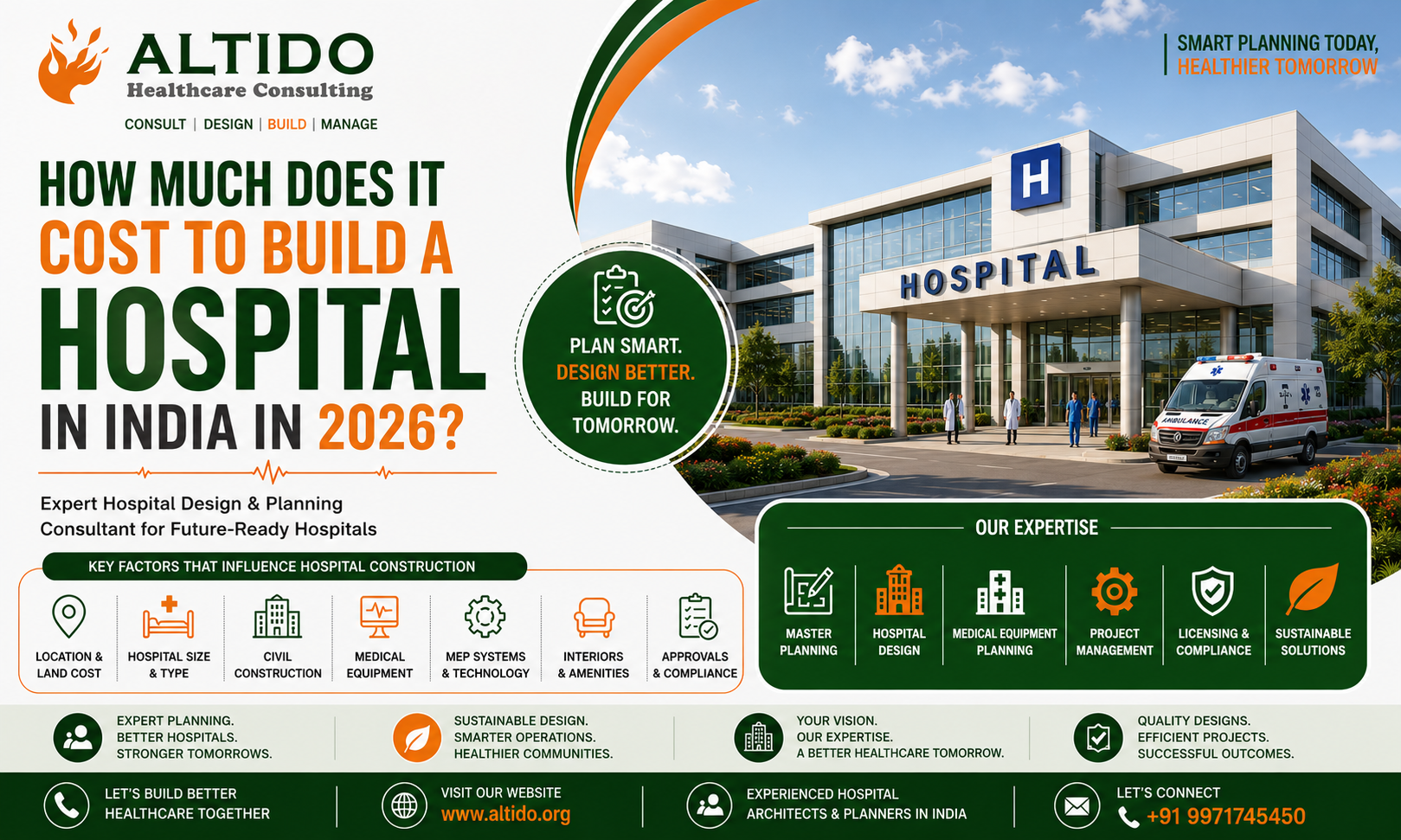
The Indian healthcare industry is expected to witness unprecedented growth in 2026, fueled by increasing demand for quality healthcare services, medical tourism, government healthcare initiatives, and private investments. Entrepreneurs, healthcare organizations, charitable trusts, and hospital chains are actively investing in new hospitals across metropolitan cities as well as Tier-II and Tier-III locations.
One of the first questions investors ask is: “How much does it cost to build a hospital in India in 2026?”
The answer depends on multiple factors, including land cost, hospital size, specialty mix, construction quality, medical equipment, and regulatory requirements. Before investing, it is essential to work with an experienced Hospital Design and Planning Consultant who can prepare a detailed feasibility study, optimize project costs, and ensure efficient infrastructure planning.
At Altido Healthcare Consulting, we specialize in hospital planning, healthcare architecture, feasibility studies, medical equipment planning, and turnkey healthcare consulting services. As one of the trusted Hospital Architects in India, we help healthcare investors design financially viable and future-ready hospitals.
People Also Like to read this: Financial Feasibility of Multispecialty Hospitals in India: A Complete Guide to Hospital Feasibility Study & Planning
Why Hospital Planning Matters Before Construction
Building a hospital is far more complex than constructing a commercial building. Hospitals require specialized planning to integrate clinical workflows, patient safety, infection control, engineering systems, and advanced medical technologies.
An experienced Hospital Design and Planning Consultant helps optimize the project by:
- Reducing unnecessary construction costs
- Improving patient flow
- Planning future expansion
- Ensuring regulatory compliance
- Enhancing operational efficiency
- Optimizing medical equipment placement
Good planning prevents costly redesigns during construction.
Major Factors That Influence Hospital Construction Cost
Hospital construction costs vary depending on several important factors.
1. Land Cost
Land prices differ significantly between locations.
For example:
- Metro cities have the highest land costs.
- Tier-II cities offer comparatively affordable land.
- Rural healthcare projects typically have lower land acquisition costs.
Site selection should also consider accessibility, utilities, demographics, and future expansion.
2. Hospital Size
The number of beds greatly influences project cost.
Examples include:
- 30-bed hospital
- 50-bed hospital
- 100-bed hospital
- 200-bed hospital
- 300-bed hospital
- 500-bed hospital
Larger hospitals require more infrastructure, equipment, and operational planning.
3. Type of Hospital
Construction cost depends on the healthcare facility type.
Examples include:
- Multi-specialty hospital
- Super-specialty hospital
- Eye hospital
- Mother & Child hospital
- Cancer hospital
- Cardiac hospital
- Orthopedic hospital
- Medical college hospital
Each specialty requires different infrastructure and equipment.
4. Civil Construction
Civil construction generally represents one of the largest portions of the total project budget.
It includes:
- Foundation
- RCC structure
- Masonry
- Roofing
- Flooring
- Doors and windows
- Exterior façade
- Waterproofing
- Landscaping
The choice of materials and design quality affects overall costs.
5. Hospital Architecture & Planning
Professional hospital architecture improves functionality while reducing long-term operational costs.
Services include:
- Hospital Master Planning
- Department Planning
- Patient Flow Planning
- Infection Control Design
- Space Optimization
- Future Expansion Planning
Experienced Hospital Architects in India ensure that every square foot is efficiently utilized.
6. Medical Equipment
Medical equipment represents a significant investment.
Common equipment includes:
- MRI
- CT Scan
- Cath Lab
- X-Ray
- Ultrasound
- ICU Equipment
- Operation Theatre
- Equipment
- Laboratory Systems
Equipment selection should align with the hospital’s service mix and financial goals.
7. MEP Engineering
Hospitals require sophisticated engineering systems.
These include:
- HVAC
- Medical Gas Pipeline Systems
- Electrical Distribution
- Plumbing
- Fire Protection
- Building Automation
- Nurse Call Systems
Proper MEP planning ensures safety, reliability, and operational efficiency.
8. Interior Design
Healthcare interiors must balance functionality with patient comfort.
Design includes:
- Reception
- OPD
- ICU
- Operation Theatres
- Wards
- Patient Rooms
- Laboratories
- Cafeteria
- Administrative Offices
Patient-centric interiors improve satisfaction and hospital branding.
9. Technology Integration
Modern hospitals increasingly invest in digital healthcare solutions.
Examples include:
- Hospital Information System (HIS)
- Electronic Medical Records (EMR)
- PACS & RIS
- Telemedicine
- Smart Building Management
- IoT Monitoring
- Digital Signage
Technology improves efficiency and enhances patient care.
Hidden Costs Investors Often Overlook
Many investors focus only on construction but overlook additional expenses such as:
- Government approvals
- Fire safety compliance
- Biomedical waste systems
Licensing - NABH preparation
- Medical gas systems
- Furniture
- IT infrastructure
- Staff recruitment
Training - Marketing and branding
- Contingency reserves
Planning for these costs early reduces financial surprises.
Why a Feasibility Study Is Essential
Before beginning construction, every hospital project should undergo a professional feasibility study.
A Hospital Design and Planning Consultant evaluates:
- Population demographics
- Healthcare demand
- Competitor analysis
- Financial projections
- Revenue potential
- Break-even analysis
- ROI
- Department planning
- Bed strength
- Service mix
A feasibility study helps investors make informed decisions and secure financing.
Cost Optimization Strategies
Professional planning can significantly improve project efficiency without compromising quality.
Recommended strategies include:
- Efficient master planning
- Optimized structural design
- Energy-efficient systems
- Modular construction where appropriate
- Phased expansion planning
- Smart procurement
- Sustainable building materials
- Space optimization
These measures can reduce lifecycle costs and improve operational performance.
Why Choose Altido Healthcare Consulting?
Altido Healthcare Consulting provides end-to-end healthcare consulting solutions for hospitals across India and international markets.
Our services include:
- Hospital Feasibility Studies
- Hospital Design & Planning
- Healthcare Architecture
- Hospital Master Planning
- Medical Equipment Planning
- Interior Design
- MEP Engineering
- Project Management Consultancy (PMC)
- Turnkey Healthcare Solutions
- Licensing & Accreditation Support
As experienced Hospital Architects in India, we combine architectural expertise with healthcare operational planning to deliver hospitals that are efficient, compliant, and future-ready.
The Future of Hospital Development in India
Hospital projects in 2026 are expected to focus on:
- Smart hospitals
- Sustainable infrastructure
- Energy-efficient buildings
- Digital healthcare technologies
- AI-enabled workflows
- Flexible department layouts
- Patient-centric architecture
- Infection-resistant design
Hospitals designed today should be adaptable to future medical and technological advancements.
Conclusion
The cost of building a hospital in India in 2026 depends on multiple factors, including location, bed capacity, specialty services, construction quality, medical equipment, and technology integration. Rather than focusing only on initial construction costs, investors should prioritize long-term operational efficiency and financial sustainability.
Partnering with an experienced Hospital Design and Planning Consultant ensures better planning, optimized investment, and successful project execution. From feasibility studies and master planning to architecture, medical equipment planning, and project management, Altido Healthcare Consulting offers complete solutions tailored to your healthcare vision.
Whether you are planning a 50-bed community hospital, a multi-specialty healthcare center, or a large tertiary care institution, Altido Healthcare Consulting is your trusted partner for designing and building world-class healthcare infrastructure.
Altido Healthcare Consulting – Consult | Design | Build | Manage