
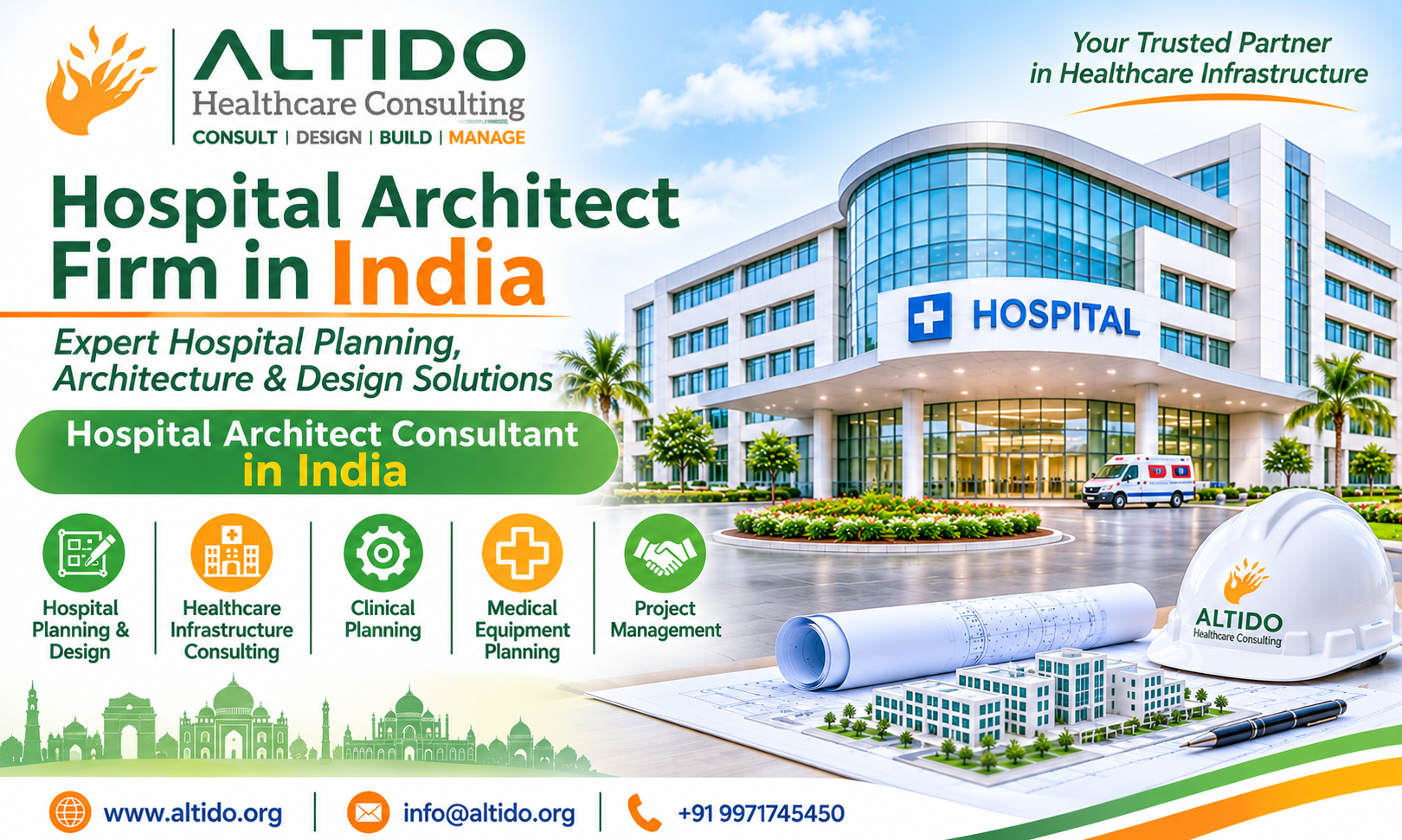
India’s healthcare sector is experiencing continuous growth, creating increasing demand for modern hospitals, multispecialty medical centres, and advanced healthcare infrastructure. Developing a successful hospital requires more than construction expertise. It involves strategic planning, architectural design, clinical understanding, engineering coordination, and efficient project management.
Choosing the right Hospital Architect Firm in India is an important decision for investors, hospital owners, healthcare developers, and medical professionals planning new healthcare facilities. A professionally designed hospital supports efficient medical operations, patient safety, staff productivity, and long-term infrastructure development.
ALTIDO Healthcare Consulting provides comprehensive healthcare infrastructure consultancy, helping clients transform hospital development ideas into functional, efficient, and future-ready healthcare facilities.
People Also Like to read this: Healthcare & Hospital Architects in South Africa: Expert Hospital Planning and Design Solutions
1. Importance of a Professional Hospital Architect Firm in India
Hospital architecture is different from conventional commercial building design. Hospitals require specialized layouts, departmental zoning, medical equipment integration, infection control considerations, and coordinated engineering systems.
An experienced hospital architecture firm understands these requirements and develops designs that support both clinical functionality and operational efficiency.
Professional hospital architecture services help with:
- Efficient utilization of available space
- Functional departmental planning
- Patient and staff circulation
- Infection prevention and control
- Medical equipment integration
- Patient safety and accessibility
- Engineering coordination
- Future expansion possibilities
- Sustainable hospital infrastructure
The right architectural planning approach helps investors avoid costly design changes and establish a strong foundation for hospital development.
2. ALTIDO – Your Hospital Architect Consultant in India
ALTIDO Healthcare Consulting offers integrated healthcare infrastructure consultancy for new hospital projects, existing hospital expansions, renovations, and specialized medical facilities.
Our approach combines healthcare planning, architectural design, clinical requirements, technical coordination, and project management support.
Our major services include:
- Hospital Feasibility Studies
- Market Research and Due Diligence
- Hospital Business Planning
- Hospital Architecture and Master Planning
- Clinical Planning and Departmental Zoning
- Architectural and Engineering Drawings
- Medical Equipment Planning
- MEP and Structural Engineering Coordination
- Interior and Landscape Design
- Project Management Consultancy
- Turnkey Healthcare Solutions
- Commissioning Management
Whether you are planning a 50-bed hospital, a 100-bed multispecialty facility, or a large super-specialty hospital, ALTIDO provides consultancy support according to your project requirements.
3. Hospital Feasibility Study and Project Planning
Before starting architectural design, investors should understand the project’s financial, operational, and market feasibility.
A hospital feasibility study evaluates whether the proposed healthcare project is suitable for its location, target patient population, investment capacity, and intended medical services.
Important considerations include:
- Healthcare market demand
- Population and demographic analysis
- Competitor hospital assessment
- Site selection and land suitability
- Proposed bed capacity
- Medical specialty selection
- Project cost estimation
- Revenue and operational projections
- Investment and financial planning
A detailed feasibility study helps investors make informed decisions before committing significant capital to hospital development.
4. Hospital Master Planning and Architectural Design
Hospital master planning establishes the overall organization of the healthcare facility. It includes site development, building configuration, departmental placement, circulation, parking, landscaping, and future expansion.
A professional Hospital Architect Consultant in India should understand how architectural planning connects with clinical operations and technical infrastructure.
Key components of hospital master planning include:
Site Planning: Evaluating land availability, road connectivity, access points, utilities, and future development opportunities.
Building Configuration: Planning the number of floors, building arrangement, vertical circulation, and departmental relationships.
Departmental Zoning: Organizing clinical, administrative, public, diagnostic, and service areas.
External Development: Planning entrances, ambulance access, parking, landscaping, and service movement.
Future Expansion: Creating provisions for additional beds, specialties, and healthcare services.
Proper master planning improves space utilization and supports efficient hospital operations.
5. Clinical Planning and Departmental Design
Clinical planning is one of the most important aspects of hospital architecture. Each department has specific spatial, medical, technical, and operational requirements.
ALTIDO focuses on developing functional departmental layouts that support smooth coordination between medical teams and hospital services.
Common hospital departments include:
- Outpatient Department (OPD)
- Emergency and Trauma Care
- Intensive Care Unit (ICU)
- Operation Theatre Complex
- Inpatient Department (IPD)
- Diagnostic Imaging
- Laboratory and Pathology
- Maternity and Labour Rooms
- Neonatal Intensive Care Unit (NICU)
- Dialysis Unit
- Pharmacy
- Central Sterile Supply Department (CSSD)
- Administration and Support Services
Departmental zoning should consider patient flow, staff movement, equipment requirements, privacy, infection prevention, and operational relationships.
6. Medical Equipment Planning and Integration
Medical equipment is a major investment component of every modern hospital. Equipment requirements should be considered during the initial architectural planning stage.
A hospital architect consultant coordinates with medical equipment planners and clinical stakeholders to ensure that each department has appropriate space and technical provisions.
Medical equipment planning includes:
- Medical equipment selection and scheduling
- Equipment layout and positioning
- Space and clearance requirements
- Electrical and utility provisions
- Medical gas pipeline requirements
- Imaging equipment planning
- Operation theatre equipment coordination
- Maintenance and replacement access
Early coordination between architecture and equipment planning helps reduce design conflicts and supports efficient clinical operations.
7. Hospital Engineering and Technical Infrastructure
Hospitals require specialized engineering systems to support safe and continuous healthcare services.
Architectural planning must be coordinated with structural, electrical, plumbing, HVAC, and fire protection requirements.
Important engineering systems include:
- HVAC and ventilation systems
- Electrical distribution
- Emergency and backup power
- Plumbing and drainage
- Fire detection and protection
- Medical Gas Pipeline Systems (MGPS)
- Modular operation theatre systems
- Structural engineering
- Healthcare IT and communication infrastructure
Integrated engineering coordination helps improve construction efficiency, building functionality, and long-term operational reliability.
8. Hospital Interior Design and Patient-Centred Architecture
Hospital interiors influence patient comfort, accessibility, and the overall healthcare experience.
A well-designed hospital should provide comfortable spaces for patients, visitors, doctors, nurses, and other healthcare professionals.
Important design considerations include:
- Reception and waiting areas
- Patient rooms and inpatient wards
- Comfortable consultation rooms
- Clear wayfinding and signage
- Accessible entrances, ramps, and lifts
- Appropriate lighting and ventilation
- Patient privacy
- Functional nursing stations
- Durable and suitable interior materials
Patient-centred architectural planning helps create welcoming and functional healthcare environments.
9. Factors to Consider When Selecting a Hospital Architect Consultant in India
Before selecting a hospital architecture consultant, investors should evaluate several important factors.
Healthcare Project Experience: Understand the consultant’s experience in hospital planning, clinical design, and healthcare infrastructure.
Comprehensive Services: Look for expertise across feasibility, architecture, clinical planning, engineering coordination, and project management.
Technical Understanding: Ensure that the consultant understands medical equipment, engineering systems, and hospital operational requirements.
Customized Planning: Every hospital requires a design based on its capacity, specialties, location, and investment objectives.
Regulatory Coordination: Hospital projects must consider applicable building regulations, fire safety requirements, accessibility provisions, and healthcare licensing requirements.
Future-Ready Design: The proposed facility should allow flexibility for future expansion and changing healthcare technology.
Selecting a healthcare-focused consultant helps connect architectural decisions with the practical requirements of hospital development.
10. Why Choose ALTIDO Healthcare Consulting?
ALTIDO Healthcare Consulting provides integrated consultancy services for hospital investors, owners, developers, and medical organizations.
Our multidisciplinary approach connects project feasibility, architecture, clinical planning, engineering, medical equipment, and project management.
Our key strengths include:
- Comprehensive healthcare infrastructure consultancy
- Specialized hospital planning and architectural design
- Clinical planning and departmental zoning
- Medical equipment planning support
- MEP and structural engineering coordination
- Feasibility studies and business planning
- Project management and turnkey solutions
- Focus on functional and sustainable healthcare infrastructure
Our objective is to help clients develop hospitals that are efficient, patient-focused, and prepared for future healthcare requirements.
Conclusion
Developing a successful hospital requires professional planning, architectural expertise, clinical understanding, and coordinated engineering solutions. Selecting the right Hospital Architect Firm in India can make an important difference in the functionality, efficiency, and long-term sustainability of a healthcare facility.
ALTIDO Healthcare Consulting offers comprehensive hospital feasibility studies, architectural planning, clinical design, medical equipment planning, engineering coordination, and project management consultancy.
If you are searching for an experienced Hospital Architect Consultant in India for a new hospital, expansion, or renovation project, connect with ALTIDO Healthcare Consulting to discuss your requirements.