
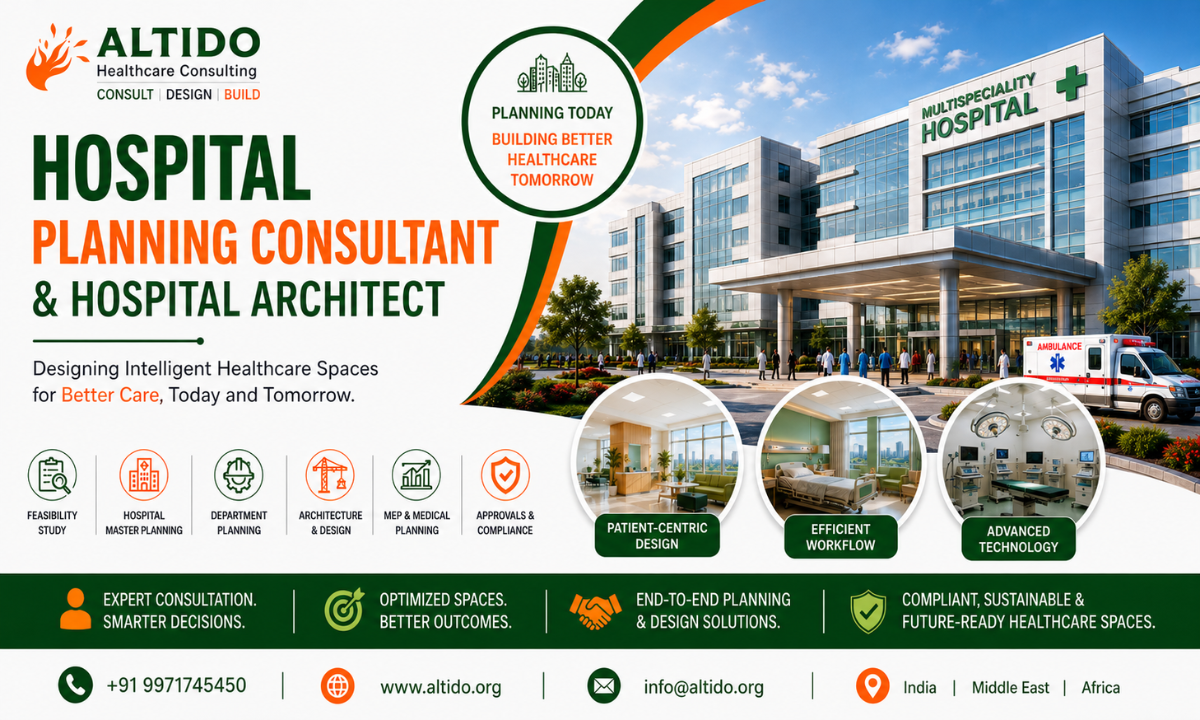
In today’s rapidly growing healthcare sector, hospitals are expected to deliver advanced medical care while maintaining operational efficiency, patient safety, and future scalability. Behind every successful healthcare facility is detailed planning that ensures smooth workflow, optimized patient care, and effective infrastructure. This is where an experienced hospital planning consultant plays a vital role.
A hospital is more than a building. It is a highly specialized ecosystem that must integrate architecture, medical operations, engineering systems, compliance, and patient experience. Altido Healthcare Consulting provides expert healthcare planning services, helping hospitals create functional and future-ready medical spaces. With extensive expertise in healthcare infrastructure development, Altido works as a trusted hospital planning consultant and hospital architect for healthcare projects across India and international markets.
People Also Like to read this: Best Hospital Architecture Firm in Asia: Planning & Designing Future-Ready Healthcare Spaces
Why Hospital Planning Is Critical
Hospital planning determines how effectively a healthcare facility will function for years to come. Poor planning can result in inefficient workflows, overcrowding, patient dissatisfaction, and increased operating costs. Strategic planning ensures that every department is placed correctly, resources are optimized, and the hospital can adapt to future growth.
An expert hospital planning consultant evaluates operational needs before design begins. This includes understanding patient flow, departmental relationships, equipment requirements, staffing, and compliance standards.
Benefits of proper hospital planning include:
- Efficient patient circulation
- Improved staff productivity
- Better infection control
- Cost-effective operations
- Regulatory compliance
- Future expansion readiness
- Enhanced patient experience
Role of a Hospital Planning Consultant
A hospital planning consultant brings together architecture, medical planning, and operational expertise. Their role is to ensure that every part of the hospital supports clinical excellence and efficient management.
Key responsibilities include:
Feasibility and Requirement Analysis
Before construction begins, a consultant evaluates:
- Project viability
- Target patient capacity
- Medical specialty requirements
- Budget estimation
- Site utilization
- Regulatory approvals
This initial planning forms the foundation for successful healthcare development.
Space Planning
Every square foot in a hospital must be planned strategically. Proper space planning ensures that departments are connected logically for patient care and workflow efficiency.
Important planning areas include:
- Outpatient departments
- Inpatient wards
- Operation theatres
- Emergency units
- Diagnostic centers
- Pharmacy
- Laboratories
- ICU/NICU
- Administrative areas
A qualified hospital architect ensures these spaces support medical functionality and user comfort.
Master Planning for Healthcare Projects
Master planning is essential for long-term success. It creates a roadmap for current operations and future growth.
Master planning includes:
- Site zoning
- Utility placement
- Building orientation
- Parking and access
- Expansion zones
- Service circulation
- Landscape planning
An experienced hospital planning consultant ensures that every aspect of the hospital works cohesively.
Importance of Functional Workflow
Workflow is one of the most critical aspects of hospital design. Proper circulation helps doctors, nurses, support staff, patients, and visitors move efficiently.
\Well-designed workflow minimizes delays and improves patient care.
Key workflow considerations:
Patient Flow
Patients should move easily from registration to consultation, diagnostics, treatment, and discharge.
Staff Flow
Doctors and staff need quick access between departments for emergency response and treatment.
Service Flow
Clean and dirty utility paths must remain separate to maintain hygiene and safety.
A professional hospital architect carefully plans these movement patterns.
Department-Specific Planning
Different hospital departments require specialized planning.
OPD Design
The outpatient department should ensure:
- Easy registration
- Comfortable waiting
- Efficient consultation rooms
- Accessible diagnostics
- Pharmacy connectivity
Emergency Department
Emergency design requires:
- Ambulance access
- Triage area
- Trauma rooms
- Emergency OT connection
- ICU proximity
Operation Theatre Design
Operation theatres need:
- Sterile zoning
- Recovery spaces
- Equipment planning
- HVAC systems
- Medical gas systems
ICU Design
ICU areas require:
- Patient visibility
- Isolation rooms
- Nurse stations
- Emergency equipment access
An experienced hospital planning consultant designs these spaces to improve medical outcomes.
Role of Hospital Architect in Modern Healthcare
A hospital architect focuses on creating spaces that combine functionality, safety, and healing environments.
Healthcare architecture involves:
- Structural planning
- Interior design
- Lighting
- Ventilation
- Acoustic control
- Safety systems
- Infection control
A modern hospital architect also incorporates flexibility for future upgrades and smart technologies.
Technology Integration in Hospital Planning
Technology has become essential in healthcare infrastructure.
Modern hospitals integrate:
- Digital patient management
- Smart nurse call systems
- Telemedicine rooms
- Automated HVAC
- Building management systems
- Security and surveillance
- Electronic health records
Altido Healthcare Consulting integrates advanced technology solutions into every healthcare project.
Sustainable Hospital Design
Sustainability reduces operating costs while creating healthier spaces.
Green healthcare design includes:
- Natural daylight utilization
- Energy-efficient systems
- Water recycling
- Solar integration
- Sustainable materials
- Waste management
A responsible hospital architect ensures that healthcare buildings are environmentally efficient.
Infection Control Through Planning
Hospital design must prioritize hygiene and infection prevention.
Important measures include:
- Separate circulation paths
- Isolation rooms
- Air filtration systems
- Antimicrobial surfaces
- Waste disposal systems
- Sterile storage zones
A well-planned hospital reduces healthcare-associated infections and improves patient safety.
Specialized Healthcare Facilities
Each healthcare facility requires customized planning.
Multispeciality Hospitals
These require integration of multiple departments and centralized support services.
Mother and Child Hospitals
Planning includes:
- Labor rooms
- NICU
- Pediatric wards
- Family support spaces
Cancer Hospitals
Require:
- Radiation-safe zones
- Chemotherapy areas
- Oncology wards
Diagnostic Centers
Need:
- Imaging planning
- Laboratory setup
- Radiation shielding
Altido Healthcare Consulting provides customized planning for every healthcare specialty.
Why Choose Altido Healthcare Consulting
Altido Healthcare Consulting is a leading healthcare planning company offering complete hospital planning and design solutions.
Services include:
- Feasibility studies
- Hospital architecture
- Master planning
- Interior design
- Medical planning
- Equipment planning
- MEP design
- Project management
- Turnkey healthcare solutions
As an experienced hospital planning consultant, Altido delivers healthcare spaces that are efficient, compliant, and future-ready.
Future of Hospital Planning
Healthcare is evolving with smart technologies and patient-centered care.
Future hospitals will focus on:
- AI-enabled healthcare systems
- Digital infrastructure
- Sustainable design
- Personalized care spaces
- Smart building automation
- Advanced emergency systems
Hospitals designed today must be adaptable to future medical innovations.
Conclusion
Hospital planning is the foundation of successful healthcare infrastructure. It ensures operational efficiency, patient safety, and long-term sustainability. A professional hospital planning consultant and skilled hospital architect help transform healthcare visions into efficient, healing environments.
Altido Healthcare Consulting provides comprehensive planning and design solutions for hospitals of all scales. From concept development to execution, the company delivers healthcare infrastructure designed for better care, smarter operations, and future growth.
Partnering with the right consultant ensures your hospital is not only functional today but ready for tomorrow’s healthcare challenges.