
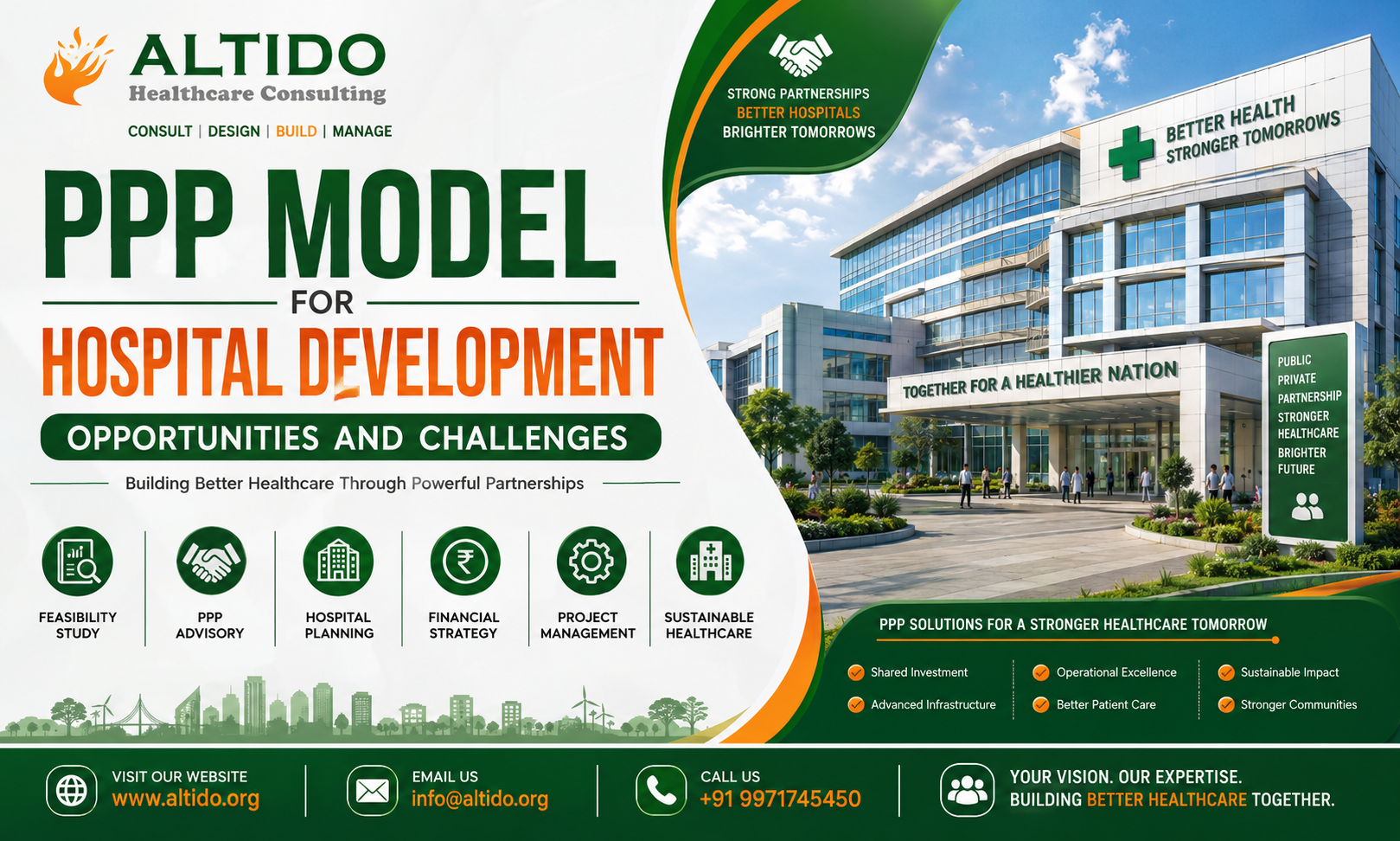
Healthcare infrastructure is one of the most critical pillars of a nation’s economic and social development. As India’s population continues to grow and demand for quality healthcare services increases, governments face the challenge of developing hospitals while managing limited public resources. One effective solution that has gained momentum worldwide is the Public-Private Partnership (PPP) Model for Hospital Development.
The PPP model combines the strengths of the public and private sectors to deliver modern, accessible, and financially sustainable healthcare facilities. Governments provide policy support, land, or infrastructure, while private organizations contribute expertise in planning, financing, construction, technology, and hospital management.
At Altido Healthcare Consulting, we specialize in hospital planning, healthcare architecture, feasibility studies, project management, and PPP advisory services. Our multidisciplinary team assists governments, healthcare investors, trusts, and private organizations in successfully developing hospitals through structured Public-Private Partnership models.
People Also Like to read this: Hospital Project Budget Planning Services: A Complete Guide to Planning and Designing a New Hospital
What is the PPP Model for Hospital Development?
A Public-Private Partnership (PPP) is a collaborative arrangement where the government and private organizations jointly develop, finance, operate, or maintain healthcare infrastructure.
Instead of relying solely on government funding, private partners participate in project planning, investment, construction, operations, and maintenance, ensuring efficient delivery of healthcare services.
PPP models are widely used for:
- Multispecialty hospitals
- Medical colleges
- District hospitals
- Diagnostic centers
- Cancer hospitals
- Trauma centers
- Specialty healthcare facilities
- Medical research institutions
Why PPP Models are Becoming Popular
Governments across India and many other countries are increasingly adopting PPP models because healthcare infrastructure requires significant investment and specialized expertise.
The PPP approach helps:
- Improve healthcare accessibility
- Accelerate hospital development
- Reduce government financial burden
- Enhance operational efficiency
- Introduce advanced medical technology
- Improve patient care quality
- Encourage private sector innovation
Common PPP Models in Healthcare
Different PPP structures are adopted depending on project objectives.
Build-Operate-Transfer (BOT)
The private partner designs, builds, operates, and manages the hospital for a specified period before transferring ownership to the government.
Design-Build-Finance-Operate (DBFO)
The private organization undertakes project financing, design, construction, and hospital operations while maintaining agreed service standards.
Build-Own-Operate (BOO)
The private entity owns and operates the hospital while providing healthcare services under government agreements.
Lease-Operate-Transfer (LOT)
Existing government hospitals are leased to private operators for modernization and efficient management before being transferred back after the lease period.
Opportunities in PPP Hospital Development
1. Improved Healthcare Infrastructure
PPP enables rapid development of modern healthcare facilities equipped with advanced medical technology and patient-centric infrastructure.
Benefits include:
- Modern hospital buildings
- Smart healthcare systems
- Digital hospital management
- Sustainable infrastructure
- Energy-efficient facilities
2. Faster Project Execution
Private sector expertise significantly reduces delays in planning, procurement, and construction.
Professional project management ensures:
- Timely approvals
- Efficient coordination
- Better quality control
- Reduced construction timelines
3. Better Financial Management
Private investors bring capital and financial discipline, reducing dependence on public funding.
This results in:
- Better cost control
- Efficient budgeting
- Improved return on investment
- Transparent financial management
4. Access to Advanced Technology
Private healthcare organizations invest in modern healthcare technologies such as:
- Hospital Information Systems (HIS)
- Electronic Medical Records (EMR)
- AI-enabled diagnostics
Telemedicine - Smart Building Management Systems
- Digital Imaging Solutions
Technology improves operational efficiency and patient outcomes.
5. Higher Quality Healthcare Services
Professional management improves:
- Clinical efficiency
- Patient safety
- Infection control
- Staff productivity
- Service quality
- Patient satisfaction
6. Increased Employment Opportunities
PPP hospital projects generate employment for:
- Doctors
- Nurses
- Biomedical engineers
- Architects
- Project managers
- Administrative professionals
- Support staff
Healthcare infrastructure development contributes to economic growth.
Challenges of PPP Hospital Development
While PPP offers significant advantages, careful planning is essential to overcome potential challenges.
Regulatory Complexity
Healthcare projects require approvals from multiple government agencies.
These include:
- Building approvals
- Fire safety
- Pollution control
- Biomedical waste management
- Clinical Establishment regulations
- Environmental clearances
Experienced consultants help navigate these processes efficiently.
Financial Risks
Hospital projects involve high capital investment.
Potential financial challenges include:
- Cost escalation
- Revenue uncertainty
Inflation - Interest rate changes
- Delayed project completion
Comprehensive financial planning minimizes these risks.
Contract Management
PPP agreements should clearly define:
- Roles and responsibilities
- Risk allocation
- Revenue-sharing mechanisms
- Performance standards
- Dispute resolution procedures
Well-structured contracts reduce future conflicts.
Operational Challenges
Hospital operations require continuous monitoring.
Common operational issues include:
- Staff shortages
- Technology upgrades
- Equipment maintenance
- Patient satisfaction
- Regulatory compliance
Professional hospital management ensures smooth operations.
Role of Feasibility Studies in PPP Projects
Before initiating any PPP hospital project, a comprehensive feasibility study should be conducted.
The study evaluates:
- Population demographics
- Healthcare demand
- Market competition
- Financial viability
- Risk assessment
- Service mix
- Bed capacity
- Revenue projections
A feasibility study provides confidence to both government authorities and private investors.
Importance of Hospital Planning
Effective planning is the foundation of every successful PPP hospital project.
Hospital planning includes:
- Master planning
- Department planning
- Space optimization
- Patient flow analysis
- Infection control
- Medical equipment planning
- Engineering coordination
- Future expansion planning
Professional planning improves operational efficiency while reducing lifecycle costs.
Why Choose Altido Healthcare Consulting?
Altido Healthcare Consulting provides comprehensive consulting services for public and private healthcare infrastructure projects.
Our expertise includes:
- PPP Advisory Services
- Hospital Feasibility Studies
- Detailed Project Reports (DPR)
- Hospital Planning & Design
- Healthcare Architecture
- Medical Equipment Planning
- MEP Engineering
Interior Design - Project Management Consultancy (PMC)
- Turnkey Healthcare Solutions
- Licensing & Regulatory Support
Our multidisciplinary team works closely with government agencies, investors, healthcare providers, and development partners to deliver sustainable healthcare infrastructure.
Benefits of Partnering with Altido
Choosing Altido Healthcare Consulting offers:
- Strategic project planning
- Accurate feasibility analysis
- Financial optimization
- Efficient infrastructure design
- Regulatory compliance support
- Risk management
- Sustainable hospital development
- End-to-end project execution
Future of PPP Healthcare Projects
India’s healthcare sector is expected to witness significant investment in PPP-based infrastructure over the coming years.
Future trends include:
- Smart hospitals
- AI-enabled healthcare
- Sustainable infrastructure
- Green hospitals
- Digital healthcare ecosystems
- Medical education campuses
- Integrated healthcare networks
- Public health innovation centers
PPP models will play a crucial role in expanding quality healthcare services to underserved regions while encouraging innovation and private sector participation.
Conclusion
The PPP Model for Hospital Development offers a practical and sustainable approach to expanding healthcare infrastructure by combining government support with private sector expertise. While PPP projects present opportunities such as faster execution, improved healthcare quality, advanced technology, and financial efficiency, they also require careful planning, transparent governance, and robust risk management.
Professional guidance is essential to ensure the success of PPP healthcare projects. From feasibility studies and master planning to healthcare architecture, financial analysis, project management, and operational planning, Altido Healthcare Consulting provides end-to-end solutions tailored to the needs of government agencies, investors, and healthcare organizations.
Whether you are planning a district hospital, medical college, multispecialty hospital, or specialty healthcare facility under a PPP framework, Altido Healthcare Consulting is your trusted partner in creating sustainable, future-ready healthcare infrastructure.
Altido Healthcare Consulting – Consult | Design | Build | Manage