
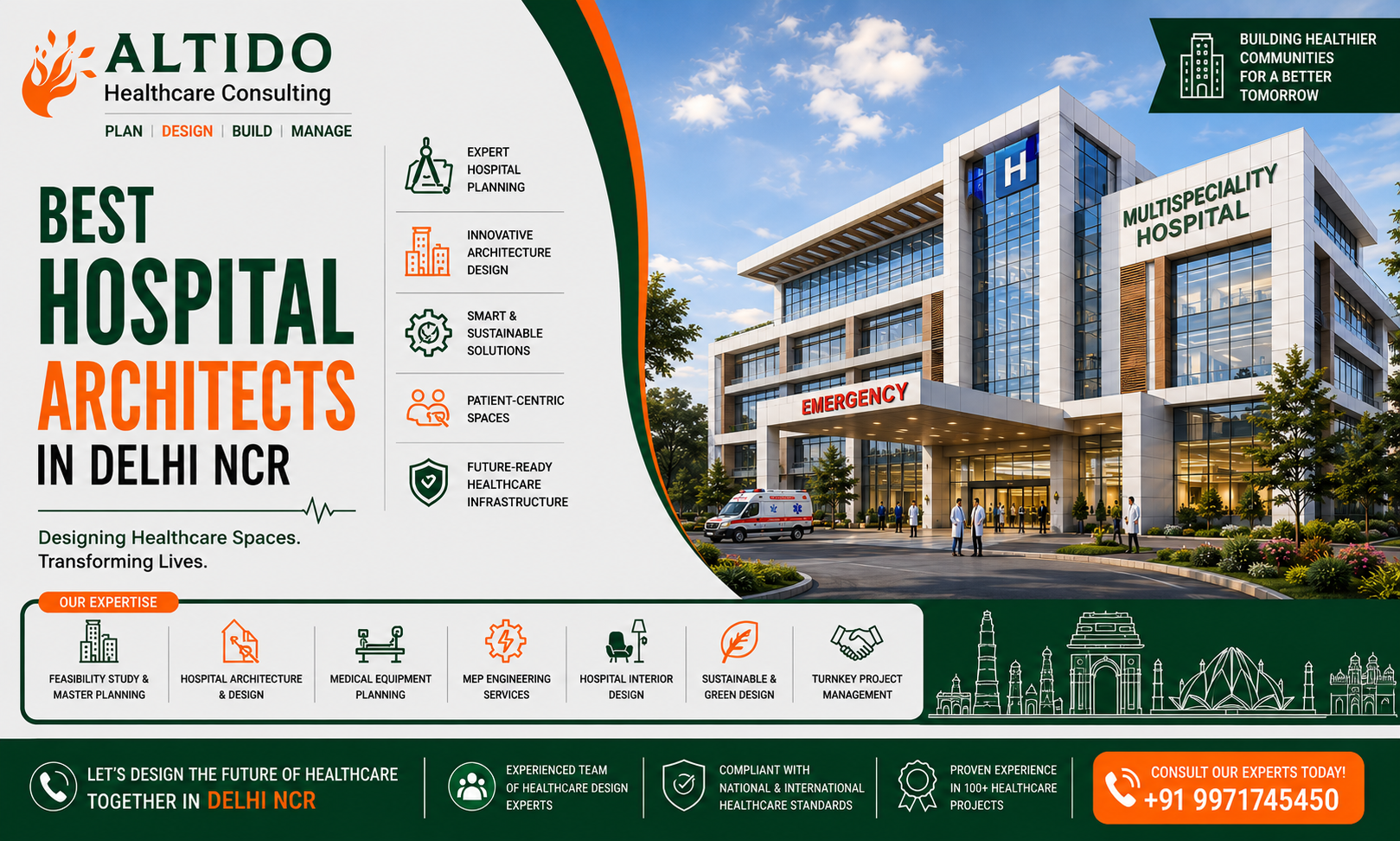
Healthcare infrastructure is one of the most important investments in modern society. As patient expectations, medical technologies, and healthcare standards continue to evolve, hospitals require specialized architectural planning that goes beyond conventional building design. This is where the expertise of the Best Hospital Architects in Delhi NCR becomes essential.
Hospital architecture combines healthcare planning, clinical workflow optimization, infrastructure engineering, patient-centered design, and future-ready technologies to create healthcare environments that improve patient outcomes and operational efficiency.
Altido Healthcare Consulting is a trusted healthcare architecture and planning firm, delivering innovative hospital design solutions across Delhi NCR and beyond. With extensive experience in healthcare infrastructure development, Altido helps healthcare providers create hospitals that are efficient, sustainable, and prepared for future growth.
People Also Like to read this: Best Hospital Structure Design Company: Building Strong Foundations for Modern Healthcare
The Growing Need for Specialized Hospital Architects
Hospitals are among the most complex buildings to design. They require careful coordination between medical departments, infrastructure systems, patient movement, healthcare technologies, and regulatory standards.
Professional hospital architects help healthcare organizations:
- Optimize healthcare operations
- Improve patient experiences
- Enhance staff productivity
- Integrate advanced medical technologies
- Ensure regulatory compliance
- Enable future expansion
- Improve sustainability
A well-designed hospital contributes significantly to healthcare delivery and long-term operational success.
Understanding Hospital Architecture
Hospital architecture is a specialized field that focuses on designing healthcare facilities that support clinical excellence and operational efficiency.
Unlike commercial buildings, hospitals must accommodate:
- Emergency services
- Intensive care units
- Operation theatres
- Diagnostic departments
- Inpatient wards
- Outpatient services
- Medical equipment infrastructure
Healthcare architects create environments that support patient care while maintaining efficiency and safety.
Why Delhi NCR Requires Advanced Healthcare Infrastructure
Delhi NCR is one of India’s fastest-growing healthcare markets. The region includes major healthcare hubs such as Delhi, Noida, Gurugram, Faridabad, and Ghaziabad, where demand for modern medical facilities continues to increase.
Healthcare investors and providers are developing:
- Multispeciality hospitals
- Super-speciality hospitals
- Mother and child hospitals
- Cancer care centers
- Diagnostic facilities
- Medical colleges
This growth requires experienced hospital architects who understand healthcare planning and infrastructure development.
Role of Hospital Architects in Healthcare Projects
Professional hospital architects are involved in every stage of healthcare infrastructure development.
Feasibility Assessment
Before designing a hospital, architects evaluate:
- Site conditions
- Market demand
- Healthcare requirements
- Financial viability
- Infrastructure availability
A detailed feasibility study helps establish a strong foundation for project success.
Master Planning
Master planning ensures the healthcare campus is organized efficiently.
It includes:
- Site utilization
- Building placement
- Utility planning
- Traffic circulation
- Emergency access
- Future expansion provisions
Proper master planning maximizes operational efficiency and long-term value.
Hospital Architecture Design
Architects create healthcare facilities that support:
- Clinical workflows
- Patient safety
- Medical technology integration
- Operational efficiency
Every design decision contributes to improved healthcare delivery.
Patient-Centered Healthcare Design
Modern hospital architecture places patients at the center of the design process.
Patient-centered design focuses on:
- Comfortable patient rooms
- Healing environments
- Natural daylight
- Easy wayfinding
- Family-friendly spaces
- Reduced stress environments
These design elements improve patient satisfaction and recovery experiences.
Departmental Planning for Efficient Operations
Every hospital department requires specialized planning.
Outpatient Department (OPD)
Well-designed OPDs improve:
- Registration processes
- Consultation efficiency
- Patient movement
- Waiting experiences
Emergency Department
Emergency facilities require:
- Ambulance access
- Trauma care areas
- Rapid treatment zones
- Efficient patient circulation
Operation Theatre Complex
OT planning includes:
- Sterile zoning
- Air filtration systems
- Equipment integration
- Recovery spaces
Intensive Care Units
ICUs require:
- Continuous monitoring capabilities
- Nurse visibility
- Isolation facilities
- Efficient emergency response access
Strategic departmental planning improves healthcare operations.
Smart Hospital Design
Technology is transforming healthcare infrastructure.
Modern hospitals increasingly incorporate:
- Electronic Medical Records (EMR)
- Telemedicine systems
- Smart building automation
- Digital patient monitoring
- Automated energy management
Smart hospitals improve efficiency while enhancing patient care quality.
Sustainable Healthcare Architecture
Sustainability has become a key focus in hospital development.
Green healthcare design includes:
- Energy-efficient HVAC systems
- Solar power integration
- Water conservation systems
- Sustainable materials
- Waste management solutions
Sustainable hospitals reduce operational costs while supporting environmental responsibility.
Infection Control Through Design
Healthcare-associated infections remain a major concern in medical facilities.
Hospital architects incorporate infection control strategies such as:
- Separate circulation routes
- Isolation rooms
- Controlled airflow systems
- Sterile utility areas
- Touch-free technologies
Design plays a vital role in maintaining patient safety.
Healthcare Interior Design
Hospital interiors influence both patient experiences and staff productivity.
Healthcare interior design focuses on:
- Functional layouts
- Comfortable furnishings
- Calming color schemes
- Accessibility
- Workflow optimization
Modern healthcare interiors create positive healing environments.
Medical Equipment Planning
Healthcare architecture must accommodate advanced medical technologies.
Medical equipment planning includes:
- Space allocation
- Utility requirements
- Structural support
- Technology integration
Proper coordination ensures equipment performs efficiently and safely.
MEP Engineering Integration
Mechanical, Electrical, and Plumbing systems are critical components of hospital infrastructure.
Mechanical Systems
- HVAC design
- Ventilation control
- Air quality management
Electrical Systems
- Power distribution
- Backup power systems
- Critical care support
Plumbing Systems
- Water supply systems
- Medical gas infrastructure
- Drainage management
Integrated engineering improves reliability and operational efficiency.
Specialized Healthcare Facility Design
Different healthcare facilities require customized architectural solutions.
Multispeciality Hospitals
Need flexible layouts supporting multiple specialties.
Super-Speciality Hospitals
Require advanced infrastructure and technology integration.
Mother and Child Hospitals
Require labor rooms, NICUs, pediatric departments, and family-centered environments.
Cancer Hospitals
Require radiation-safe environments and specialized treatment facilities.
Altido Healthcare Consulting provides tailored solutions for all healthcare segments.
Turnkey Healthcare Consulting Solutions
Healthcare projects involve multiple stakeholders and technical disciplines.
Altido Healthcare Consulting offers turnkey services including:
- Feasibility studies
- Hospital planning
- Architecture design
- Interior design
- MEP engineering
- Equipment planning
- Project management
- Commissioning support
This integrated approach ensures seamless project execution.
Why Choose Altido Healthcare Consulting?
Altido Healthcare Consulting is recognized among the leading healthcare design firms serving Delhi NCR and other regions.
Key strengths include:
- Healthcare-focused expertise
- Comprehensive hospital planning services
- Modern architecture solutions
- Sustainable healthcare design
- Smart hospital integration
- End-to-end project support
- International healthcare design standards
The company works closely with healthcare providers, investors, and institutions to create world-class healthcare facilities.
Future of Hospital Architecture in Delhi NCR
Healthcare infrastructure in Delhi NCR continues to evolve rapidly.
Emerging trends include:
- Smart hospitals
- Digital healthcare ecosystems
- Sustainable healthcare campuses
- Flexible infrastructure
- AI-enabled healthcare environments
- Patient-centered design innovations
Healthcare facilities developed today must be adaptable to future advancements.
Conclusion
The demand for high-quality healthcare infrastructure continues to grow across Delhi NCR. Professional hospital architects play a crucial role in creating healthcare facilities that improve patient outcomes, operational efficiency, and long-term sustainability.
As one of the trusted healthcare consulting firms, Altido Healthcare Consulting provides comprehensive hospital planning, architecture, and infrastructure solutions tailored to modern healthcare requirements. From feasibility studies and master planning to architecture design and project execution, Altido helps healthcare organizations build future-ready hospitals that support excellence in patient care.
By partnering with experienced hospital architects, healthcare providers can create efficient, sustainable, and technologically advanced facilities that meet the healthcare challenges of tomorrow.