
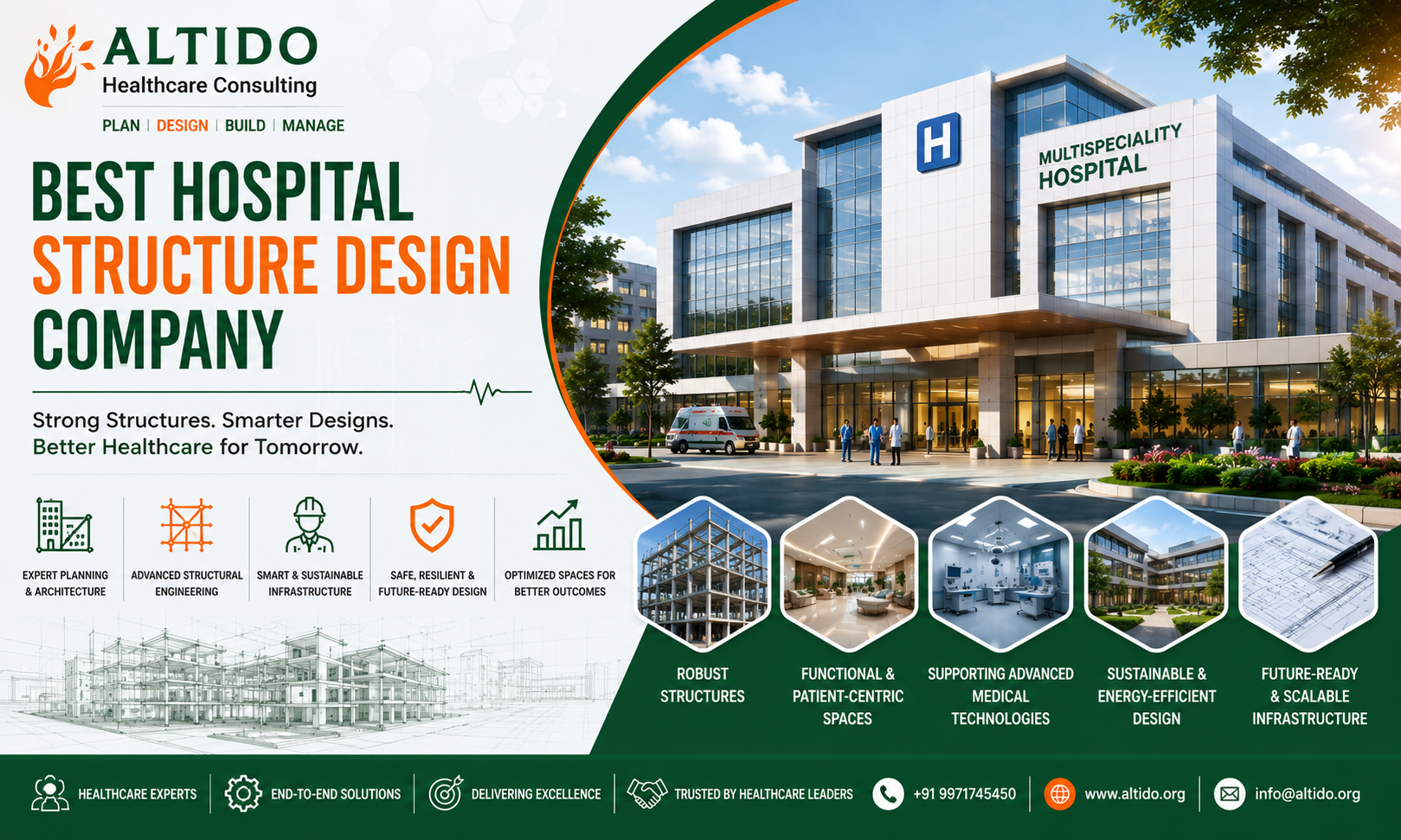
The success of any healthcare facility begins with a well-planned and structurally sound design. Hospitals are among the most complex buildings in the world, requiring specialized expertise in architecture, engineering, infrastructure planning, and healthcare operations. A properly designed hospital structure ensures patient safety, operational efficiency, future scalability, and long-term sustainability.
As a Best Hospital Structure Design Company, Altido Healthcare Consulting specializes in creating robust healthcare infrastructure that supports modern medical technologies, clinical workflows, and patient-centered care. From conceptual planning to detailed structural engineering, Altido delivers comprehensive healthcare design solutions tailored to the evolving needs of healthcare providers.
Understanding Hospital Structure Design
Hospital structure design is far more complex than conventional building design. Hospitals must accommodate advanced medical equipment, high patient volumes, emergency services, critical care units, and specialized departments while maintaining safety and functionality.
A hospital structure must support:
- Clinical operations
- Medical technology integration
- Infection control measures
- Emergency preparedness
- Future expansion
- Sustainable infrastructure
- Regulatory compliance
Professional hospital structure design ensures that healthcare facilities remain functional, resilient, and adaptable for decades.
People Also Like to read this: Hospital Renovation: Planning for Success
Importance of Structural Design in Healthcare Facilities
The structural framework of a hospital forms the backbone of healthcare operations. Every department, medical system, and patient service depends on a stable and efficient structure.
Benefits of proper hospital structural design include:
Enhanced Safety
Hospitals must remain operational during emergencies, natural disasters, and high-demand situations. Structural resilience helps protect patients, staff, and equipment.
Operational Efficiency
A well-designed structure supports efficient departmental layouts and smooth patient movement.
Equipment Support
Modern hospitals house heavy medical equipment such as MRI machines, CT scanners, cath labs, and radiotherapy systems that require specialized structural support.
Future Expansion
Hospitals frequently expand as healthcare demands increase. Flexible structural planning allows seamless future development.
Key Components of Hospital Structure Design
Site Planning and Evaluation
The design process begins with a detailed site assessment.
Factors considered include:
- Soil conditions
- Topography
- Accessibility
- Utility availability
- Environmental considerations
- Future expansion opportunities
A thorough site analysis helps optimize structural performance and long-term project success.
Structural Framework Design
The structural system forms the skeleton of the hospital building.
Common structural systems include:
- Reinforced concrete structures
- Steel structures
- Composite structural systems
- Earthquake-resistant frameworks
The selected system depends on project requirements, local conditions, and healthcare functions.
Load Management
Hospital structures must support various loads, including:
- Medical equipment
- Utility systems
- Occupancy loads
- Mechanical systems
- Emergency infrastructure
Accurate load calculations ensure safety and performance throughout the building’s lifecycle.
Hospital Planning and Structural Coordination
Hospital structure design must align closely with healthcare planning requirements.
Key considerations include:
Departmental Layout Planning
Structural grids should support:
- Operation theatres
- Intensive care units
- Emergency departments
- Diagnostic centers
- Outpatient facilities
- Inpatient wards
Efficient planning improves workflow and healthcare delivery.
Vertical and Horizontal Circulation
Hospitals require carefully designed circulation systems for:
- Patients
- Medical staff
- Visitors
- Supplies
- Biomedical waste
Proper circulation planning enhances operational efficiency and infection control.
Designing for Medical Technology
Healthcare technology continues to evolve rapidly, making structural flexibility essential.
Modern hospitals require space and support for:
- MRI systems
- CT scanners
- PET scanners
- Cath labs
- Robotic surgery systems
- Digital healthcare technologies
Structural engineers coordinate closely with equipment planners to ensure seamless integration.
Earthquake-Resistant Hospital Structures
Hospitals are critical infrastructure facilities that must remain operational during disasters.
Earthquake-resistant design includes:
- Seismic-resistant structural systems
- Flexible joints
- Shock absorption technologies
- Structural redundancy
Resilient healthcare infrastructure improves emergency preparedness and community safety.
Sustainable Hospital Structure Design
Sustainability has become a major priority in healthcare construction.
Sustainable structural strategies include:
- Energy-efficient building envelopes
- Natural daylight optimization
- Sustainable construction materials
- Water conservation systems
- Renewable energy integration
Green hospital structures reduce operating costs while supporting environmental goals.
Smart Healthcare Infrastructure
The future of healthcare is increasingly digital.
Smart hospital structures accommodate:
- Intelligent building management systems
- IoT-enabled healthcare technologies
- Automated facility controls
- Smart energy systems
- Advanced security infrastructure
Technology-ready structures improve healthcare efficiency and patient experiences.
Structural Design for Specialized Healthcare Facilities
Different healthcare facilities require customized structural solutions.
Multispeciality Hospitals
Require flexible layouts and large-scale infrastructure support.
Super-Speciality Hospitals
Need advanced structural provisions for sophisticated medical technologies.
Mother and Child Hospitals
Require patient-focused layouts with specialized clinical areas.
Cancer Hospitals
Need radiation-safe structural solutions and specialized treatment environments.
Medical Colleges and Teaching Hospitals
Require additional infrastructure for education, research, and training activities.
Altido Healthcare Consulting develops customized structural solutions for every healthcare segment.
Importance of MEP Coordination
Mechanical, electrical, and plumbing systems significantly impact hospital structure design.
Mechanical Systems
- HVAC infrastructure
- Ventilation systems
- Air quality management
Electrical Systems
- Power distribution
- Emergency backup systems
- Critical care power support
Plumbing Systems
- Medical gas networks
- Water supply systems
- Waste management infrastructure
Integrated planning ensures smooth coordination between structure and building services.
Infection Control Through Design
Hospital structures must support infection prevention strategies.
Design measures include:
- Isolation facilities
- Controlled circulation routes
- Air pressure zoning
- Sterile utility areas
- Separate service corridors
Structural planning directly contributes to safer healthcare environments.
Future-Proofing Hospital Infrastructure
Healthcare needs evolve rapidly. Future-ready hospital structures allow flexibility for:
- Capacity expansion
- Technology upgrades
- New medical specialties
- Changing healthcare delivery models
Future-proofing protects investments and ensures long-term facility relevance.
Challenges in Hospital Structure Design
Hospital projects often face unique challenges, including:
- Complex clinical requirements
- Advanced technology integration
- Regulatory compliance
- Budget constraints
- Expansion planning
- Sustainability goals
Specialized healthcare consultants help address these challenges through strategic planning and technical expertise.
Why Choose Altido Healthcare Consulting?
Altido Healthcare Consulting is recognized as a trusted healthcare infrastructure partner, delivering innovative and efficient hospital structure design solutions.
Key strengths include:
- Healthcare-focused expertise
- Structural and architectural planning
- Hospital master planning
- Engineering coordination
- Sustainable healthcare design
- Technology integration
- Turnkey healthcare consulting
The company works closely with healthcare providers, investors, and institutions to create infrastructure that supports exceptional healthcare delivery.
Future Trends in Hospital Structure Design
The healthcare industry continues to evolve, influencing hospital infrastructure development.
Emerging trends include:
- Smart hospital buildings
- Modular healthcare construction
- Sustainable infrastructure
- Flexible healthcare spaces
- AI-enabled healthcare environments
- Resilient healthcare infrastructure
Hospitals designed today must be prepared for tomorrow’s healthcare challenges.
Conclusion
A hospital’s structural design plays a vital role in ensuring patient safety, operational efficiency, and long-term sustainability. From supporting advanced medical technologies to enabling future expansion, a well-designed healthcare structure forms the foundation of successful healthcare delivery.
As a leading Hospital Structure Design Company, Altido Healthcare Consulting provides end-to-end solutions that combine healthcare expertise, engineering excellence, and innovative planning. Through comprehensive structural design, healthcare planning, and infrastructure consulting, Altido helps create hospitals that are resilient, efficient, and future-ready.
Investing in expert hospital structure design today ensures stronger healthcare infrastructure and better patient care for generations to come.