
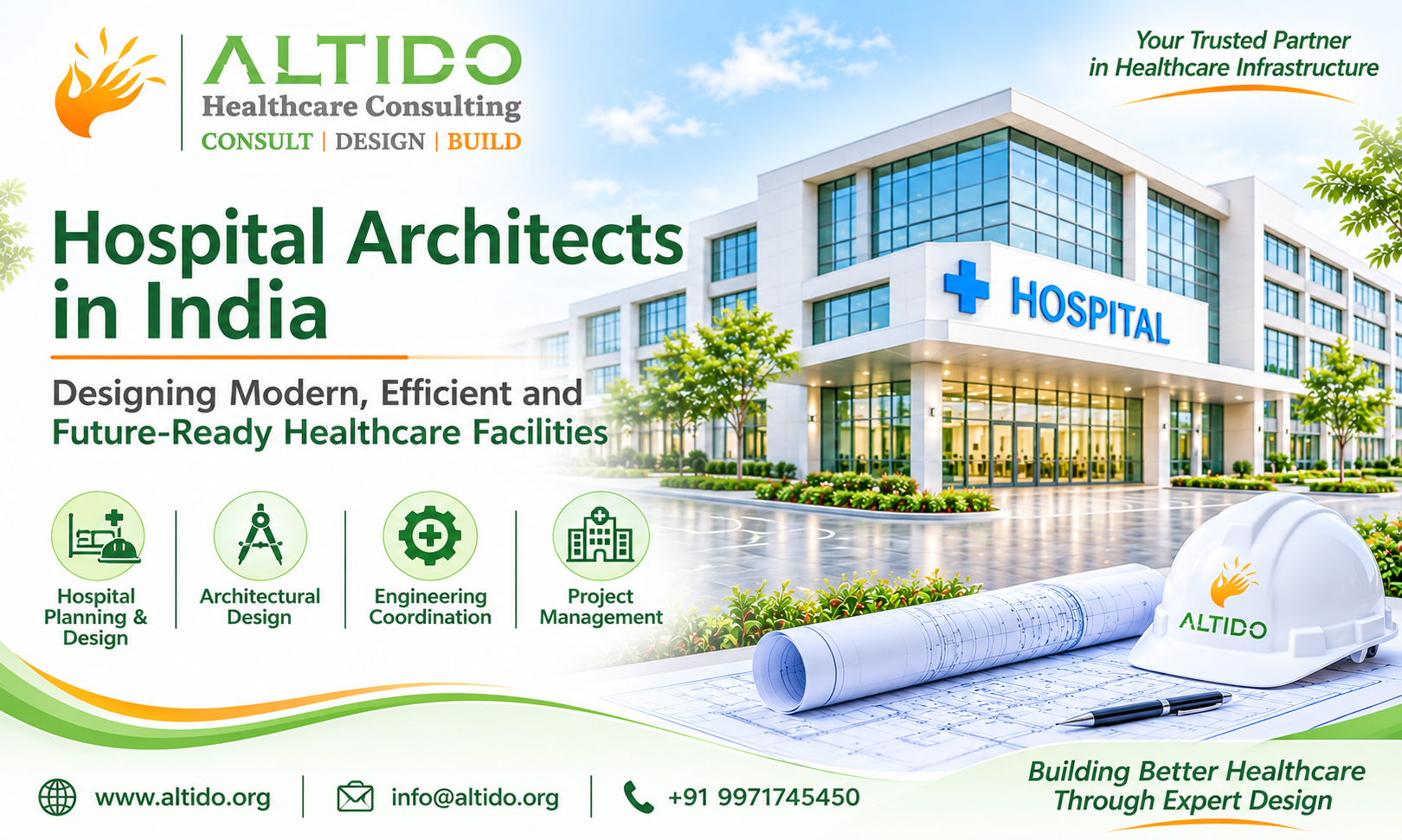
India’s healthcare sector is continuously expanding, creating new opportunities for hospital development, healthcare infrastructure investment, and specialized medical facilities. With increasing demand for quality healthcare services, hospitals require professionally planned buildings that combine modern architecture, clinical functionality, advanced technology, and patient comfort.
Choosing experienced Hospital Architects in India is an important step in developing a successful healthcare facility. Hospital architecture involves much more than designing an attractive building. It requires an understanding of medical workflows, departmental requirements, patient movement, engineering systems, safety standards, and long-term operational needs.
ALTIDO Healthcare Consulting provides comprehensive hospital planning, architectural design, engineering coordination, and project consultancy services to help healthcare investors and hospital owners develop efficient and future-ready medical infrastructure.
People Also Like to read this: Rehabilitation Centre Planning and Designing Consultant: Creating Modern and Patient-Centred Rehabilitation
Why Professional Hospital Architects Are Important
Hospital buildings are among the most complex types of infrastructure because they accommodate multiple medical departments, specialized equipment, healthcare professionals, patients, and support services.
Professional hospital architects understand the relationship between architectural planning and healthcare operations.
A well-designed hospital should provide:
- Efficient patient and staff circulation
- Proper departmental zoning
- Functional clinical layouts
- Infection prevention and control considerations
- Patient safety and accessibility
- Efficient space utilization
- Medical equipment integration
- Future expansion possibilities
- Comfortable patient and visitor environments
Working with experienced healthcare architects during the initial planning stage helps investors make better development decisions and minimize avoidable design changes.
Hospital Architecture Planning and Designing Services in India
Hospital architecture requires a multidisciplinary approach involving architectural design, clinical planning, structural engineering, MEP services, and medical equipment coordination.
ALTIDO Healthcare Consulting supports healthcare projects through various planning and design services.
1. Hospital Master Planning
Master planning establishes the overall development strategy for a hospital project.
It includes site analysis, building placement, departmental distribution, circulation planning, parking, landscaping, and future expansion provisions.
A comprehensive master plan helps ensure that the hospital’s available land is utilized effectively while maintaining accessibility and operational efficiency.
2. Clinical Planning and Departmental Zoning
Clinical planning is one of the most important aspects of hospital architecture.
Every department has specific space, equipment, operational, and technical requirements. Proper zoning ensures that departments are positioned according to their functional relationships.
Important hospital departments include:
- Outpatient Department (OPD)
- Emergency and Trauma Care
- Intensive Care Unit (ICU)
- Operation Theatre Complex
- Inpatient Department (IPD)
- Diagnostic Imaging
- Laboratory and Pathology
- Maternity and Labour Rooms
- Neonatal Intensive Care Unit (NICU)
- Dialysis Unit
- Pharmacy
- Central Sterile Supply Department (CSSD)
Proper clinical planning supports efficient workflows, patient convenience, and coordination between medical departments.
3. Architectural Design
Architectural design transforms the hospital master plan into a functional building.
The process considers building elevation, floor plans, circulation, room layouts, façade development, natural lighting, ventilation, and accessibility.
Hospital architectural drawings should be developed with a clear understanding of the clinical functions and engineering requirements of each department.
4. MEP and Structural Engineering Coordination
Modern hospitals require specialized engineering systems to support continuous healthcare operations.
These include:
- HVAC and ventilation systems
- Electrical distribution
- Plumbing and drainage
- Fire detection and protection
- Medical Gas Pipeline Systems (MGPS)
- Structural engineering
- Emergency power systems
- Modular operation theatre requirements
Coordination between architectural and engineering teams helps minimize design conflicts and supports efficient project execution.
5. Medical Equipment Planning
Medical equipment planning should begin during the architectural design stage.
Equipment dimensions, installation requirements, electrical provisions, medical gas connections, accessibility, and maintenance space must be considered before finalizing departmental layouts.
ALTIDO provides medical equipment planning support to help align hospital infrastructure with clinical requirements.
Types of Hospital Projects Designed by Healthcare Architects
Different healthcare facilities require different architectural and operational planning approaches.
Experienced hospital architects understand these variations and develop solutions according to the proposed healthcare services.
Multi-Specialty Hospitals: Facilities providing multiple medical and surgical specialties require carefully coordinated clinical departments and diagnostic services.
Super-Specialty Hospitals: These hospitals require advanced planning for specialized treatment facilities, critical care, operation theatres, and medical technology.
Mother and Child Hospitals: Planning focuses on maternity services, labour rooms, NICU, paediatric departments, and patient-friendly spaces.
Cancer Hospitals: These facilities require specialized oncology treatment areas, chemotherapy units, radiotherapy planning, diagnostic facilities, and supportive care spaces.
Rehabilitation Centres: These require accessible circulation, physiotherapy areas, occupational therapy spaces, recovery rooms, and patient-centred environments.
Medical Colleges and Teaching Hospitals: These projects combine academic infrastructure, clinical facilities, laboratories, teaching spaces, hostels, and administrative areas.
Important Factors to Consider Before Starting a Hospital Project
Hospital investors should evaluate several important factors before beginning architectural design.
1. Project Feasibility: Conduct market research and healthcare demand assessments to understand the project’s potential.
2. Location and Site Selection: Evaluate connectivity, land suitability, surrounding infrastructure, and development possibilities.
3. Hospital Capacity: Determine the appropriate number of beds based on patient demand, proposed specialties, and investment capacity.
4. Investment and Budget: Estimate land, construction, interiors, medical equipment, engineering, and operational expenses.
5. Regulatory Requirements: Identify applicable building regulations, healthcare licensing requirements, fire safety provisions, and statutory approvals with qualified local professionals.
6. Future Expansion: Consider additional departments, bed capacity, technology upgrades, and future development requirements.
A detailed feasibility study and business plan can help investors evaluate these factors before committing significant resources.
Role of Technology in Modern Hospital Architecture
Technology is transforming the way hospitals are planned, designed, and operated.
Modern healthcare infrastructure increasingly requires provisions for digital healthcare systems, automation, advanced diagnostic equipment, and integrated building management.
Important considerations include:
- Hospital Information Systems (HIS)
- Electronic Medical Records (EMR)
- Telemedicine infrastructure
- Smart patient monitoring systems
- Automated building management
- Digital wayfinding
- Energy-efficient building systems
- Advanced medical equipment integration
Hospital architects should coordinate these requirements during the design stage to create facilities that can adapt to changing healthcare technology.
Why Choose ALTIDO Healthcare Consulting?
ALTIDO Healthcare Consulting provides integrated healthcare infrastructure consultancy for investors, hospital owners, developers, and medical organizations.
Our approach connects the different stages of hospital development, from initial feasibility assessment to architectural design and project execution support.
Our services include:
- Hospital Feasibility Studies
- Market Research and Due Diligence
- Hospital Business Planning
- Hospital Architecture and Master Planning
- Clinical Planning and Departmental Zoning
- Architectural and Engineering Drawings
- Medical Equipment Planning
- MEP and Structural Engineering Coordination
- Interior and Landscape Design
- Project Management Consultancy
- Turnkey Healthcare Solutions
- Commissioning Management
With experience in healthcare infrastructure projects across different markets, ALTIDO focuses on developing practical, efficient, and future-ready healthcare environments.
Conclusion
Hospital architecture plays a significant role in determining the functionality, efficiency, and long-term sustainability of healthcare facilities. From site selection and master planning to clinical zoning, engineering coordination, and medical equipment integration, every stage requires specialized knowledge.
Selecting experienced Hospital Architects in India helps investors develop healthcare facilities that meet clinical requirements while supporting patient safety, operational efficiency, and future growth.
ALTIDO Healthcare Consulting offers comprehensive hospital planning, architectural design, and project consultancy services to support healthcare infrastructure development.
Whether you are planning a new hospital, expanding an existing medical facility, or developing a specialized healthcare centre, connect with ALTIDO Healthcare Consulting to discuss your project.