
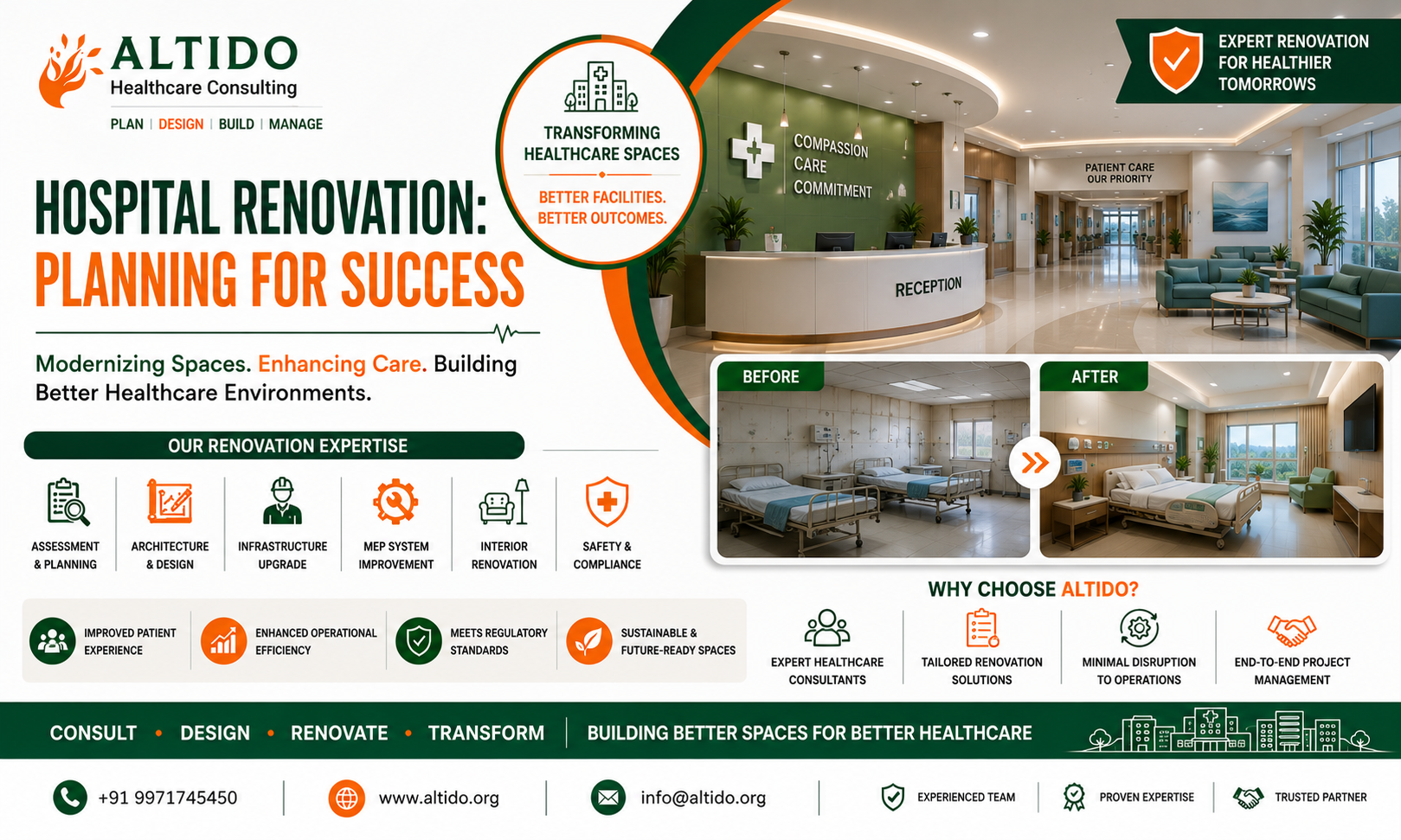
Healthcare facilities must continuously evolve to meet changing patient expectations, technological advancements, regulatory requirements, and operational demands. As hospitals age, renovation becomes essential to improve functionality, enhance patient experiences, and maintain healthcare standards. A well-planned renovation project can transform outdated healthcare facilities into modern, efficient, and patient-centered environments.
As a trusted Hospital Renovation Consultant and Hospital Renovation Company, Altido Healthcare Consulting specializes in planning, designing, and executing healthcare renovation projects that improve infrastructure while minimizing disruptions to ongoing medical services.
People Also Like to read this: A Step-by-Step Guide to Hospital Leasing & Operational Partnerships
Why Hospital Renovation Matters
Hospitals are among the most complex facilities to operate. Unlike commercial buildings, healthcare facilities function around the clock and must maintain strict safety, infection control, and operational standards.
Hospital renovation helps organizations:
- Upgrade aging infrastructure
- Improve patient experiences
- Enhance clinical efficiency
- Meet regulatory requirements
- Integrate new medical technologies
- Increase operational capacity
- Improve sustainability
- Strengthen hospital branding
A strategic renovation ensures healthcare facilities remain competitive and capable of delivering quality patient care.
Understanding Hospital Renovation
Hospital renovation involves modifying, upgrading, or expanding existing healthcare facilities to improve performance and functionality.
Renovation projects may include:
- Infrastructure modernization
- Department upgrades
- Patient room improvements
- Operation theatre renovation
- ICU modernization
- Emergency department expansion
- Diagnostic center upgrades
- Interior redesign
- MEP system improvements
Every renovation project requires careful planning to ensure seamless healthcare operations.
The Role of a Hospital Renovation Consultant
A professional Hospital Renovation Consultant helps healthcare organizations assess existing infrastructure and develop a renovation strategy aligned with operational goals.
Key responsibilities include:
Facility Assessment
Consultants evaluate:
- Building condition
- Structural integrity
- Workflow efficiency
- Utility infrastructure
- Regulatory compliance
- Future expansion potential
A comprehensive assessment identifies areas requiring immediate improvement.
Renovation Planning
Renovation consultants develop detailed strategies covering:
- Scope of work
- Budget estimation
- Phased execution plans
- Operational continuity
- Risk management
Proper planning minimizes disruptions and improves project outcomes.
Step 1: Assess Existing Infrastructure
The first step in any hospital renovation project is understanding the current condition of the facility.
This assessment includes:
- Structural evaluation
- Space utilization review
- Utility system analysis
- Department performance evaluation
- Safety compliance assessment
Healthcare consultants identify opportunities for modernization and operational improvement.
Step 2: Define Renovation Goals
Every hospital renovation project should begin with clearly defined objectives.
Common goals include:
- Increasing patient capacity
- Improving workflow efficiency
- Modernizing healthcare infrastructure
- Enhancing patient comfort
- Supporting advanced medical technologies
- Achieving sustainability targets
Well-defined goals help guide design and investment decisions.
Step 3: Conduct Feasibility Analysis
A feasibility study helps determine whether renovation plans are financially and operationally viable.
Key factors include:
- Budget requirements
- Operational impact
- Project timelines
- Return on investment
- Expansion opportunities
Feasibility analysis ensures realistic project planning.
Step 4: Develop a Master Renovation Plan
A renovation master plan outlines project phases and implementation strategies.
Components include:
- Department upgrades
- Infrastructure improvements
- Construction sequencing
- Utility modifications
- Temporary relocation plans
Master planning helps maintain uninterrupted healthcare services during renovation.
Step 5: Upgrade Hospital Infrastructure
Infrastructure modernization is often a major component of renovation projects.
Areas requiring upgrades may include:
Building Systems
- HVAC systems
- Electrical networks
- Plumbing systems
- Fire safety infrastructure
Medical Gas Systems
Modern healthcare facilities require reliable medical gas infrastructure for patient care.
Information Technology Systems
Digital healthcare technologies require upgraded IT infrastructure and connectivity.
Infrastructure upgrades improve reliability and operational efficiency.
Step 6: Improve Patient-Centered Spaces
Modern healthcare design prioritizes patient comfort and well-being.
Patient-focused renovation strategies include:
- Private patient rooms
- Comfortable waiting areas
- Improved lighting
- Enhanced accessibility
- Healing environments
These improvements contribute to better patient satisfaction and recovery experiences.
Step 7: Modernize Clinical Departments
Clinical areas must support evolving healthcare technologies and treatment methods.
Operation Theatre Renovation
OT modernization may include:
- Advanced air filtration systems
- Modular OT solutions
- Integrated surgical technologies
- Improved infection control measures
ICU Upgrades
ICU renovation focuses on:
- Enhanced monitoring capabilities
- Improved visibility
- Isolation facilities
- Technology integration
Emergency Department Expansion
Emergency departments often require:
- Additional treatment bays
- Improved patient flow
- Better ambulance access
- Enhanced triage systems
Department modernization supports better healthcare outcomes.
Step 8: Focus on Infection Control
Infection prevention remains a critical consideration during renovation projects.
Design strategies include:
- Separate circulation pathways
- Isolation facilities
- Antimicrobial surfaces
- Improved ventilation systems
- Sterile utility spaces
Effective infection control design protects patients and healthcare staff.
Step 9: Integrate Smart Healthcare Technologies
Technology plays an increasingly important role in healthcare delivery.
Hospital renovations often include:
- Electronic medical records
- Smart building management systems
- Telemedicine infrastructure
- Digital patient monitoring
- Automated lighting and HVAC systems
Technology integration improves operational efficiency and patient care quality.
Step 10: Implement Sustainable Design Solutions
Sustainability is becoming a priority in healthcare infrastructure development.
Green renovation initiatives include:
- Energy-efficient lighting
- Water conservation systems
- Renewable energy integration
- Sustainable materials
- Waste reduction strategies
Sustainable hospitals reduce operational costs while supporting environmental goals.
Managing Renovation in Operational Hospitals
One of the greatest challenges in hospital renovation is maintaining healthcare services during construction.
Successful renovation projects require:
- Phased construction schedules
- Temporary department relocations
- Noise control measures
- Dust containment systems
- Safety management protocols
Careful coordination minimizes disruption to patient care.
Challenges in Hospital Renovation
Hospital renovation projects often face unique challenges.
Common issues include:
- Limited construction space
- Ongoing patient care requirements
- Regulatory compliance
- Budget constraints
- Technology integration complexities
- Infection control management
Experienced healthcare consultants help mitigate these challenges through strategic planning.
Benefits of Hospital Renovation
A successful renovation project delivers significant advantages.
Improved Patient Experience
Modernized facilities create more comfortable and welcoming healthcare environments.
Enhanced Operational Efficiency
Optimized workflows improve staff productivity and healthcare delivery.
Increased Revenue Opportunities
Upgraded facilities can attract more patients and support additional healthcare services.
Regulatory Compliance
Renovations help hospitals meet evolving healthcare regulations and accreditation requirements.
Future Readiness
Modern infrastructure supports future technological and operational advancements.
Why Choose a Professional Hospital Renovation Company?
Healthcare renovation requires specialized expertise that differs significantly from conventional construction projects.
A professional Hospital Renovation Company provides:
- Healthcare-specific planning
- Regulatory guidance
- Clinical workflow expertise
- Engineering coordination
- Project management support
- Infection control planning
Working with specialists ensures healthcare projects are completed efficiently and safely.
Why Choose Altido Healthcare Consulting?
Altido Healthcare Consulting offers comprehensive healthcare renovation and modernization solutions tailored to healthcare providers’ unique requirements.
Key strengths include:
- Healthcare infrastructure expertise
- Hospital renovation planning
- Architecture and interior design
- MEP engineering coordination
- Technology integration
- Turnkey project management
The company helps healthcare organizations modernize facilities while maintaining operational excellence.
Future Trends in Hospital Renovation
Healthcare renovation projects are increasingly focused on:
- Smart hospital technologies
- Flexible healthcare spaces
- Sustainable infrastructure
- Patient-centered design
- Digital healthcare integration
- Modular healthcare solutions
Hospitals that embrace these trends will be better positioned to meet future healthcare demands.
Conclusion
Hospital renovation is a strategic investment that improves patient care, operational efficiency, and long-term healthcare sustainability. Whether upgrading aging infrastructure, expanding clinical services, or integrating advanced technologies, careful planning is essential for success.
As an experienced Hospital Renovation Consultant and Hospital Renovation Company, Altido Healthcare Consulting provides end-to-end renovation solutions that transform healthcare facilities into modern, efficient, and future-ready environments.
With expert planning, innovative design, and specialized healthcare knowledge, Altido helps hospitals achieve successful renovation outcomes while continuing to deliver exceptional patient care.