
The healthcare industry in India continues to grow rapidly, driven by increasing population, rising healthcare awareness, expanding health insurance coverage, and government initiatives to improve medical infrastructure. As a result, investing in hospitals has become an attractive opportunity for entrepreneurs, healthcare organizations, trusts, doctors, and private equity firms.
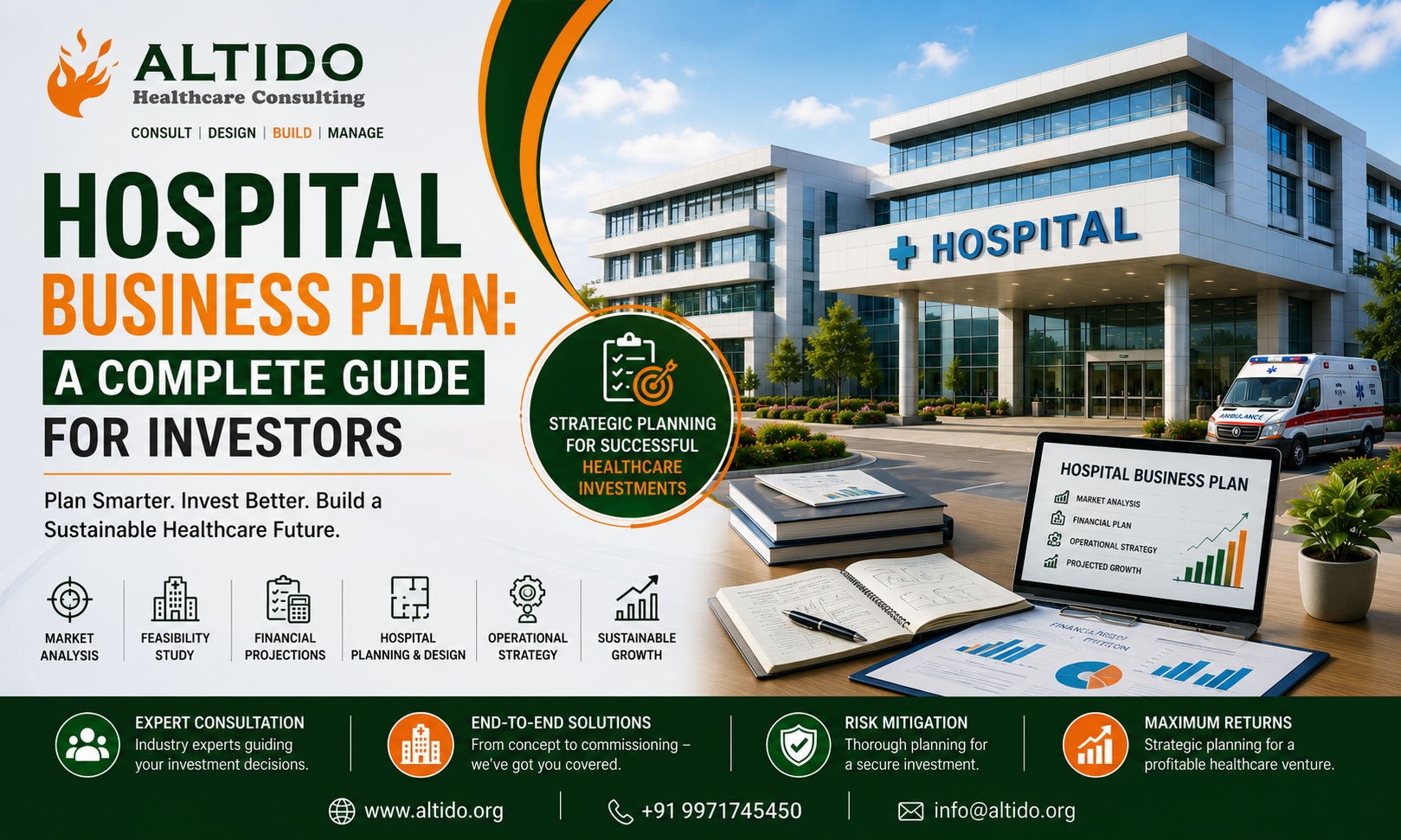
However, building a successful hospital requires much more than capital investment. A well-prepared Hospital Business Plan serves as the roadmap for transforming a healthcare vision into a profitable, sustainable, and patient-centric institution. It outlines every aspect of the project—from market analysis and financial planning to hospital design, operational strategy, and long-term growth.
At Altido Healthcare Consulting, we specialize in preparing comprehensive hospital business plans, feasibility studies, hospital planning, healthcare architecture, medical equipment planning, and turnkey healthcare consulting solutions that help investors make informed decisions and build world-class healthcare facilities.
People Also Like to read this: How Much Does It Cost to Build a Hospital in India in 2026? A Complete Cost Guide
What is a Hospital Business Plan?
A Hospital Business Plan is a detailed document that defines the strategy for establishing, operating, and growing a hospital. It includes financial projections, market research, infrastructure planning, staffing requirements, marketing strategies, risk analysis, and operational workflows.
Whether you are planning a 50-bed community hospital or a 500-bed multispecialty healthcare facility, a business plan provides clarity, direction, and confidence for investors and lenders.
Why is a Hospital Business Plan Important?
A professionally prepared business plan helps investors understand:
- Project feasibility
- Market demand
- Investment requirements
- Revenue potential
- Operational costs
- Risk factors
- Break-even timeline
- Return on investment (ROI)
Banks, financial institutions, venture capital firms, and healthcare investors often require a detailed hospital business plan before approving funding.
Key Components of a Hospital Business Plan
1. Executive Summary
The executive summary provides a snapshot of the entire project.
It includes:
- Hospital concept
- Vision and mission
- Location
- Bed capacity
- Specialty services
- Investment requirement
- Competitive advantages
- Financial highlights
Although placed at the beginning, it is usually prepared after completing the full business plan.
2. Market Research and Demand Analysis
Understanding the local healthcare market is essential before investing.
A market study includes:
- Population demographics
- Disease patterns
- Existing hospitals
- Competitor analysis
- Patient expectations
- Healthcare gaps
- Medical tourism opportunities
This analysis helps determine the services the hospital should offer.
3. Hospital Location Analysis
Choosing the right location significantly impacts hospital success.
Factors include:
- Accessibility
- Population density
- Connectivity
- Availability of utilities
- Nearby healthcare facilities
- Future development potential
A strategic location improves patient access and long-term profitability.
4. Hospital Size and Capacity Planning
The business plan defines:
- Number of beds
- Departments
- Outpatient clinics
- Emergency services
- Diagnostic facilities
- Operation theatres
- ICU capacity
- Future expansion opportunities
Capacity planning should align with market demand and financial goals.
5. Hospital Planning and Architecture
Hospital infrastructure directly affects operational efficiency.
Professional planning includes:
- Master planning
- Department layouts
- Patient flow
- Staff circulation
- Infection control
- Space optimization
- Future expansion
Working with experienced healthcare architects ensures compliance with healthcare standards while maximizing efficiency.
6. Medical Equipment Planning
Medical equipment represents a significant investment.
Planning includes:
- Diagnostic equipment
- Imaging systems
- ICU equipment
- Operation theatre equipment
- Laboratory systems
- Medical gas systems
Proper equipment planning avoids unnecessary expenses while supporting clinical excellence.
7. Human Resource Planning
Hospitals rely on skilled healthcare professionals.
The staffing plan includes:
- Doctors
- Nurses
- Technicians
- Pharmacists
- Administrative staff
- Housekeeping
- Security
- Biomedical engineers
A workforce strategy ensures efficient hospital operations.
8. Financial Planning
Financial planning is the foundation of a successful hospital business plan.
It includes:
Capital Investment
- Land acquisition
- Construction
- Medical equipment
- Furniture
- IT infrastructure
- Engineering systems
Operational Costs
- Salaries
- Utilities
- Maintenance
- Medicines
- Consumables
- Marketing
- Administrative expenses
Revenue Sources
- OPD consultations
- IPD admissions
- Surgeries
- Diagnostics
- Pharmacy
- ICU services
- Health packages
- Insurance reimbursements
- Corporate healthcare contracts
9. Marketing Strategy
Even the best hospital requires effective marketing.
A marketing plan may include:
- Digital marketing
- SEO
- Google Business Profile optimization
- Social media campaigns
- Community outreach
- Health awareness programs
- Corporate tie-ups
- Referral networks
A strong brand presence builds trust and attracts patients.
10. Legal and Regulatory Compliance
Hospitals must comply with various statutory requirements.
These include:
- Hospital registration
- Fire safety approval
- Pollution control clearance
- Biomedical waste management authorization
- Clinical Establishment regulations
- NABH preparation
- Local building approvals
Proper compliance ensures uninterrupted operations.
Risk Assessment
Every hospital project carries certain risks.
Potential risks include:
- Market competition
- Construction delays
- Cost escalation
- Staffing shortages
- Technology upgrades
- Regulatory changes
- Economic fluctuations
A business plan identifies these risks and recommends mitigation strategies.
Importance of Feasibility Studies
Before finalizing the business plan, a comprehensive feasibility study should be conducted.
This includes:
- Technical feasibility
- Financial feasibility
- Operational feasibility
- Market feasibility
A feasibility study validates the project’s viability and supports better investment decisions.
Role of Technology in Modern Hospitals
Healthcare technology improves patient care and operational efficiency.
Modern hospitals integrate:
- Hospital Information System (HIS)
- Electronic Medical Records (EMR)
- PACS
- Telemedicine
- Smart Building Management Systems
- IoT-enabled monitoring
- AI-powered diagnostics
Technology planning should be incorporated into the business plan from the beginning.
Why Choose Altido Healthcare Consulting?
Altido Healthcare Consulting offers end-to-end healthcare consulting services for investors, healthcare providers, trusts, and government organizations.
Our expertise includes:
- Hospital Business Plans
- Feasibility Studies
- Detailed Project Reports (DPR)
- Hospital Planning & Design
- Healthcare Architecture
- Medical Equipment Planning
- MEP Engineering
- Interior Design
- Project Management
- Consultancy (PMC)
- Turnkey Hospital Solutions
- Licensing & Accreditation Support
Our multidisciplinary team combines healthcare, architecture, engineering, finance, and management expertise to deliver successful healthcare projects.
Benefits of a Professional Hospital Business Plan
A professionally developed business plan helps investors:
- Reduce investment risks
- Secure funding
- Improve operational efficiency
- Optimize infrastructure planning
- Forecast revenue accurately
- Control project costs
- Support future expansion
- Enhance long-term profitability
Future of Hospital Investments
Healthcare demand will continue to grow due to:
- Population growth
- Aging demographics
- Medical tourism
- Health insurance expansion
- Digital healthcare
- Government healthcare initiatives
Hospitals planned today should be adaptable, sustainable, technology-enabled, and patient-centric.
Conclusion
A successful hospital begins with a strong business plan. From financial projections and feasibility studies to hospital planning, architecture, staffing, and operational strategies, every aspect must be carefully evaluated before construction begins.
A comprehensive Hospital Business Plan minimizes investment risks, improves decision-making, and provides a clear roadmap for developing a financially sustainable healthcare facility.
Altido Healthcare Consulting specializes in preparing investor-ready hospital business plans, feasibility studies, healthcare architecture, and project management solutions tailored to hospitals of all sizes. Whether you are establishing a new multispecialty hospital, expanding an existing healthcare facility, or seeking funding, our experienced team can help you turn your vision into a successful healthcare enterprise.
Altido Healthcare Consulting – Consult | Design | Build | Manage