
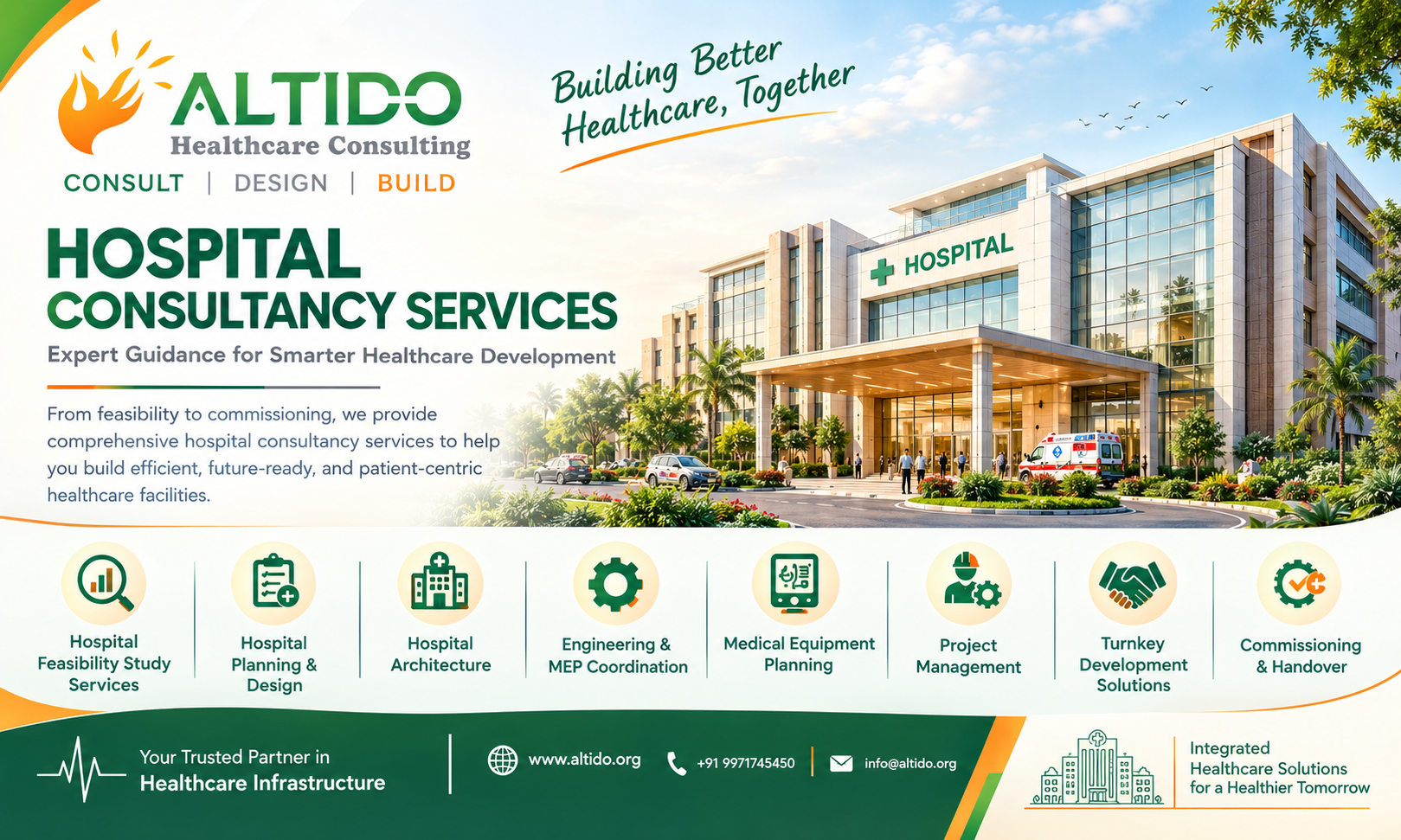
Developing a hospital is a complex process that requires much more than architectural design and construction. From understanding market demand and selecting the right service mix to planning clinical departments, medical equipment, infrastructure, finances, and operations, every decision can influence the long-term success of a healthcare project.
This is where Hospital Consultancy Services play an important role. A professional healthcare consultant brings together healthcare planning, architecture, engineering, financial analysis, medical planning, project management, and operational expertise to help investors and healthcare organizations make informed decisions at every stage of hospital development.
Altido Healthcare Consulting provides integrated healthcare consulting solutions for new hospitals, hospital expansion, renovation, redevelopment, and modernization projects. With a focus on practical planning and project execution, Altido supports healthcare organizations from the initial concept and feasibility stage through design, construction, commissioning, and project handover.
People Also Like to read this: New Hospital Planning and Designing Architect Company in India
What Are Hospital Consultancy Services?
Hospital consultancy services cover the professional advice and planning required to develop, improve, or expand a healthcare facility. Unlike conventional construction consultancy, hospital consulting requires an understanding of clinical workflows, healthcare operations, medical technology, patient movement, infection control, infrastructure, and regulatory requirements.
A hospital consultant can assist with:
- Healthcare market research
- Hospital feasibility studies
- Business planning
- Bed capacity and service planning
- Clinical planning
- Hospital architecture and space planning
- Medical equipment planning
- MEP and engineering coordination
- Project management consultancy
- Hospital renovation and expansion
- Procurement support
- Commissioning and operational readiness
The objective is to create a hospital that is operationally efficient, financially practical, patient-focused, and capable of adapting to future healthcare requirements.
Importance of Hospital Feasibility Study Services
Before investing substantial capital in a hospital project, it is essential to determine whether the proposed project is viable. Hospital Feasibility Study Services help investors understand the opportunities, risks, market conditions, and operational requirements associated with a proposed healthcare facility.
A feasibility study can help answer important questions such as:
- Is there sufficient healthcare demand in the proposed location?
- What type of hospital should be developed?
- How many beds should be planned?
- Which medical specialties should be included?
- Who are the target patients?
- What healthcare facilities already exist in the surrounding market?
- What investment may be required?
- What infrastructure and equipment will be needed?
- What revenue-generating departments can be developed?
- What operational resources will be required?
These assessments provide a structured foundation for investment and development decisions.
Hospital Detailed Feasibility Study
A Hospital Detailed Feasibility Study goes beyond a basic assessment of market demand. It examines the proposed hospital project from multiple perspectives and creates a detailed roadmap for development.
Depending on the project requirements, a detailed feasibility assessment may include:
1. Market Assessment
The healthcare market surrounding the proposed project is studied to understand population characteristics, healthcare demand, existing hospitals, competing facilities, specialty availability, and potential gaps in healthcare services.
2. Hospital Concept Development
The consultant helps define the hospital’s proposed positioning, service profile, specialties, bed strength, target patient segments, and broad operational model.
3. Financial Feasibility
The project is evaluated in terms of anticipated capital investment, operating expenditure, revenue potential, department-wise income opportunities, staffing requirements, and financial projections.
4. Site Assessment
The proposed site can be assessed for accessibility, surrounding development, land characteristics, connectivity, parking requirements, future expansion opportunities, and suitability for the proposed hospital model.
5. Capacity Planning
Bed capacity and departmental requirements are evaluated according to the intended healthcare services. This may include OPD, emergency, ICU, OT, diagnostics, wards, maternity, dialysis, rehabilitation, and other specialty departments.
6. Infrastructure Planning
The study considers the infrastructure requirements necessary to support clinical and non-clinical functions, including electrical systems, HVAC, plumbing, fire protection, medical gases, IT infrastructure, and other engineering services.
Hospital Planning and Architectural Consultancy
Once the feasibility stage establishes the project direction, detailed hospital planning becomes critical.
Hospital planning is different from designing a conventional commercial building. The layout needs to support efficient movement of patients, doctors, nurses, visitors, equipment, supplies, and waste while maintaining appropriate separation between different functions.
Altido’s hospital planning approach can address:
- Master planning
- Departmental zoning
- Space programming
- Patient and staff circulation
- Emergency planning
- OPD planning
- ICU and critical-care planning
- Operation theatre planning
- Diagnostic department planning
- Ward planning
- Maternity and pediatric areas
- Support services
- Administrative areas
- Future expansion
Good planning can help reduce unnecessary movement, improve workflow, support operational efficiency, and create a better environment for patients and healthcare professionals.
Medical Equipment Planning
Medical equipment represents a significant component of hospital investment and directly influences clinical functionality.
Hospital consultants can coordinate medical equipment planning with architectural and engineering requirements. This includes identifying equipment categories, preparing departmental equipment requirements, determining space requirements, considering utility requirements, and coordinating equipment locations with hospital workflows.
Proper equipment planning also helps avoid situations where expensive equipment cannot be installed or operated efficiently because of inadequate space, infrastructure, or utility provisions.
Engineering and Infrastructure Consultancy
A hospital requires highly coordinated engineering systems. Electrical power, HVAC, plumbing, fire safety, medical gas systems, water supply, drainage, communication systems, and other services need to work together with the architectural design.
Hospital consultancy can therefore include coordination between architecture, clinical planning, structural requirements, MEP services, medical equipment, and operational needs.
This integrated approach can reduce design conflicts and support smoother project execution.
Project Management and Implementation Support
Planning is only one part of hospital development. Effective implementation is equally important.
Hospital consultants can support project owners through different stages of execution, including:
- Design coordination
- Project scheduling
- BOQ and cost coordination
- Contractor coordination
- Procurement support
- Site monitoring
- Quality coordination
- Equipment installation coordination
- Commissioning
- Handover and operational readiness
An integrated consultancy approach allows project decisions to remain aligned with the original hospital concept.
Why Choose Altido Healthcare Consulting?
Altido Healthcare Consulting provides a comprehensive approach to healthcare infrastructure development. Instead of treating feasibility, architecture, engineering, equipment, and execution as isolated activities, Altido brings these requirements together under an integrated healthcare consultancy model.
Its services can support clients through the complete project lifecycle, including:
Consult | Design | Build | Manage
From feasibility and due diligence to hospital architecture, engineering, medical equipment planning, project management, turnkey development, and commissioning, the objective is to create healthcare facilities that are functional, efficient, and future-ready.
Whether the requirement is a new hospital, specialty hospital, multispecialty facility, hospital expansion, renovation, or redevelopment project, professional consultancy can provide a structured framework for making important project decisions.
Conclusion
Successful hospital development begins long before construction starts. Understanding the market, defining the healthcare concept, evaluating financial feasibility, planning clinical departments, coordinating infrastructure, and preparing for implementation are all essential components of a healthcare project.
Professional Hospital Consultancy Services can help investors and healthcare organizations navigate these interconnected requirements. From Hospital Feasibility Study Services to a comprehensive Hospital Detailed Feasibility Study, hospital planning, architecture, medical equipment, engineering, project management, and commissioning, an integrated approach can provide stronger coordination throughout the project lifecycle.
With its healthcare-focused consultancy approach, Altido Healthcare Consulting helps clients transform healthcare project concepts into well-planned and professionally coordinated healthcare facilities.