
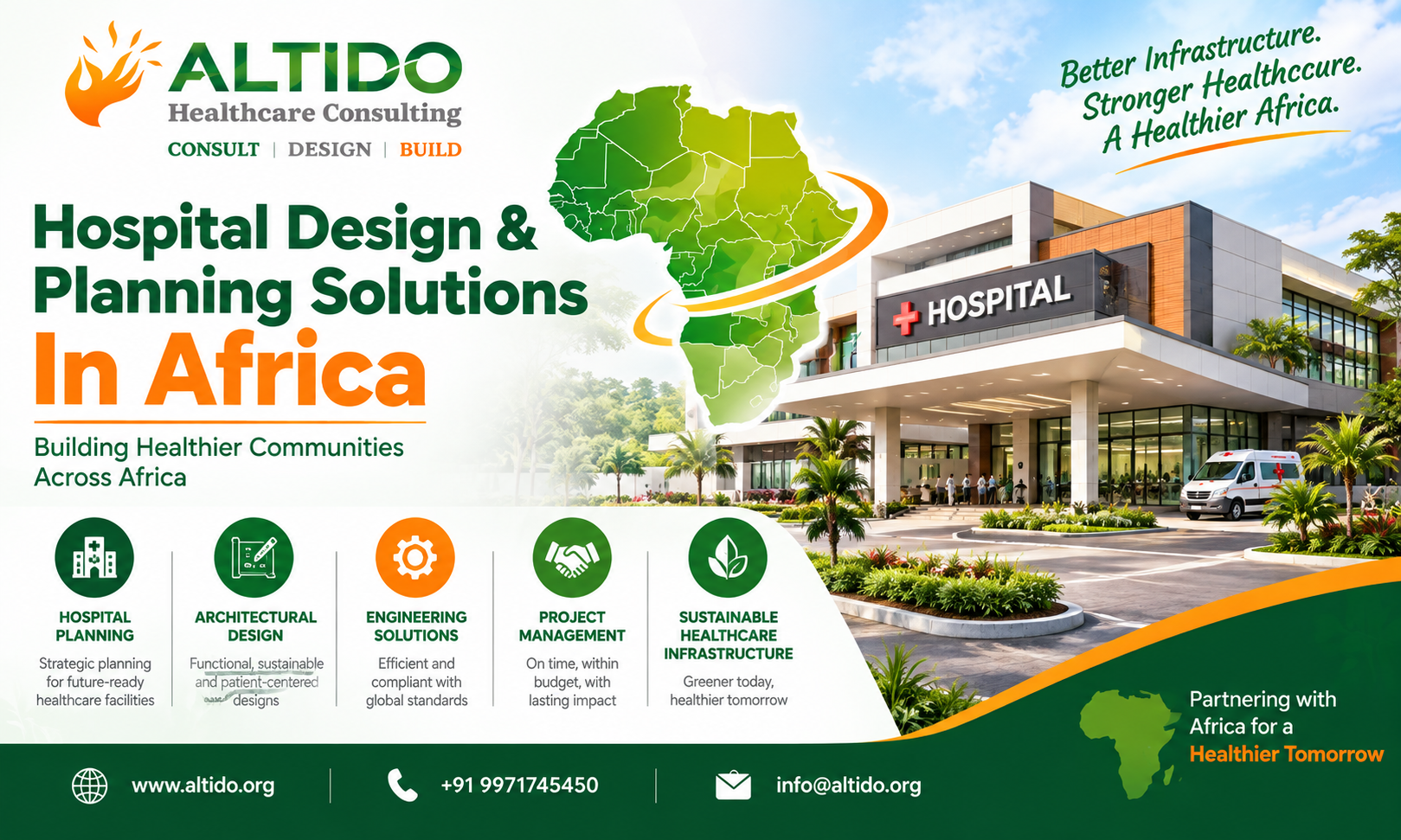
Africa’s healthcare sector is experiencing significant demand for modern, accessible, efficient, and future-ready healthcare infrastructure. As populations grow and healthcare needs become more complex, hospitals must be planned not only as buildings but as integrated healthcare environments that support clinical services, medical technology, staff efficiency, patient safety, and long-term operational sustainability.
Choosing the right Hospital Design & Planning Consultant In Africa is therefore an important step for healthcare investors, hospital owners, governments, healthcare organizations, and developers planning a new facility or upgrading an existing one.
At Altido Healthcare Consulting, we provide comprehensive healthcare planning, architectural design, engineering coordination, medical equipment planning, project management, and turnkey healthcare solutions designed around the specific requirements of each project.
People Also like to read this: Hospital Design and Planning Consultant in Papua New Guinea
Why Professional Hospital Planning Is Important in Africa
Hospital development involves considerably more than designing attractive buildings. A successful healthcare facility requires coordination between clinical functions, architecture, engineering, equipment, technology, patient movement, staff circulation, emergency access, utilities, and future expansion.
African healthcare projects can also have different requirements depending on the country, city, population, healthcare model, available infrastructure, climatic conditions, and project objectives.
Professional hospital planning helps establish a clear development strategy before construction begins. It can help reduce design conflicts, improve space utilization, support efficient clinical workflows, and create an infrastructure framework that can adapt to changing healthcare requirements.
WHO emphasizes that effective hospitals require reliable infrastructure, appropriate technology, well-planned spaces, resilience, and designs that respond to the needs of the communities they serve.
Hospital Design & Planning Consultant In Africa
A Hospital Design & Planning Consultant In Africa plays a multidisciplinary role throughout the development of a healthcare project.
The planning process generally begins with understanding the project’s objectives, target population, clinical specialties, bed capacity, healthcare delivery model, investment strategy, site conditions, and expected future growth.
At Altido Healthcare Consulting, hospital planning can cover:
- Hospital feasibility studies
- Healthcare market research
- Due diligence
- Bed and capacity planning
- Clinical department planning
- Hospital master planning
- Architectural planning and designing
- Medical equipment planning
- MEP and engineering coordination
- Interior and landscape planning
- Project management consultancy
- Procurement support
- Commissioning and handover
- Turnkey healthcare project solutions
This integrated approach allows different project components to be coordinated from the beginning rather than addressed separately during construction.
Hospital Master Planning and Space Programming
Master planning establishes the overall framework for the hospital campus. It considers the relationship between buildings, roads, parking, emergency access, service access, landscaping, utilities, future expansion areas, and pedestrian movement.
Space programming then translates the hospital’s clinical requirements into functional areas.
Depending on the project, planning may include:
- Outpatient departments
- Emergency and trauma services
- Intensive Care Units
- Operating theatres
- Diagnostic imaging
- Laboratories
- Pharmacy
- Maternity and neonatal services
- Dialysis
- Inpatient wards
- Private and general rooms
- Administration
- CSSD
- Medical stores
- Kitchen and dietary services
- Housekeeping
- Biomedical and engineering areas
Efficient zoning and circulation are particularly important because patients, visitors, doctors, nurses, materials, waste, and emergency services should be able to move through the hospital without unnecessary conflicts.
Patient-Centred Hospital Architecture
Modern hospital architecture should create an environment that supports patients as well as healthcare professionals.
Clear wayfinding, accessible entrances, comfortable waiting areas, appropriate daylight, privacy, safe circulation, ventilation, acoustic comfort, and supportive outdoor spaces can contribute to a better healthcare environment.
Patient-centred planning is also important for children, elderly patients, people with disabilities, and patients requiring long-term care.
The design should balance clinical efficiency with dignity, comfort, safety, and ease of navigation.
Climate-Responsive Hospital Design
Africa contains a wide range of climatic conditions, from hot and arid environments to tropical and humid regions. Hospital design should therefore respond to the local climate rather than follow a single architectural model.
Depending on the location, solutions may include:
- Solar shading
- Recessed windows
- External fins and screens
- Natural daylight strategies
- Efficient building orientation
- Controlled glazing
- Thermal insulation
- Efficient HVAC systems
- Covered pedestrian walkways
- Water-efficient landscaping
- Renewable energy integration where appropriate
Climate-responsive planning can contribute to a more comfortable healthcare environment while supporting long-term operational efficiency.
WHO has highlighted climate resilience and healthcare-space design as important considerations for healthcare facilities, including experiences from African countries such as Ethiopia and Kenya.
Medical Equipment Planning
Medical equipment has a direct relationship with hospital architecture and engineering.
Equipment planning should therefore begin during the design stage rather than after construction. Imaging systems, operating theatre equipment, ICU equipment, laboratory systems, dialysis equipment, medical gas systems, sterilization equipment, and other technologies require appropriate room dimensions, electrical capacity, HVAC, plumbing, structural provisions, access routes, and maintenance considerations.
A coordinated medical equipment plan can help ensure that clinical spaces are designed around actual operational requirements.
Engineering and Healthcare Infrastructure
Reliable infrastructure is fundamental to hospital operations.
Hospital engineering planning may include:
- Electrical systems
- HVAC systems
- Plumbing
- Fire and life-safety systems
- Medical gas pipeline systems
- Backup power
- Water supply and treatment
- Drainage
- Vertical transportation
- ICT infrastructure
- Security systems
- Building management systems
Particular attention should be given to critical infrastructure and backup systems because hospitals must continue providing essential services during disruptions.
WHO notes that water, energy, telecommunications, technology, and other infrastructure form the backbone of hospital operations and should incorporate appropriate resilience and redundancy.
Future-Ready Hospital Development
Healthcare requirements change over time. A hospital designed only for current requirements may face capacity and operational limitations in the future.
Future-ready hospital planning can include provisions for:
- Additional beds
- New clinical departments
- Expansion of diagnostic services
- Additional operating theatres
- New medical technologies
- Digital healthcare systems
- Additional parking
- Future buildings
- Infrastructure capacity upgrades
Planning expansion possibilities during the initial master-planning stage can reduce disruption when the hospital eventually grows.
Hospital Renovation and Expansion Planning
Hospital development in Africa is not limited to new construction. Existing healthcare facilities may require renovation, redevelopment, modernization, or expansion.
Renovation planning must carefully consider how construction activities will affect ongoing patient services.
A professional consultant can develop phased planning strategies that help separate construction zones from active clinical areas while maintaining essential hospital operations.
This may include department relocation, temporary facilities, phased construction, circulation modifications, infrastructure upgrades, and modernization of clinical spaces.
Why Choose Altido Healthcare Consulting?
Altido Healthcare Consulting provides an integrated approach to healthcare infrastructure development, supporting projects from initial concept and feasibility through planning, design, execution, and commissioning.
Our healthcare consulting approach combines:
Consult | Design | Build | Manage
Our services can support new hospitals, specialty hospitals, multispecialty facilities, healthcare expansions, renovations, and redevelopment projects.
By coordinating feasibility, hospital planning, architecture, engineering, medical equipment, project management, and implementation requirements, Altido helps clients develop healthcare facilities that are functional, efficient, patient-focused, and prepared for future growth.
Conclusion
Developing a hospital in Africa requires a clear understanding of healthcare delivery, local conditions, infrastructure, clinical workflows, technology, patient needs, and long-term development objectives.
A qualified Hospital Design & Planning Consultant In Africa can help transform these requirements into a coordinated healthcare infrastructure strategy.
From feasibility studies and master planning to architectural design, engineering coordination, medical equipment planning, project management, renovation, expansion, and commissioning, Altido Healthcare Consulting provides end-to-end solutions for healthcare infrastructure development.
For organizations planning a new hospital or looking to modernize an existing healthcare facility, professional planning at the beginning of the project can establish a stronger foundation for successful healthcare delivery.