
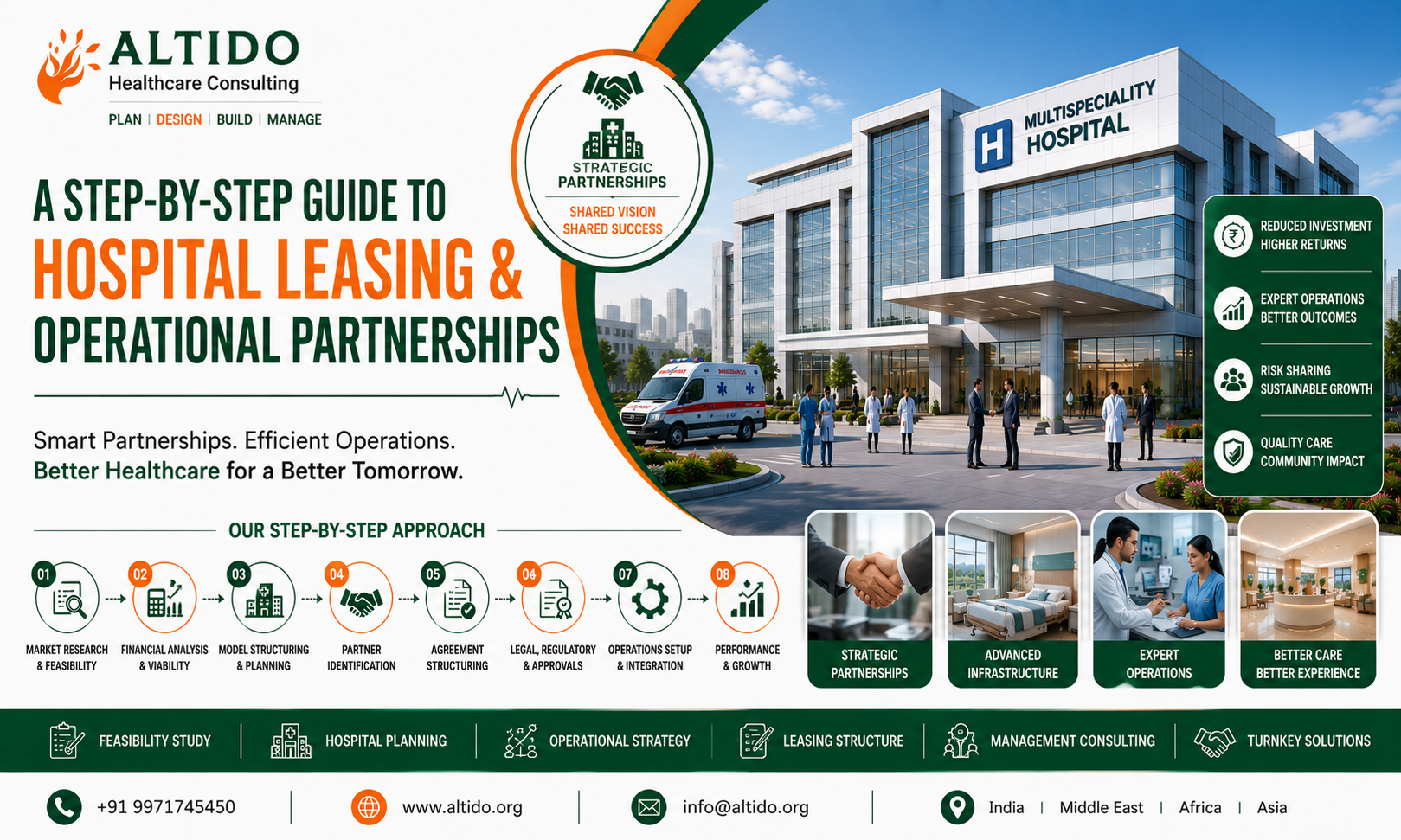
The healthcare industry is evolving rapidly, and hospitals today are exploring innovative business models to improve financial sustainability, operational efficiency, and healthcare accessibility. One of the most effective strategies emerging in the healthcare sector is Hospital Leasing & Operational Partnerships. These models allow healthcare investors, property owners, and medical operators to collaborate efficiently while minimizing financial risks and maximizing healthcare delivery capabilities.
Hospital leasing and operational partnerships are becoming increasingly popular in India and global healthcare markets because they offer flexible solutions for healthcare infrastructure development and management. Altido Healthcare specializes in healthcare planning, hospital infrastructure consulting, and strategic operational partnership solutions that help healthcare institutions establish successful and sustainable healthcare facilities.
People Also Like to read this: Architects for Hospital Design: Creating Modern Healthcare Infrastructure for Better Patient Care
Understanding Hospital Leasing
Hospital leasing refers to an arrangement where a healthcare facility owner leases hospital infrastructure to a healthcare operator or medical organization for running healthcare services.
In this model:
- The property owner develops or owns the hospital infrastructure.
- The healthcare operator manages medical services and hospital operations.
- Both parties work together under mutually agreed financial and operational terms.
Hospital leasing helps reduce investment pressure on healthcare operators while enabling property owners to generate stable long-term revenue.
What Are Operational Partnerships in Healthcare?
Operational partnerships involve collaboration between healthcare investors, hospital operators, medical professionals, and healthcare consultants to manage and operate healthcare facilities effectively.
These partnerships may include:
- Hospital management agreements
- Revenue-sharing models
- Joint ventures
- Public-private partnerships (PPP)
- Clinical collaboration agreements
- Specialty healthcare partnerships
Operational partnerships help combine infrastructure, expertise, and healthcare resources for better healthcare delivery.
Importance of Hospital Leasing & Operational Partnerships
Healthcare infrastructure development requires substantial investment, operational expertise, and regulatory compliance. Leasing and partnership models help distribute risks while improving project feasibility.
Key benefits include:
- Reduced financial burden
- Faster project execution
- Operational efficiency
- Access to healthcare expertise
- Improved patient care
- Better resource utilization
- Scalability and flexibility
Healthcare partnerships allow hospitals to focus on delivering quality care while optimizing business operations.
Step 1: Conduct Healthcare Market Research
The first step in hospital leasing and operational partnerships is understanding market demand.
Healthcare market research includes:
- Population demographics
- Disease burden analysis
- Existing healthcare infrastructure
- Competitor analysis
- Specialty demand assessment
- Healthcare accessibility gaps
A detailed market study helps identify viable healthcare opportunities and service requirements.
Step 2: Feasibility Study and Financial Analysis
Before entering into a hospital lease or partnership agreement, a detailed feasibility study is essential.
This includes:
- Capital investment analysis
- Revenue projections
- Operational expense estimation
- Occupancy forecasting
- Break-even analysis
- ROI calculations
Healthcare consultants evaluate financial sustainability and long-term profitability before project implementation.
Step 3: Define the Healthcare Facility Model
The next step is selecting the appropriate healthcare facility model based on market demand and investment goals.
Possible healthcare models include:
- Multispeciality hospitals
- Super-speciality hospitals
- Mother and child hospitals
- Diagnostic centers
- Daycare surgery centers
- Rehabilitation facilities
- Specialty clinics
The selected model determines infrastructure requirements and operational strategies.
Step 4: Site Selection and Infrastructure Planning
Location plays a crucial role in the success of healthcare projects.
Important factors for site selection include:
- Accessibility
- Population density
- Emergency connectivity
- Parking availability
- Utility infrastructure
- Future expansion possibilities
Professional healthcare planning ensures optimal utilization of healthcare infrastructure.
Step 5: Hospital Planning and Architecture
Efficient hospital design is essential for operational success.
Healthcare architecture focuses on:
- Patient flow optimization
- Departmental planning
- Infection control
- Equipment integration
- Staff workflow efficiency
- Emergency accessibility
Altido Healthcare provides healthcare planning and architectural solutions that support efficient healthcare operations and patient-centered care.
Step 6: Identify Operational Partners
Choosing the right operational partner is critical for long-term success.
Healthcare operators should be evaluated based on:
- Clinical expertise
- Brand reputation
- Operational experience
- Financial stability
- Technology capabilities
- Regulatory compliance
Strong operational partnerships improve hospital performance and patient satisfaction.
Step 7: Structure the Lease or Partnership Agreement
A well-structured agreement protects the interests of all stakeholders.
Key components include:
- Lease duration
- Revenue-sharing structure
- Operational responsibilities
- Maintenance obligations
- Regulatory compliance
- Performance benchmarks
- Exit clauses
Healthcare legal consultants and project advisors help develop transparent agreements that minimize future disputes.
Step 8: Regulatory Approvals and Licensing
Healthcare facilities require multiple approvals and licenses before operations begin.
These may include:
- Building approvals
- Fire safety clearances
- Pollution control approvals
- Healthcare licensing
- NABH compliance
- Biomedical waste management approvals
Proper regulatory planning ensures smooth project execution.
Step 9: Medical Equipment Planning
Modern healthcare facilities rely on advanced medical technologies.
Medical equipment planning includes:
- Equipment selection
- Vendor coordination
- Utility integration
- Space allocation
- Future upgrade planning
Proper equipment planning improves healthcare delivery and operational efficiency.
Step 10: Recruit and Train Healthcare Staff
Healthcare operations depend heavily on skilled medical and administrative teams.
Staff recruitment includes:
- Doctors and specialists
- Nursing teams
- Administrative personnel
- Technical support staff
- Facility management teams
Training programs help maintain service quality and operational consistency.
Step 11: Technology Integration
Technology is transforming modern healthcare operations.
Healthcare facilities now integrate:
- Electronic medical records
- Hospital information systems
- Telemedicine platforms
- Smart monitoring systems
- Automated billing solutions
- Digital patient management
Technology integration enhances patient care and operational efficiency.
Step 12: Launch Operations and Monitor Performance
Once infrastructure, staffing, and systems are in place, healthcare operations can begin.
Continuous monitoring focuses on:
- Patient satisfaction
- Clinical quality
- Operational efficiency
- Financial performance
- Regulatory compliance
- Staff productivity
Regular performance evaluation helps hospitals maintain operational excellence.
Benefits of Hospital Leasing Models
Hospital leasing offers several advantages to healthcare stakeholders.
For Property Owners
- Stable long-term revenue
- Reduced operational responsibility
- Asset value appreciation
For Healthcare Operators
- Lower capital investment
- Faster operational setup
- Reduced infrastructure risks
For Patients
- Improved healthcare accessibility
- Better healthcare services
- Advanced medical facilities
Leasing models create mutually beneficial partnerships across the healthcare ecosystem.
Advantages of Operational Partnerships
Healthcare operational partnerships improve efficiency and scalability.
Major benefits include:
- Shared expertise
- Better resource utilization
- Improved service quality
- Faster expansion opportunities
- Reduced operational risk
- Access to advanced healthcare systems
Collaborative healthcare models strengthen healthcare delivery systems.
Challenges in Hospital Leasing & Partnerships
While partnerships offer significant advantages, they also require careful management.
Common challenges include:
- Contract disputes
- Operational conflicts
- Financial misalignment
- Regulatory compliance issues
- Quality management concerns
Professional healthcare consulting helps organizations manage these risks effectively.
Why Choose Altido Healthcare?
Altido Healthcare provides specialized expertise in healthcare infrastructure planning, hospital leasing strategies, and operational partnership consulting.
Key strengths include:
- Healthcare feasibility studies
- Hospital planning and architecture
- Infrastructure consulting
- Operational strategy development
- Regulatory guidance
- Turnkey healthcare solutions
Altido supports healthcare investors, developers, and operators in building successful healthcare partnerships.
Future of Hospital Leasing & Operational Partnerships
Healthcare infrastructure development is increasingly moving toward collaborative business models.
Future trends include:
- Asset-light healthcare expansion
- Public-private healthcare partnerships
- Smart hospital operations
- Digital healthcare integration
- Specialty operational partnerships
- Sustainable healthcare infrastructure
Healthcare organizations adopting flexible operational models will be better positioned for long-term growth.
Conclusion
Hospital leasing and operational partnerships offer innovative solutions for expanding healthcare infrastructure while minimizing financial and operational risks. By combining strategic planning, healthcare expertise, and collaborative management models, healthcare organizations can create sustainable and efficient medical facilities.
Altido Healthcare provides comprehensive consulting services that guide healthcare projects through every stage, from feasibility studies and infrastructure planning to operational partnerships and turnkey implementation.
A well-structured healthcare partnership not only improves operational success but also contributes to better patient care, stronger healthcare systems, and long-term healthcare sustainability.