
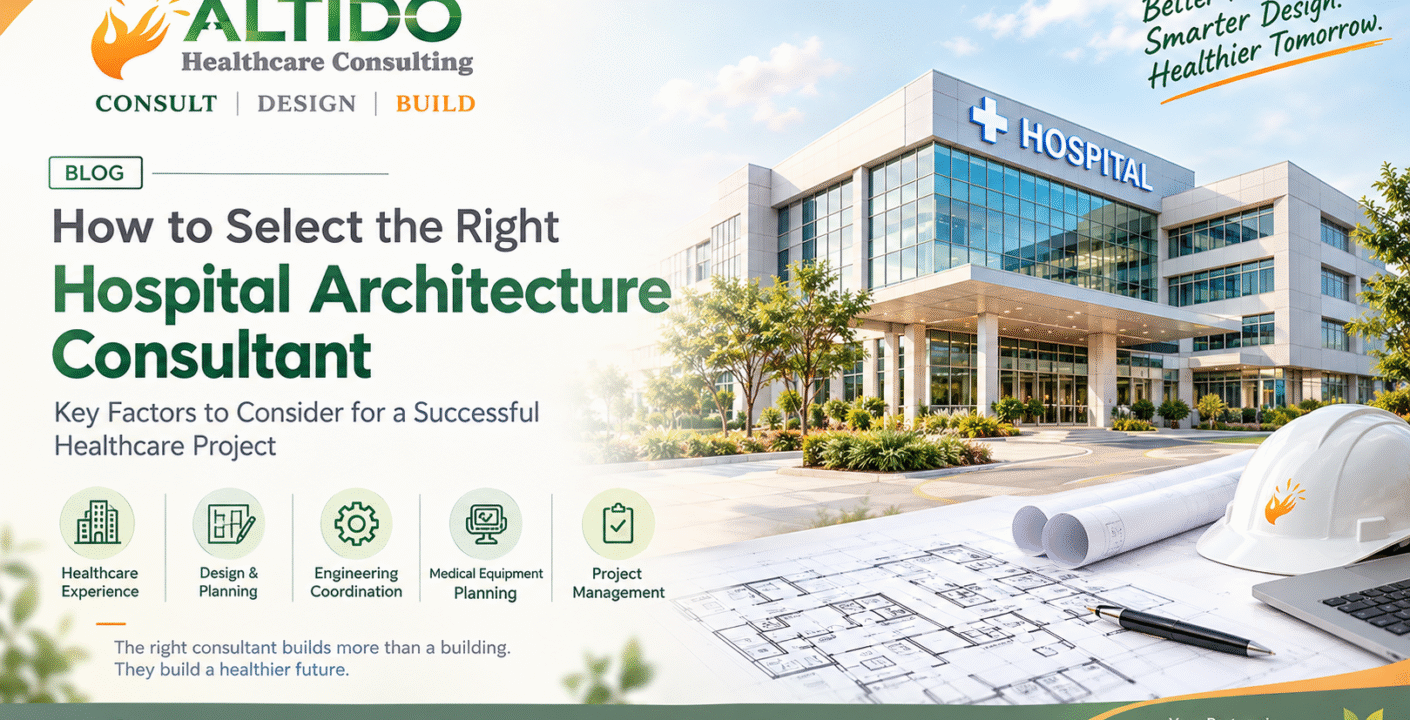
A successful hospital begins with effective planning and architecture. From the location and master plan to emergency access, operating theatres, ICUs, patient rooms, diagnostics, staff areas, medical equipment, and engineering infrastructure, every part of a hospital must be carefully coordinated.
Unlike general architecture projects, healthcare facilities require specialized knowledge of clinical workflows, patient safety, infection control, medical technology, healthcare regulations, and operational requirements.
Therefore, choosing the right Hospital Architecture Consultant should not be based only on architectural creativity or the appearance of previous buildings. Healthcare experience, multidisciplinary capabilities, planning methodology, technical coordination, and understanding of hospital operations are equally important.
People Also Like to read this: How to Plan a Hospital from Concept to Construction
1. Look for Specialized Healthcare Experience
The first factor to consider is whether the consultant has dedicated experience in healthcare architecture.
Hospital architecture requires an understanding of how different departments interact and how patients, doctors, nurses, visitors, equipment, supplies, and waste move through the facility.
A specialized consultant should understand planning requirements for areas such as:
- Outpatient Departments (OPD)
- Emergency and trauma
- Intensive Care Units
- Operation theatres
- Diagnostic imaging
- Laboratories
- Maternity and neonatal care
- Dialysis
- Cardiology
- Oncology
- Inpatient wards
- Pharmacy
- CSSD
- Medical stores
- Administration and support services
Altido’s published hospital architecture approach includes master planning, departmental layouts, patient-flow optimization, medical equipment coordination, MEP engineering, and future expansion planning.
2. Evaluate Their Hospital Architecture Services
A good consultant should be able to provide more than basic architectural drawings.
When evaluating Hospital Architecture Services, ask what is included in the consultant’s scope.
Depending on the project, services may include:
- Feasibility studies
- Site analysis
- Hospital master planning
- Medical planning
- Space programming
- Architectural design
- Interior planning
- Structural coordination
- MEP coordination
- HVAC planning
- Fire and life-safety planning
- Medical gas pipeline planning
- Medical equipment planning
- Landscape planning
- Project management
- Commissioning support
An integrated scope can reduce coordination gaps between architecture, engineering, clinical planning, and project execution.
Altido Healthcare Consulting describes its services as covering feasibility studies, hospital planning and designing, project management, equipment planning, management consultancy, and turnkey healthcare development.
3. Check Their Feasibility and Planning Capabilities
Hospital architecture should not begin with drawings alone.
Before the architectural concept is finalized, the project should be evaluated in terms of healthcare demand, location, target population, proposed specialties, bed capacity, service mix, investment requirements, and future development.
A feasibility study can help establish the basis for:
- Bed capacity
- Department requirements
- Healthcare services
- Project phasing
- Site utilization
- Infrastructure requirements
- Investment planning
- Future expansion
This makes feasibility and planning capability an important criterion when selecting a Hospital Architecture Consultant.
Altido’s published approach places feasibility and business planning before detailed hospital planning and architecture.
4. Examine Their Approach to Master Planning
Hospital master planning establishes the overall framework for the healthcare campus.
A consultant should consider:
- Building placement
- Department zoning
- Main entrance
- Emergency entrance
- Ambulance movement
- Service access
- Parking
- Pedestrian circulation
- Utility areas
- Landscape zones
- Future expansion areas
The master plan should also allow the hospital to expand without unnecessarily disrupting existing operations.
A well-developed master plan creates a relationship between the building, site, clinical functions, infrastructure, and future development.
5. Assess Their Understanding of Clinical Workflows
Architecture should support healthcare operations rather than simply provide attractive spaces.
The consultant should understand the movement of different users and materials within the hospital.
For example, patient movement from registration to consultation and diagnostics should be logical. Emergency patients require rapid access to critical treatment areas. Operating theatres need appropriate relationships with pre-operative, post-operative, ICU, CSSD, and support functions.
Similarly, clean and dirty circulation should be carefully considered.
The consultant should therefore demonstrate how their planning decisions improve workflow, reduce unnecessary movement, and support efficient hospital operations.
6. Review Their Medical Equipment Planning Experience
Medical equipment has a direct impact on hospital architecture and engineering.
CT scanners, MRI systems, X-ray equipment, operating theatre systems, ICU equipment, dialysis systems, laboratory equipment, sterilization systems, and other technologies have specific spatial and infrastructure requirements.
Medical equipment planning may influence:
- Room dimensions
- Structural requirements
- Electrical loads
- HVAC
- Plumbing
- Medical gases
- Radiation protection
- Access routes
- Maintenance requirements
A consultant who coordinates medical equipment planning with architectural design can help prevent design conflicts during later project stages.
7. Check Engineering Coordination Capabilities
Hospital buildings depend on complex engineering infrastructure.
The consultant should have experience coordinating architecture with:
- Electrical systems
- HVAC
- Plumbing
- Fire protection
- Medical gas systems
- Water supply
- Drainage
- Backup power
- ICT systems
- Security
- Vertical transportation
Engineering coordination should happen during the design process rather than after architectural drawings have already been finalized.
Altido’s hospital architecture and project consulting services include coordination of structural, MEP, HVAC, fire-safety, and medical-gas requirements.
8. Consider Regulatory and Compliance Knowledge
Healthcare projects are subject to numerous regulatory, safety, planning, and operational requirements.
The consultant should understand the applicable requirements for the project’s location and healthcare model.
Depending on the project and jurisdiction, this may involve:
- Building regulations
- Fire and life-safety requirements
- Healthcare facility standards
- Accessibility
- Infection-control considerations
- Environmental requirements
- Medical equipment regulations
- Statutory approvals
A consultant should be able to identify compliance requirements during the planning stage rather than waiting until construction or approval stages.
9. Review Previous Hospital Projects
Past work can provide useful evidence of a consultant’s experience.
Instead of reviewing only attractive photographs, examine the types and scale of healthcare projects they have handled.
Consider whether they have experience with:
- New hospitals
- Multispecialty hospitals
- Specialty hospitals
- Diagnostic centres
- Day-care facilities
- Medical colleges
- Hospital renovations
- Hospital expansions
- Redevelopment projects
Also consider whether their experience matches your project’s scale, specialty mix, location, and development objectives.
Altido’s current portfolio includes healthcare projects in India and international markets, including projects listed in Ethiopia, Nigeria, Bangladesh, Mauritius, Qatar, and other locations.
10. Evaluate Their Project Management and Execution Support
Architecture is only one stage of hospital development.
A consultant who can remain involved during engineering coordination, procurement, construction, quality management, commissioning, and handover can provide greater continuity between design and execution.
Project management services may include:
- Project scheduling
- Contractor coordination
- Budget monitoring
- Quality assurance
- Design coordination
- Procurement support
- Site coordination
- Risk management
- Commissioning
- Handover
Altido’s published project-consulting services include planning, scheduling, budget control, contractor coordination, quality assurance, regulatory compliance, commissioning, and handover support.
Why Choose Altido Healthcare Consulting?
Altido Healthcare Consulting provides an integrated approach to hospital infrastructure development.
The company’s services cover the project lifecycle from feasibility and planning through architectural design, engineering coordination, equipment planning, project management, and commissioning.
Its healthcare architecture approach focuses on creating facilities that are:
- Patient-centric
- Operationally efficient
- Technically coordinated
- Scalable
- Healthcare-focused
- Designed around clinical workflows
Altido’s current website also presents its model as a one-stop solution for turnkey healthcare projects, with experience across domestic and international markets.
Conclusion
Selecting the right Hospital Architecture Consultant is an important step in developing a successful healthcare facility.
The right consultant should bring together healthcare architecture, clinical planning, engineering coordination, medical equipment planning, regulatory understanding, project management, and future expansion strategies.
When evaluating Hospital Architecture Services, hospital owners and developers should look beyond drawings and visual design. The consultant’s healthcare experience, multidisciplinary capabilities, project portfolio, planning methodology, technical coordination, and execution support should all be considered.
At Altido Healthcare Consulting, we combine healthcare planning, architecture, engineering, equipment planning, project management, and turnkey solutions to help transform healthcare concepts into functional and future-ready facilities.